
Exa
Exa gives developers one API for real-time online retrieval, crawling, contents, answers, and research agents.
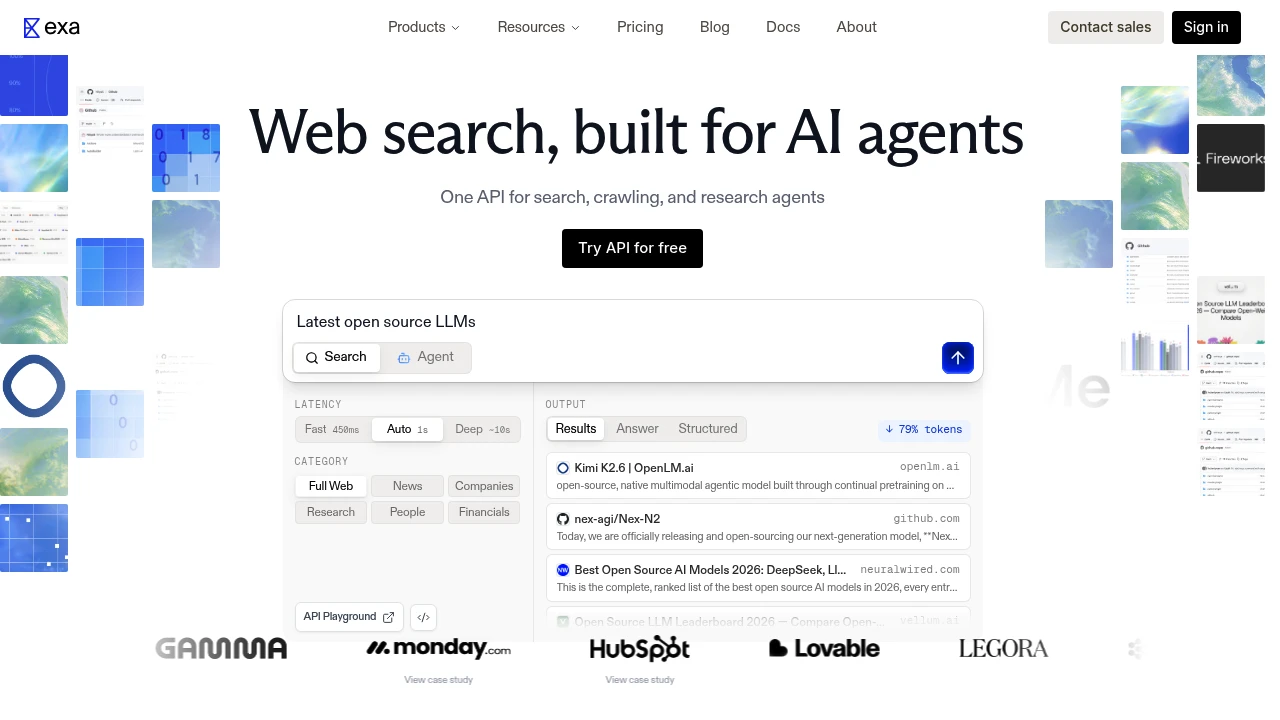
Exa is a real-time online retrieval API for AI agents. Teams use it to call live search, crawl pages, pull contents, ask for structured answers, and run deeper research tasks. It is built for products that need current web context, including coding assistants, enrichment tools, monitors, and research agents.
Key Highlights
- Search, crawling, contents, answers, monitors, and agents in one API
- Verticals for web, news, companies, research, people, financials, and code
- Configurable latency, with Exa Instant claimed under 180 ms
- Highlights return relevant page excerpts instead of full noisy pages
- Structured outputs and web-grounded citations for research workflows
- Enterprise controls: Zero Data Retention, SOC 2 Type II, and SSO
What Makes It Different
Exa is built around retrieval for model workflows, not only human search. The site emphasizes neural and keyword search, token-efficient highlights, and structured output formats that can feed directly into agents.
The same product spans fast search calls, page contents, deep search, asynchronous agents, and recurring monitors. That lets an AI app use low-latency context in one flow and longer cited research in another without switching providers.
Features & Capabilities
Developers can request live web results, webpage text, highlights, answers, and structured extraction. The pricing page lists coding agents, chatbots, news monitoring, enrichments, voice agents, people search, and company search as core use cases.
For coding agents, Exa says it searches GitHub repos, docs, changelogs, and Stack Overflow. Enterprise options add custom rate limits, tailored moderation, custom indexes, SLAs, MSAs, onboarding, and Zero Data Retention.
User Ratings and Testimonials
Exa publishes selected customer testimonials and benchmark results. Test retrieval against the sources, freshness, and response format your application needs. Inspect returned pages and citations before using research output in a decision; benchmark performance does not guarantee every result.
Pricing & Value
- Free Tier: $0 for a $10 monthly credit allowance plus a $10 onboarding bonus, with access to search, webpage contents, highlights, and other endpoints
- Search: Instant $4 or Fast/Auto $7 per 1,000 requests, with up to 10 results for real-time search data and page contents
- Deep Search: $12 to $15 per 1,000 requests for multi-step workflows, structured answers, and citations
- Agent: fixed-effort runs from $0.012 to $1.00; Ultra is usage-based for async research, lists, and enrichment, with contact enrichment billed separately
- Contents: $1 per 1,000 pages per content type for full page contents and highlights
- Monitors: $15 per 1,000 requests for recurring searches that send webhook updates
- Enterprise: Custom pricing for higher volume, custom data, security, support, and discounts
Endpoint pricing lets teams pay for the search mode they use.
Product facts
- Pricing
- Not yet verified
- Access
- Not yet verified
- Product status
- Not yet verified
FAQs
It searches the live web and returns results, page text, highlights, answers, and structured data through APIs that agents can call.
Free includes $10 monthly credits plus a $10 signup bonus. Instant Search costs $4/1,000 requests; Fast/Auto costs $7 for up to 10 results.
EXA LABS INC. is the company behind Exa.
Exa's site positions it as a developer API for search, crawling, contents, and agent research, not just a user-facing answer app.
Exa claims leading results on FRAMES, Tip-of-Tongue, and Seal0, plus Instant search under 180 ms. Treat those as vendor benchmarks.

You might also like
 bisibility — Free beta: Track your website’s keywords, Google rankings, Search Console insights, and share of voice.

