LM Studio Alternatives
A curated collection of the 5 best alternatives to LM Studio.
The best alternative to LM Studio is AnythingLLM. If that doesn't suit you, we've compiled a ranked list of other LM Studio alternatives to help you find a suitable replacement. Other interesting alternatives to LM Studio are: Open WebUI, Jan, GPT4All and Ollama.
LM Studio alternatives are mainly Local and Self-Hosted AI tools. Browse these if you want a narrower list of alternatives or looking for a specific functionality of LM Studio.


AnythingLLM is a desktop and self-hosted AI app for private document chat, local models, agents, and team workspaces.
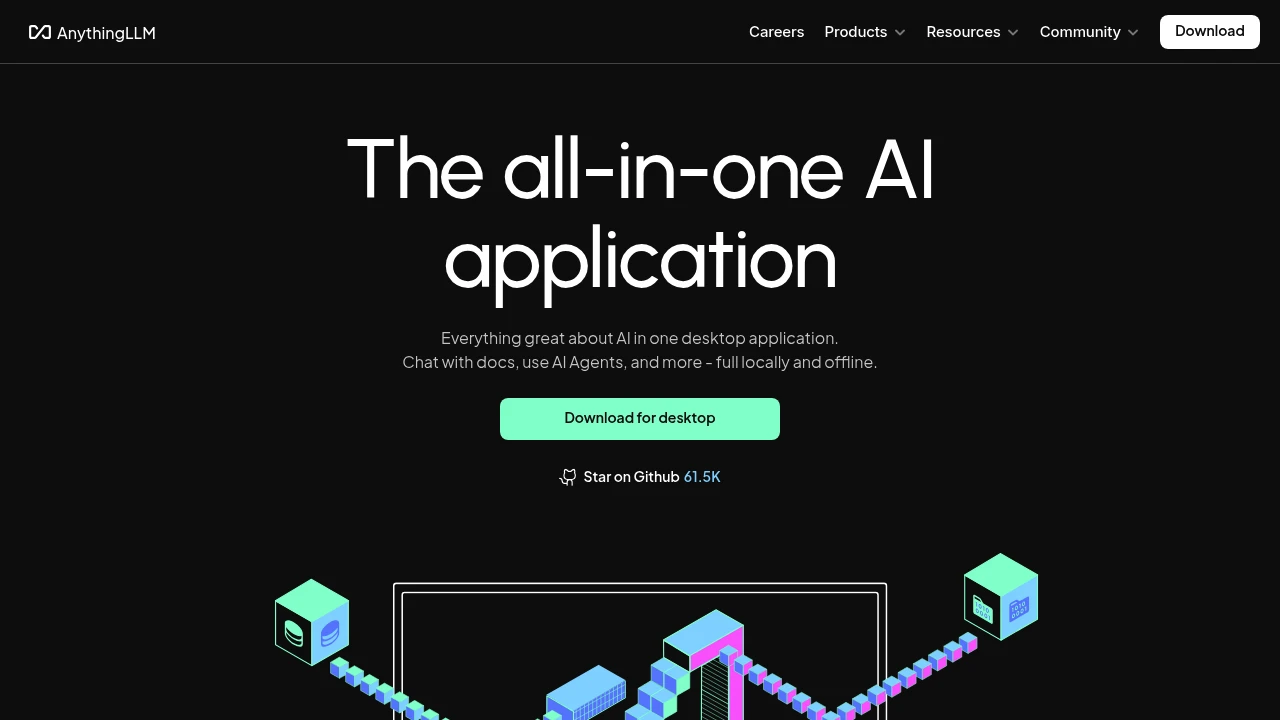
AnythingLLM is an AI application for private document chat, agents, and model choice without building a custom stack. It runs as a free desktop app for local use, with hosted and self-hosted options for teams that need multi-user access, admin controls, and branding.
Key Highlights
- Chat with PDFs, Word documents, CSV files, codebases, and web imports
- Run local models through the built-in LLM provider or connect to OpenAI, Azure, AWS, and other providers
- Use AI agents, agent skills, system prompts, and slash commands
- Keep desktop work local by default, including models, documents, chats, storage, and vector data
- Move to hosted or self-hosted team deployments with multi-user isolation and admin controls
What Makes It Different
AnythingLLM bundles pieces that usually require separate setup: an LLM provider, embedder, vector database, storage, document chat, agents, and a desktop interface. Individuals get a desktop install with no account required. Teams can move to hosted or self-hosted deployments with private instances and tenant isolation.
The other difference is model flexibility. The site positions it as "any LLM, any document, any agent," with support for local and enterprise providers.
Features & Capabilities
The main workflow starts with a workspace: add documents, pick a model, then ask questions or run agent tasks against that context. AnythingLLM supports PDFs, Word documents, CSVs, and codebases, and the Community Hub adds shared agent skills, system prompts, and slash commands.
Desktop is designed for private local use. Basic hosted includes a private instance, RAG, agents, and requires an LLM API key. Pro and Enterprise add larger-team support, user controls, tenant isolation, custom branding, and on-premise options.
User Ratings and Testimonials
AnythingLLM does not publish a third-party rating or user testimonials. The clearest fit is users who care about local document chat, private defaults, open source licensing, and provider choice.
The main tradeoff is plan fit. Hosted Basic is aimed at individuals or teams of less than 5 users and fewer than 100 documents. Larger teams should compare Pro or Enterprise.
Pricing & Value
- Desktop: $0, free to use, open source, MIT licensed, local by default, no account required
- Basic hosted: $50/month, for independent use or teams of less than 5 users and fewer than 100 documents, with a private instance, custom subdomain, RAG, and agents
- Pro hosted: $99/month, for larger teams, with a private instance, RAG, agents, and a 72-hour support SLA
- Enterprise: Contact sales, with on-premise installation, custom support SLA, custom domain, and custom integration support
The free desktop app is the starting point for local RAG and agent workflows. Hosted plans fit teams that want a managed private instance.
Looking for alternatives to other popular tools? Check out other posts in the alternatives series and flowtools.co, a directory of best AI tools with filters for tags and categories for easy browsing and discovery.

Open WebUI is a self-hosted AI interface for teams that want local and cloud models in one controlled workspace.
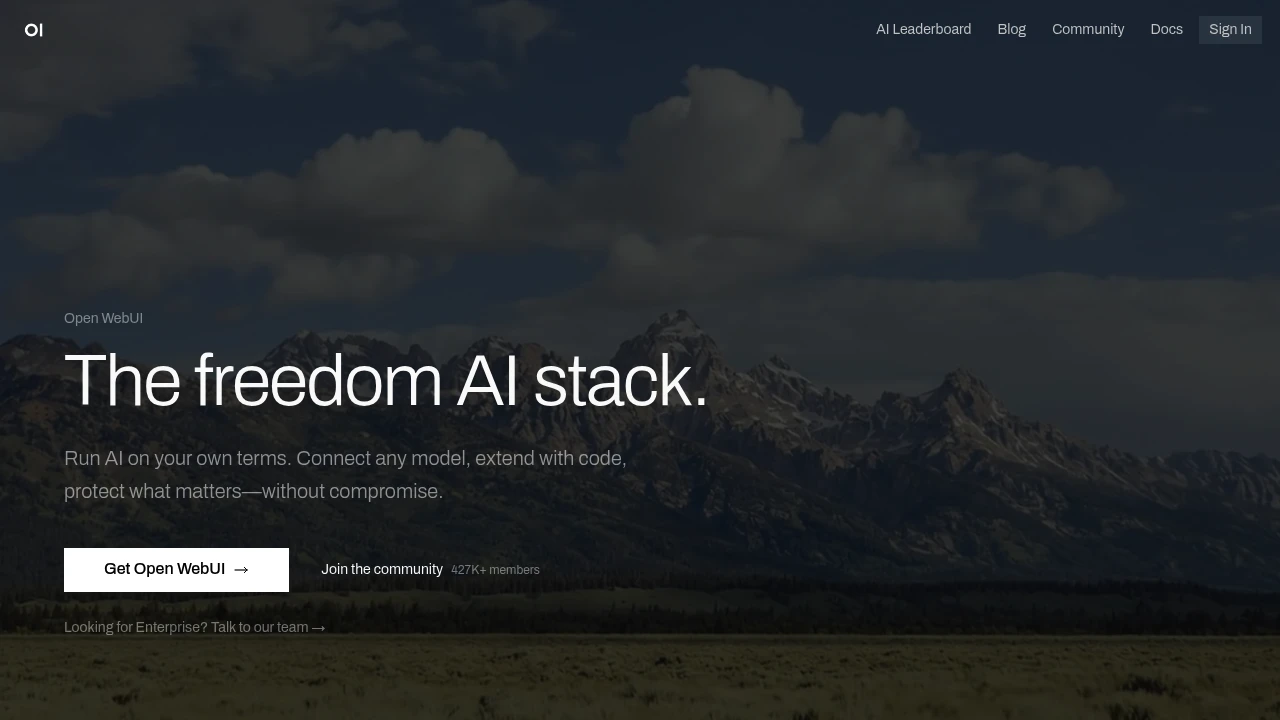
Open WebUI is a self-hosted AI interface for teams that want one place to run local models, cloud models, conversations, and tools. It connects to Ollama, OpenAI, Anthropic, and compatible providers while keeping user control. The project is open source and built for laptops to enterprises.
Key Highlights
- Connects local and cloud models in one web interface
- Supports Ollama, OpenAI, Anthropic, and compatible providers
- Includes voice, vision, retrieval, generation, and search workflows
- Extends through Python for custom tools and functions
- Provides enterprise options such as SSO, RBAC, audit logs, and private deployment patterns
- Large public community: 427K+ members, 290M+ downloads, and 141K+ GitHub stars
What Makes It Different
Open WebUI is positioned around ownership. Instead of sending every AI workflow through a hosted chat product, you can run the interface yourself, connect the models you choose, and decide whether it lives locally, in the cloud, or in a hybrid environment.
That makes it different from simple chatbot front ends. The source site describes a full AI stack: conversations, model access, prompts, tools, functions, retrieval, search, voice, and vision.
Features & Capabilities
The core workflow is a shared web UI for working with different models. A team can connect local Ollama models, add cloud providers when needed, and keep the same conversation and tool layer across both. The community hub adds shared prompts, models, tools, functions, discussions, and reviews.
For organizations, Open WebUI supports controlled deployments. The enterprise source describes on-premise, private cloud, hybrid, and air-gapped options, plus LDAP, Active Directory, SSO, RBAC, audit logs, high availability architecture, and dedicated support.
User Ratings and Testimonials
Open WebUI does not publish a third-party average rating. Open WebUI's own site points to community scale and enterprise stories, including secure self-hosted deployments and a university stack serving tens of thousands of students and employees.
The main tradeoff is operational. Because Open WebUI is self-hosted, teams are responsible for deployment, model access, data controls, uptime, and compliance decisions instead of buying a fully managed chat app.
Pricing & Value
- Standard use: $0, free to use as-is when the original branding stays intact
- Enterprise licensing: Contact sales, for organizations that need white labeling, rebranding, dedicated support, or deeper enterprise engagement
- Sponsorship: Optional, for users that want to support ongoing development without needing an enterprise license
Open WebUI is strongest for teams that want control over where AI runs and which models it uses. Open WebUI does not publish a public USD price for enterprise licensing.

Jan is a desktop AI assistant for running open models locally or connecting to cloud models when needed.
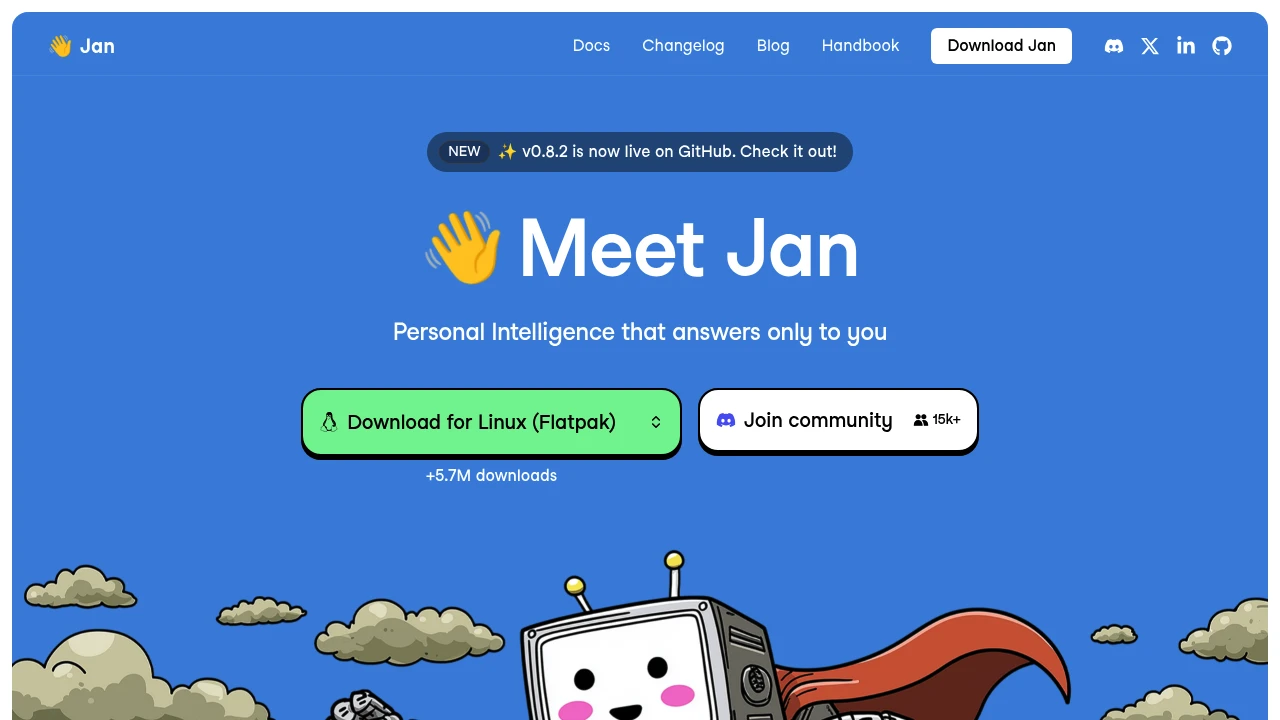
Jan is an open-source desktop AI assistant for people who want a ChatGPT-style interface that can run open models locally. It is built for privacy-minded users, developers, and AI tinkerers who want local model control without giving up the option to connect cloud models.
Key Highlights
- Runs open-source AI models locally on the desktop
- Connects to online models from OpenAI, Anthropic, Google, Meta, Mistral, Alibaba, DeepSeek, Moonshot AI, and others
- Free and open source, with the site reporting more than 5.7 million downloads
- Online retrieval and MCP options are mentioned in user quotes on the homepage
- Memory is listed as a coming soon feature for keeping context and preferences
What Makes It Different
Jan focuses on local control first. Instead of making a hosted chatbot the default place for every conversation, it gives you a desktop app for open models that can run on your own machine, while still letting you plug in cloud providers when you want them.
That mix makes it different from tools that are either only local runtimes or only cloud chat apps. The homepage also emphasizes that Jan is built in public, which fits users who want an open-source assistant they can inspect and follow.
Features & Capabilities
The core workflow is simple: choose an open model, run it locally, and chat from a desktop interface. Jan names GPT, Claude, Gemini, Llama, Mistral, Qwen, DeepSeek, Gemma, and Kimi as model families or providers users can work with.
Jan also supports connected online models, so the same app can act as a local model workspace and a front end for cloud providers. The homepage previews a future memory feature that would carry user context and preferences across chats.
User Ratings and Testimonials
Jan does not publish an average rating. It does include user quotes praising its privacy angle, local model support, clean interface, online retrieval, MCP options, and open-source direction.
The source is mostly promotional, so it does not provide a balanced list of criticisms. The clearest caveat from the page is that memory is marked as coming soon rather than available today.
Pricing & Value
- Free and open source: $0, with the desktop app positioned for local open models and optional cloud model connections
Jan is best value for users who want a free local AI assistant first, then the flexibility to connect external model providers when needed.

GPT4All runs open-source language models locally for developers, teams, and power users who want private AI chat.
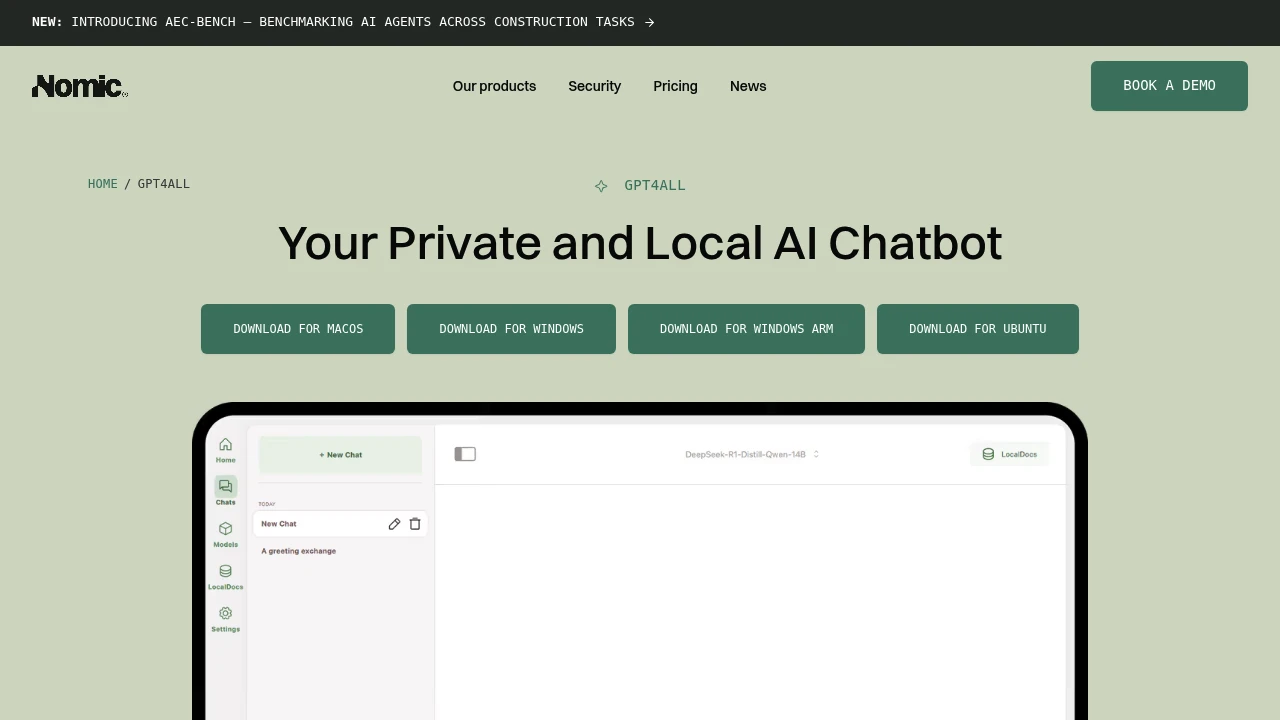
GPT4All is a local AI chatbot from Nomic for running open-source language models on your own device. It is built for developers, teams, and AI power users who want private chat, document Q&A, and model control without sending prompts to a cloud service.
Key Highlights
- Runs open-source language models on Windows, macOS, and Linux
- Keeps chat data on your device with no cloud required
- Includes LocalDocs for chatting with local documents
- Supports full customization for local assistant workflows
- Works with thousands of models for different local setups
What Makes It Different
GPT4All is positioned around local ownership rather than hosted chat. Nomic's page says the chatbot runs on your device, requires no cloud, and keeps data on your machine. That makes it a practical fit for private notes, internal documents, code snippets, and other prompts you do not want routed through a hosted model provider.
The product also focuses on model choice. Instead of locking users into one hosted model, GPT4All supports open-source language models across desktop operating systems, with LocalDocs and customization for personal or team assistants.
Features & Capabilities
The main workflow is local chat with an open-source model. You install GPT4All on Windows, macOS, or Linux, choose a model that fits your machine, and use it for private conversations, drafting, analysis, and assistant-style tasks. LocalDocs adds retrieval over local files, so the chatbot can answer from documents stored on your computer.
For technical users, GPT4All's value is control. GPT4All emphasizes full customization, support for thousands of models, and use by developers and AI power users. That makes it useful for testing private assistant workflows or giving a team a no-cloud option for sensitive prompts.
User Ratings and Testimonials
GPT4All does not publish public ratings or named customer testimonials for the desktop chatbot. The clearest trust signal is Nomic's positioning around privacy, local execution, LocalDocs, and broad model support.
The main caveat is practical: local AI performance depends on the user's hardware and chosen model. Teams that need managed hosting, centralized admin, or cloud-scale speed may need a hosted AI platform.
Pricing & Value
- Local desktop chatbot: no published paid app price on the GPT4All product page, with local model chat, LocalDocs, customization, and no cloud requirement
GPT4All is strongest for users who already have suitable desktop hardware and want private local AI without a hosted SaaS workflow. Verify Nomic's current download and licensing details before rolling it out across a team.

Ollama is the easiest way to download and run open-source LLMs locally, keeping your data private, with an optional cloud for larger models.
Ollama is an open-source tool that makes running large language models on your own computer simple. It is built for developers and privacy-conscious users who want to use open models like Llama, Qwen, DeepSeek, and Gemma without sending data to a third party. A single command downloads and runs a model, and a local API lets your apps talk to it just like a hosted service.
Key Highlights
- One-line install and one command to run any supported model
- Runs fully local, so your prompts and data stay on your machine
- Large library of open models (Llama, Qwen, DeepSeek, Gemma, and more)
- Local REST API compatible with common tooling
- Desktop app for macOS, Windows, and Linux
- Optional Ollama Cloud for larger models on datacenter hardware
What Makes It Different
Ollama removed the friction from local AI: no manual weight downloads, quantization juggling, or server setup, just ollama run. Because it exposes a standard local API, it has become the default backend for many local-first apps and coding agents, and the new cloud option lets you scale to bigger models without changing your workflow.
Features & Capabilities
You install Ollama, pull a model, and run it from the terminal or via its local API. It handles model management, GPU/CPU acceleration, and a familiar OpenAI-style endpoint that tools and agents can target.
Many apps (coding assistants, chat UIs, and automation tools) integrate Ollama directly. When local hardware isn't enough, Ollama Cloud runs the same models on larger machines, with parallel requests and optional web access.
User Ratings and Testimonials
Developers love Ollama for how trivial it makes local AI and for keeping data private and offline-capable. Criticisms are that running the largest models requires serious hardware, and that local inference is slower than hosted frontier APIs unless you pay for the cloud tier.
Pricing & Value
- Free: the local app and CLI are free and open-source
- Ollama Cloud / Pro: paid tiers for larger models and faster, parallel cloud inference
For private, offline, or cost-controlled AI, Ollama is among the best free tools available, with a paid cloud only when you need more horsepower.
Similar proprietary alternatives:

 bisibility — Free beta: Track your website’s keywords, Google rankings, Search Console insights, and share of voice.


