
Mosaic AI
Databricks tools for developing, evaluating, deploying, and governing AI applications and agents on enterprise data.
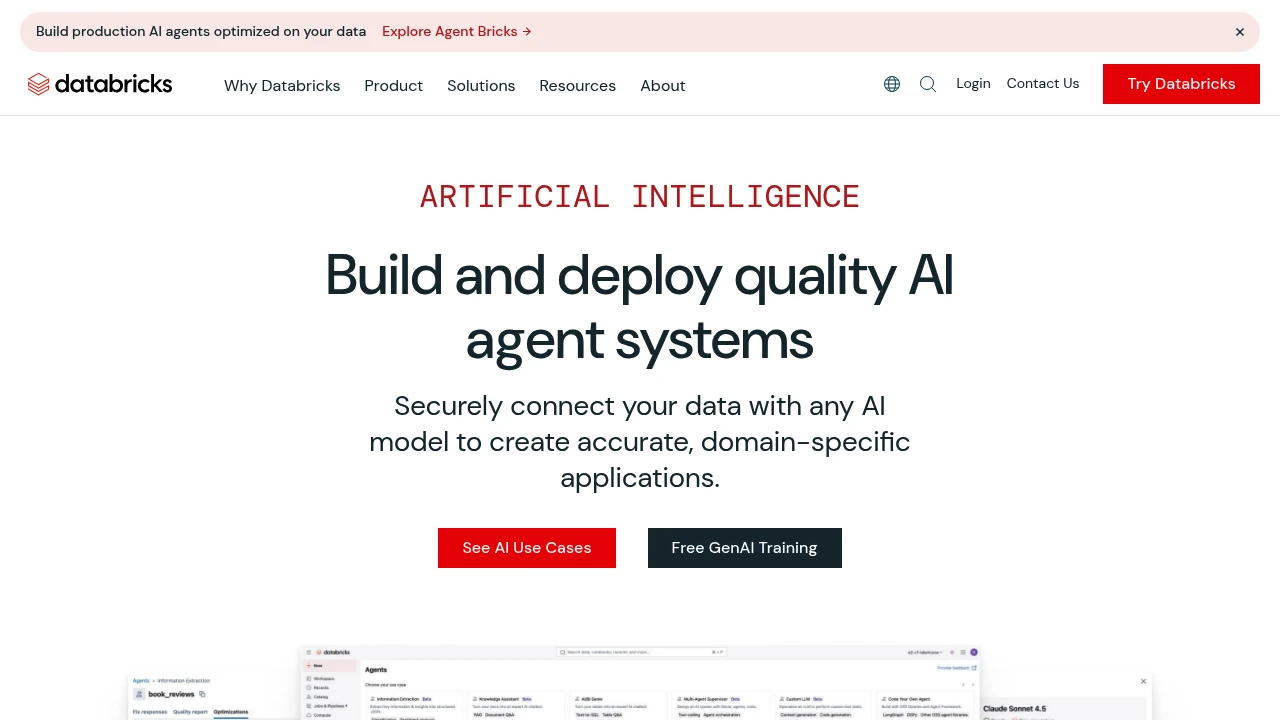
Databricks' AI platform helps teams build, evaluate, and deploy AI applications and agent systems using their own data. It combines development tools with model serving, evaluation, and governance. The workflow supports both generative AI and conventional machine-learning applications.
Key Highlights
- Agent development connected to enterprise data
- Evaluation with AI-assisted assessments and human feedback
- Model serving for agents, generative AI, and ML
- Access controls, guardrails, rate limits, and lineage
- Search and retrieval for data-grounded applications
What Makes It Different
The platform connects agent development to the data and governance tools used by an organization. Teams can evaluate an application and monitor its deployment within the wider Databricks environment. This does not make every response accurate: evaluation criteria and the underlying data still determine what the system can reliably do.
Features & Capabilities
Develop agents with the Agent Framework or other supported development tools, then evaluate their output with application-specific examples. Model Serving handles deployment, and AI Search supports retrieval from indexed data. Managed MLflow and notebooks support related development work.
Governance tools help apply controls across models and agents. Teams can configure access, track lineage, and set usage limits. The appropriate configuration depends on the data, users, connected tools, and deployment environment.
User Ratings and Testimonials
Databricks publishes customer case studies about AI applications and operational outcomes. Those results describe particular systems and evaluation methods. Test a representative workload for answer quality, latency, governance requirements, and cost before extending it to a production process. Include difficult and incomplete-data cases in that evaluation.
Pricing & Value
Pricing depends on the Databricks services and resources used. Model serving, compute, search, and other services can contribute to the total; there is no single universal agent price in this listing. Review the selected service pricing and any contract terms for the intended region and workload.
Product facts
- Pricing
- Not yet verified
- Access
- Not yet verified
- Product status
- Not yet verified

You might also like
 bisibility — Free beta: Track your website’s keywords, Google rankings, Search Console insights, and share of voice.

