
Opik
Opik records AI traces, runs evaluation tests, manages prompts, and monitors agent behavior in development and production.
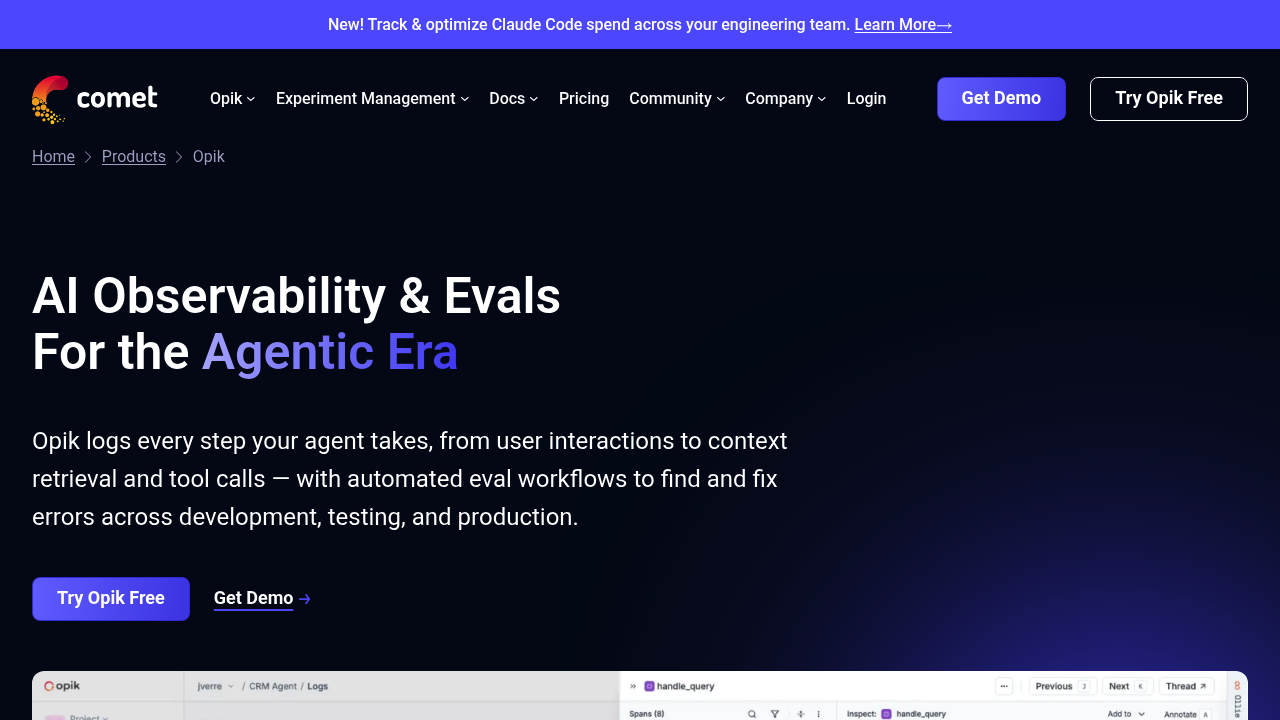
Opik is Comet's observability and evaluation product for LLM applications and AI agents. It records model interactions, retrieved context, and tool calls to help developers diagnose failures. Teams can run evaluations on those traces and compare changes before or after deployment.
Key Highlights
- Agent tracing and execution analysis
- Dataset evaluations and test assertions
- LLM-as-a-judge metrics and human annotations
- Prompt management and an agent playground
- Token usage and model cost tracking
What Makes It Different
Opik offers both an Apache 2.0 open-source codebase and hosted cloud plans. Its focus is AI application tracing and evaluation, while Comet also sells separate ML experiment-management products. Teams can choose self-hosting for operational control or cloud service for a managed setup.
Features & Capabilities
Developers instrument their application to capture traces, then inspect the model, retrieval, and tool steps behind a response. Annotation workflows let subject-matter experts add feedback to underperforming examples. Sessions group interactions in multi-turn workflows.
Datasets, evaluators, and test suites make repeatable comparisons possible. Assertions can express expected behavior, while model-based metrics evaluate qualities such as answer relevance. Production monitoring applies evaluation criteria to live traces. Cost and token views help teams find expensive stages of a workflow.
User Ratings and Testimonials
Comet publishes Opik user stories describing deployment and evaluation work. Test whether the product exposes the failures your team needs to diagnose and whether automated scores agree with expert judgments. Self-hosting adds infrastructure responsibility, while cloud plans impose span and retention allowances. Include these operational differences when comparing options.
Pricing & Value
- Open Source: free software for self-hosting under Apache 2.0.
- Free Cloud: $0, with 25,000 monthly spans, up to ten team members, and 60-day retention.
- Pro Cloud: $19/month, with 100,000 monthly spans and up to 50 team members.
- Enterprise: custom usage, security, support, and deployment terms.
Check additional usage and model-provider costs alongside the base plan. Self-hosted infrastructure is a separate expense.
FAQs
Opik evaluates outputs against datasets using code checks, LLM judges, and human feedback, then compares results across application versions.
AI evaluation measures outputs against task-specific criteria. Opik uses metrics and assertions to test quality and detect regressions.
A rubric defines criteria for judging an output. In Opik, reference datasets and plain-text assertions express expected behavior.

You might also like
 bisibility — Free beta: Track your website’s keywords, Google rankings, Search Console insights, and share of voice.

