
Mem0
Mem0 gives developers a memory layer for AI agents and apps that need persistent context across sessions.
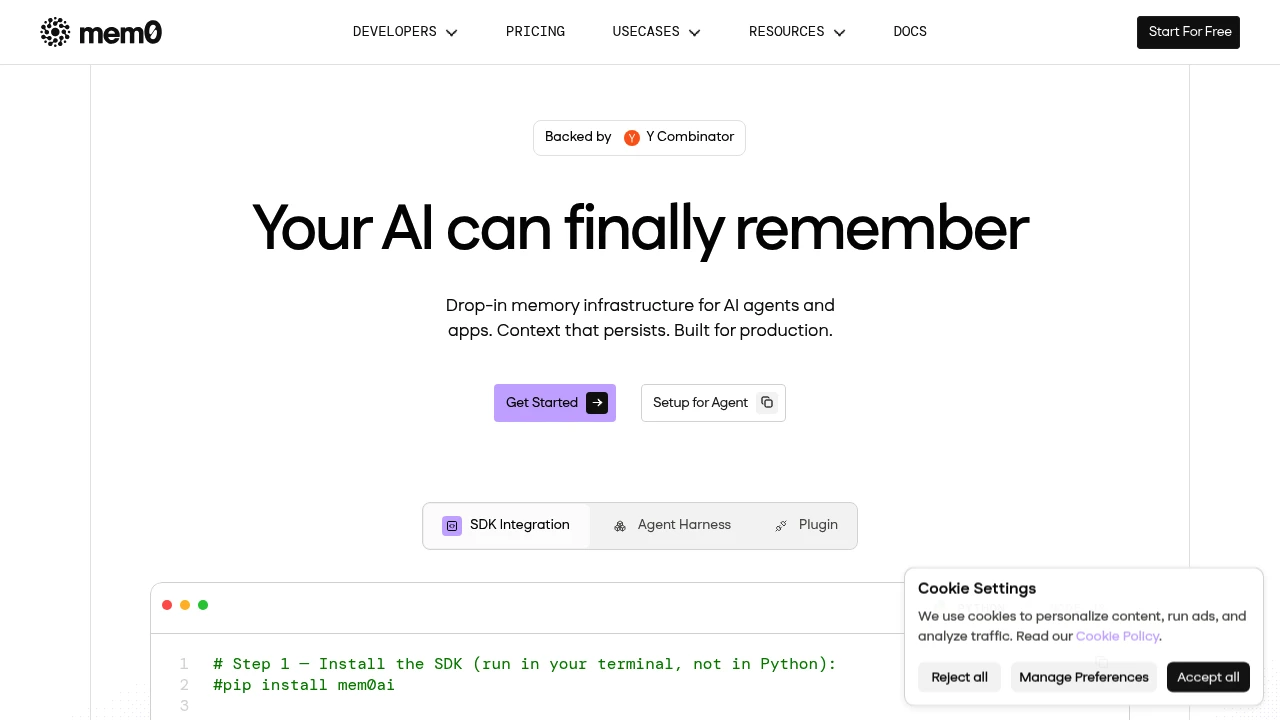
Mem0 is a persistent memory layer for AI agents and apps. It helps developers store, update, and retrieve user context across sessions, so agents can remember preferences, history, and important details without replaying every past conversation.
Key Highlights
- Drop-in memory infrastructure for AI agents and apps
- SDK setup with examples for adding and searching memories
- Memory compression to reduce repeated context and latency
- Domain use cases for healthcare, education, e-commerce, customer support, and sales
- Enterprise controls for governance, audit logs, and private deployment
What Makes It Different
Mem0 focuses on memory as infrastructure, not just chat history storage. Its workflow is built around adding interaction data, extracting and updating memories, then retrieving the key memories when a user interacts again.
The product also puts weight on production controls. Mem0 highlights SOC 2 Type 1 and HIPAA compliance, BYOK, zero-trust, Kubernetes, private cloud, and air-gapped deployment options for teams that need memory to fit security and governance requirements.
Features & Capabilities
Developers can use the SDK to add a conversation, associate it with a user, and search those memories later. The Python flow uses mem0ai, a MemoryClient, memory add requests, and search by user_id.
For teams building at scale, Mem0 adds observability and control around memory reads and writes. It is designed for agents that need compact long-term context, such as patient care assistants, adaptive tutors, customer support agents, and sales assistants that remember objections and milestones across long cycles.
User Ratings and Testimonials
Mem0 does not publish a public aggregate rating. The clearest appeal is for engineering teams that want persistent context without building a custom memory pipeline. Teams should still evaluate what gets remembered, how retrieval behaves in their domain, and which data belongs under audit or access controls.
Pricing & Value
- Hobby: Free, with unlimited end users, 10,000 add requests, 1,000 retrieval requests, 1 project, and community support
- Starter: $19/month, with unlimited end users, 50,000 add requests, 5,000 retrieval requests, 1 project, and community support
- Growth: $79/month, with 200,000 add requests, 20,000 retrieval requests, 3 projects, email support, and basic analytics
- Pro: $249/month, with 500,000 add requests, 50,000 retrieval requests, unlimited projects, private Slack support, and advanced analytics
- Enterprise: Custom pricing, with unlimited requests, Private Slack plus SLA, advanced analytics, on-prem deployment, audit logs, custom integrations, and SSO
The free plan is useful for testing memory quality, while paid tiers mainly increase request volume, project limits, support, analytics, and deployment control.
FAQs
It stores facts from past interactions, updates them as users talk, and retrieves the most relevant memories for future agent responses.
Yes. Mem0 supports Kubernetes, private cloud, and air-gapped deployment for teams that need to run it outside the hosted platform.
No. It is a memory layer that extracts, compresses, and retrieves context for AI agents, rather than a general-purpose database.
LangGraph manages agent workflows and state graphs. Mem0 focuses on persistent, searchable memory across agents and apps.
It fits agents that need long-term user context, lower repeated context, and production controls such as logs and governance.
Yes. Enterprise deployment supports private cloud, Kubernetes, and air-gapped setups, with the same API across environments.

You might also like
 bisibility — Free beta: Track your website’s keywords, Google rankings, Search Console insights, and share of voice.

