
BrowserOS
Two open-source browsers for AI-assisted web work: BrowserOS has built-in AI, while BrowserOS neo serves external agents.
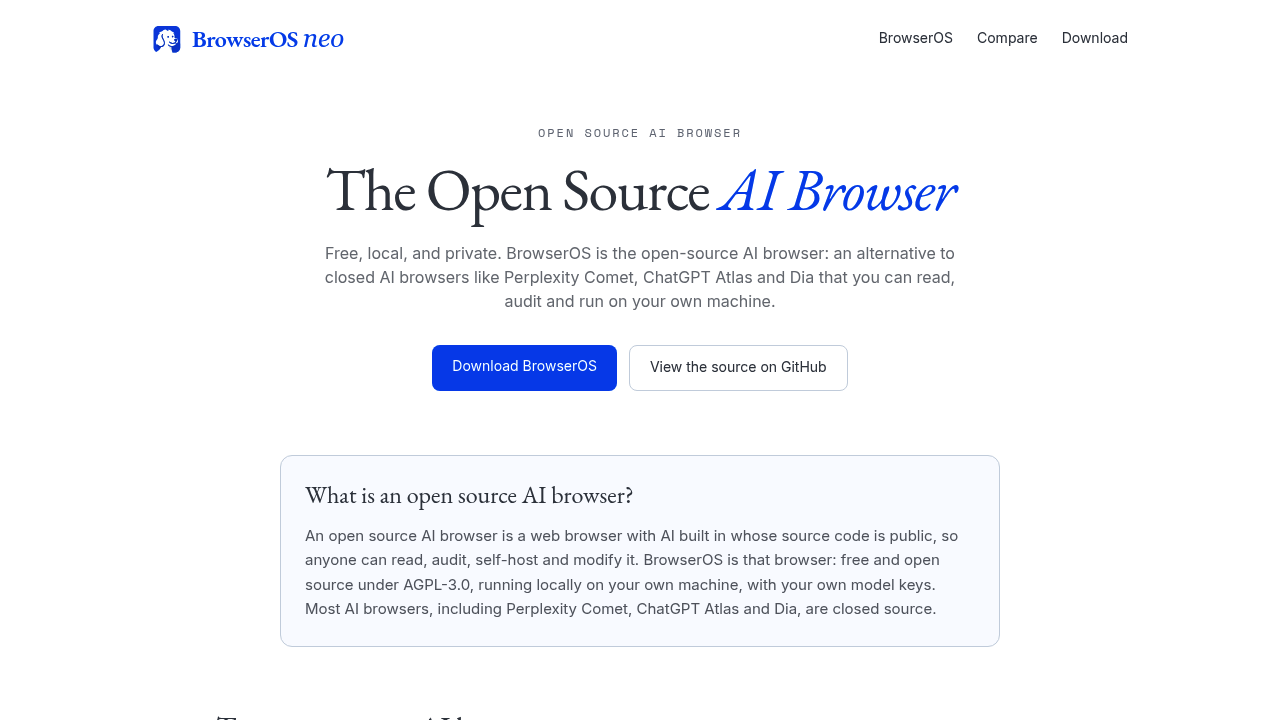
BrowserOS is a family of two independently installable Chromium browsers for people who want AI help with web work. BrowserOS has built-in AI for everyday browsing. BrowserOS neo lets external AI agents work in a separate browser using accounts you have signed into.
Key Highlights
- BrowserOS: page chat, summaries and task automation
- BrowserOS: cloud providers or local models through Ollama and LM Studio
- BrowserOS neo: external agents connect over MCP
- BrowserOS neo: parallel agent tabs, a live dashboard and local session replay
- Both: Chrome extensions and imported bookmarks and passwords
What Makes It Different
The choice is who drives the browser. BrowserOS puts an assistant inside your daily browsing workflow. In neo, you give tasks to Claude Code, Cowork, Codex or another MCP client. BrowserOS can also expose an MCP server; neo is designed around external agents.
Features & Capabilities
In BrowserOS, ask the side panel about a page or describe actions such as filling forms and extracting structured data. Its built-in agent can combine browsing with app integrations and local file operations. Scheduled tasks support recurring work.
In BrowserOS neo, connect an agent, sign into the accounts it needs and follow its activity in the dashboard. Each agent uses its own tabs. Replays pair recorded sessions with an action timeline. Recordings stay on disk, but cloud AI requests go to the chosen provider. Neo sends anonymous usage telemetry by default; you can turn it off in Settings.
User Ratings and Testimonials
For BrowserOS, evaluate page chat separately from multi-step automation: local models suit chat, while Agent Mode requires stronger cloud models. For BrowserOS neo, review a session replay to assess the agent's clicks and results in your own workflow.
Pricing & Value
- BrowserOS: free, open-source desktop application under AGPL-3.0. The included default AI has usage limits; bring your own provider or use local models for chat.
- BrowserOS neo: free, open-source desktop application under AGPL-3.0. Connect an external MCP agent to automate logged-in websites.
Model API usage or an external agent subscription may cost separately. Choose BrowserOS for built-in AI, or neo to give an existing agent its own browser.
FAQs
An open-source browser family: BrowserOS has built-in AI, while the separate BrowserOS neo lets external MCP agents use your logged-in accounts.

You might also like
 bisibility — Free beta: Track your website’s keywords, Google rankings, Search Console insights, and share of voice.

