
Langflow
Langflow helps developers build AI agents, RAG apps, and MCP servers with visual flows and Python customization.
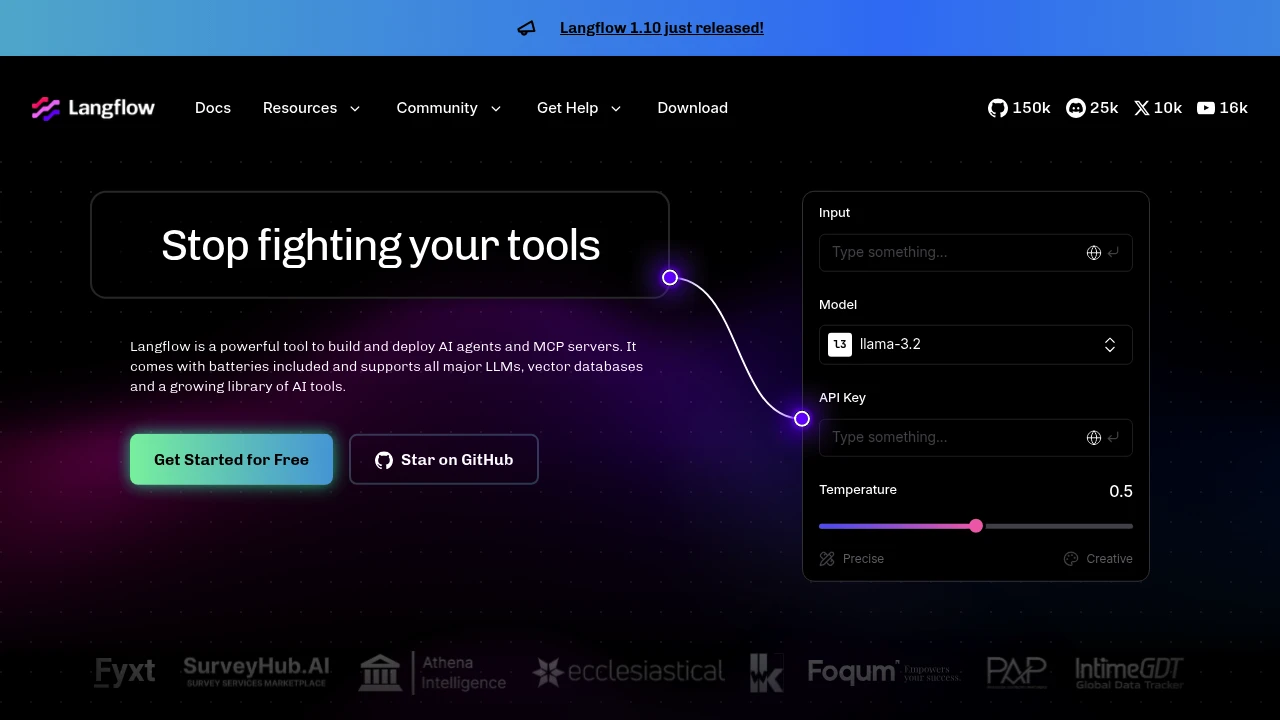
Langflow is a low-code AI builder for developers building agentic and retrieval-augmented generation (RAG) applications. It gives teams a visual flow editor for wiring prompts, models, data sources, vector stores, tools, and agents, while keeping Python under the hood for deeper customization. The same product can be used as OSS or in Langflow Cloud, so teams can prototype visually and still move toward production.
Key Highlights
- Visual state flows for AI agents, RAG apps, and MCP servers
- Supports major LLMs, vector databases, and a broad library of AI tools
- Python customization for teams that need control beyond drag-and-drop
- Reusable components, pre-built flows, and fast iteration loops
- Run single agents or fleets of agents with components exposed as tools
- Deploy a flow as an API or run it in Langflow Cloud
What Makes It Different
Langflow is not a code-only orchestration library. Its main advantage is the visual flow layer: developers can drag components together, inspect the chain of work, swap models or tools, and compare behavior without rebuilding the whole app stack.
It also avoids being a sealed no-code box. The public site emphasizes Python customization, the same Langflow across OSS and Cloud, and the ability to deploy flows as APIs. That makes it a practical fit for teams that want low-code speed during design, but still need ownership over logic, integrations, and deployment.
Features & Capabilities
The core workflow starts with a flow: add inputs, pick a model, connect data sources or vector stores, configure agent tools, then test the behavior before deployment. Langflow lists integrations across model providers, data tools, and vector databases, including Anthropic, Azure, Google Cloud, Hugging Face, Mistral, MongoDB, Notion, NVIDIA, Ollama, Pinecone, Qdrant, Slack, Weaviate, OpenAI, and many more.
For agent work, Langflow can run a single agent or a fleet of agents that use your components as tools. For application teams, the key production path is Flow as an API, where a visual workflow becomes something a product can call from an app or service.
User Ratings and Testimonials
Langflow does not list an average customer rating. It highlights customer quotes from BetterUp, WinWeb, and Athena Intelligence, with users praising visual flows, faster RAG development, and quicker workflow iteration.
The tradeoff is that serious projects still need engineering judgment. Teams must choose model providers, manage API keys, tune vector stores, and use Python when a flow needs custom behavior.
Pricing & Value
- OSS / self-hosted: Free, for teams that want to deploy and manage Langflow themselves
- Cloud account: Free account option for deploying apps on Langflow Cloud, with no public USD usage limits listed
Langflow does not publish fixed paid plan prices in USD, so the clearest entry point is the free OSS or cloud option before a team decides how it wants to run production workloads.
FAQs
It is used to build agentic and RAG apps, connect LLMs, vector stores, and tools, then run flows through a UI or API.
Langflow has free open-source self-hosting and a free cloud account. Services and support are contact-led without public prices.
Langflow is a visual builder for AI flows. LangChain is a separate code framework; Langflow can connect with LangChain components.
Yes. IBM acquired DataStax, the company behind Langflow, so Langflow now sits under IBM through DataStax.
You drag components into a flow, configure models, data stores, and tools, test the result, then deploy it or expose it as an API.
You might also like
 bisibility — Free beta: Track your website’s keywords, Google rankings, Search Console insights, and share of voice.

