
LocalAI
LocalAI is an open-source, self-hosted AI server for teams running compatible models on their own hardware.
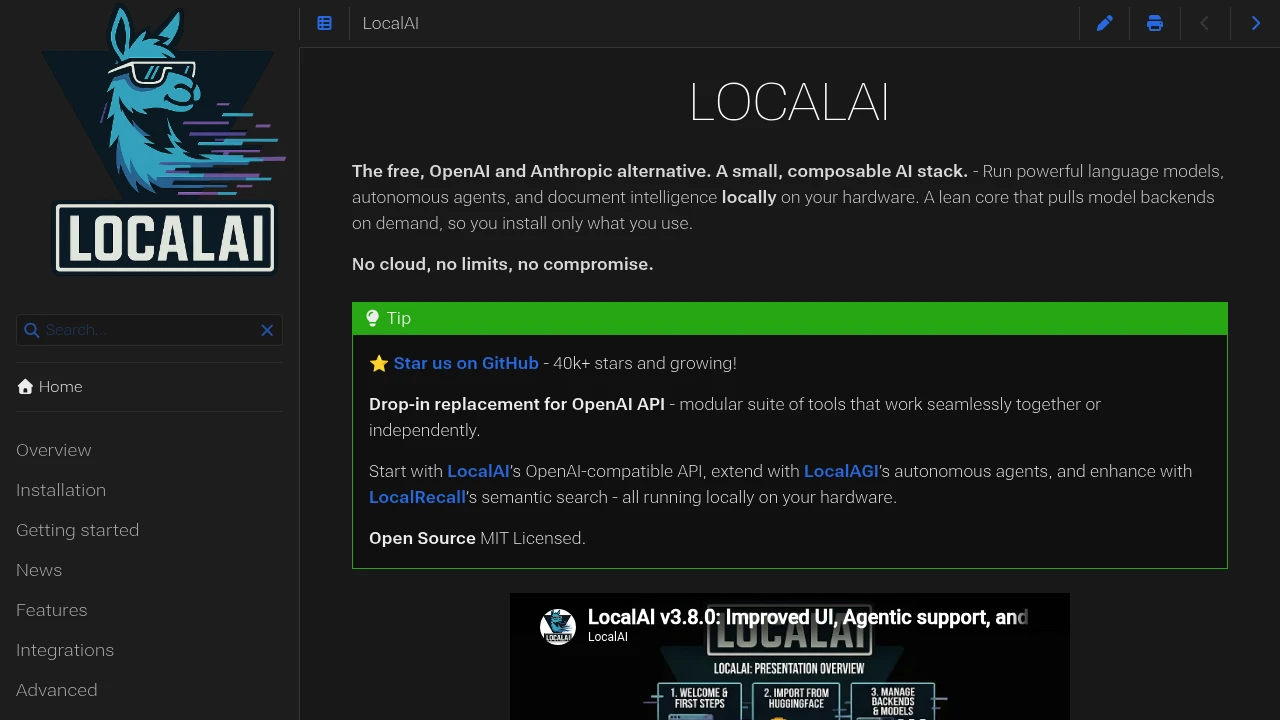
LocalAI is an open-source local AI server for running language, image, audio, agent, and document intelligence workflows on your own hardware. It is built for developers and teams that want an OpenAI-compatible API without sending requests to a hosted model provider. The project positions itself as a small, composable stack: install the core server, then add only the backends and companion tools you need.
Key Highlights
- Runs LLMs, image generation, audio models, agents, and semantic search locally
- Provides a drop-in OpenAI-compatible API for existing apps and libraries
- Uses a lean core that pulls model backends on demand
- Supports Docker, Podman, Kubernetes, binaries, and local installation
- Works on consumer-grade hardware, with no GPU required for supported setups
- MIT licensed and community driven
What Makes It Different
LocalAI is not just a desktop model runner. Its main role is to act as a local server that existing OpenAI-style clients can call, so teams can move compatible workloads from hosted APIs to their own machines or infrastructure.
The broader stack is modular. LocalAI handles local model serving, LocalAGI adds autonomous agents, and LocalRecall adds a local REST API for semantic search and memory management. That makes it better suited to developers building private AI applications than to someone who only wants a chat window.
Features & Capabilities
The core workflow starts with installation, with Docker recommended by the project for most users. A basic container can expose the service on port 8080, then applications can call the local endpoint with OpenAI-compatible requests.
LocalAI supports multiple model families and backends for inference. LocalAI calls out LLM inferencing, image generation, audio generation, autonomous agents through LocalAGI, and knowledge or memory workflows through LocalRecall. Because the stack runs locally, the project emphasizes privacy: prompts, documents, and responses stay on your hardware rather than going through a cloud API.
User Ratings and Testimonials
The homepage highlights a large open-source community, with 40k+ stars cited by the project. Users who need local control will likely value the privacy model, API compatibility, and flexible installation paths.
The tradeoff is operational responsibility. You manage hardware, model files, backends, updates, and performance tuning yourself, and consumer-grade hardware can still limit which models feel practical.
Pricing & Value
- Open source: $0, MIT licensed, self-hosted on your own machine or infrastructure
- Bring your own hardware: $0 for the software, with compute, storage, and operations handled by you
LocalAI is strongest when privacy, local deployment, or API compatibility matters more than the convenience of a hosted model service.

FAQs
It runs models on your own hardware and exposes an OpenAI-compatible API that local apps and services can call.

You might also like
 bisibility — Free beta: Track your website’s keywords, Google rankings, Search Console insights, and share of voice.

