
Open WebUI

Open WebUI is a self-hosted AI interface for teams that want local and cloud models in one controlled workspace.
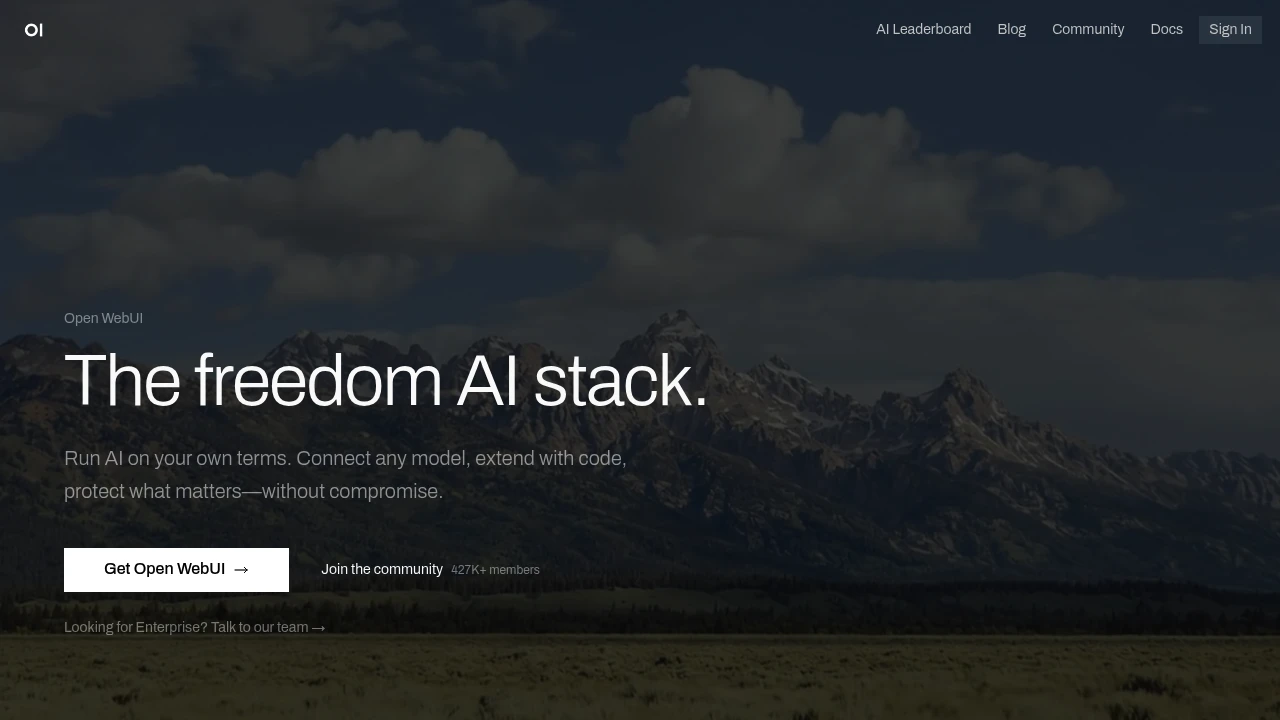
Open WebUI is a self-hosted AI interface for teams that want one place to run local models, cloud models, conversations, and tools. It connects to Ollama, OpenAI, Anthropic, and compatible providers while keeping user control. The project is open source and built for laptops to enterprises.
Key Highlights
- Connects local and cloud models in one web interface
- Supports Ollama, OpenAI, Anthropic, and compatible providers
- Includes voice, vision, retrieval, generation, and search workflows
- Extends through Python for custom tools and functions
- Provides enterprise options such as SSO, RBAC, audit logs, and private deployment patterns
- Large public community: 427K+ members, 290M+ downloads, and 141K+ GitHub stars
What Makes It Different
Open WebUI is positioned around ownership. Instead of sending every AI workflow through a hosted chat product, you can run the interface yourself, connect the models you choose, and decide whether it lives locally, in the cloud, or in a hybrid environment.
That makes it different from simple chatbot front ends. The source site describes a full AI stack: conversations, model access, prompts, tools, functions, retrieval, search, voice, and vision.
Features & Capabilities
The core workflow is a shared web UI for working with different models. A team can connect local Ollama models, add cloud providers when needed, and keep the same conversation and tool layer across both. The community hub adds shared prompts, models, tools, functions, discussions, and reviews.
For organizations, Open WebUI supports controlled deployments. The enterprise source describes on-premise, private cloud, hybrid, and air-gapped options, plus LDAP, Active Directory, SSO, RBAC, audit logs, high availability architecture, and dedicated support.
User Ratings and Testimonials
Open WebUI does not publish a third-party average rating. Open WebUI's own site points to community scale and enterprise stories, including secure self-hosted deployments and a university stack serving tens of thousands of students and employees.
The main tradeoff is operational. Because Open WebUI is self-hosted, teams are responsible for deployment, model access, data controls, uptime, and compliance decisions instead of buying a fully managed chat app.
Pricing & Value
- Standard use: $0, free to use as-is when the original branding stays intact
- Enterprise licensing: Contact sales, for organizations that need white labeling, rebranding, dedicated support, or deeper enterprise engagement
- Sponsorship: Optional, for users that want to support ongoing development without needing an enterprise license
Open WebUI is strongest for teams that want control over where AI runs and which models it uses. Open WebUI does not publish a public USD price for enterprise licensing.


FAQs
Yes. The enterprise page says it is free to use as-is, with optional paid licenses for white labeling and support.
Individuals, startups, enterprises, and self-hosting teams use it for local, cloud, or hybrid AI deployments.
It can be self-hosted so data stays in your environment, but privacy depends on deployment and connected model providers.
It depends on the setup. Open WebUI is strongest for self-hosted control; hosted chat tools can be easier to operate.

You might also like
 bisibility — Free beta: Track your website’s keywords, Google rankings, Search Console insights, and share of voice.

