Mastra
Mastra is an open-source TypeScript framework for developers building AI agents, workflows, memory, MCP, and observability.
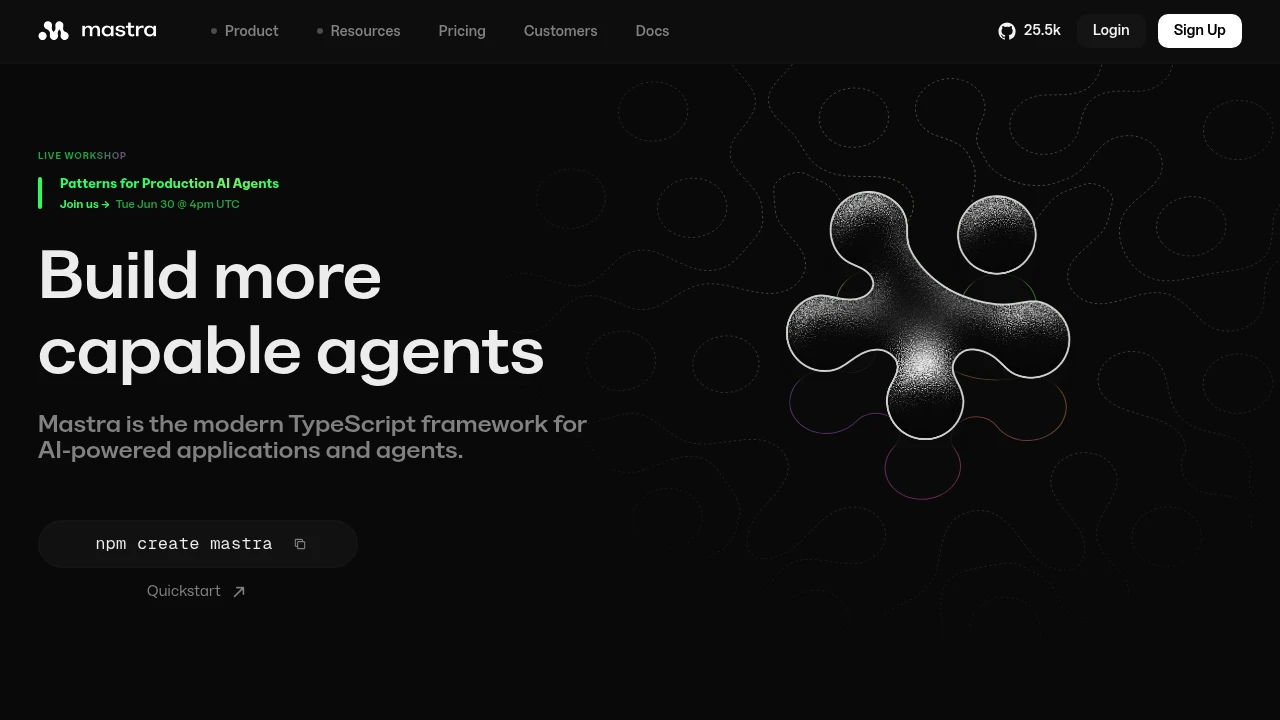
Mastra is an open-source TypeScript framework for building AI agents and AI-powered apps. It packages typed agents, graph workflows, memory, MCP support, and observability for JavaScript teams that want agent logic inside an existing app stack instead of a separate Python service.
Key Highlights
- Define agents with instructions, models, tools, memory, and runtime behavior
- Build workflows with branches, parallel steps, stored pauses, and human approval
- Add conversation history, retrieval, working memory, and semantic memory
- Route models through one interface with 90+ providers
- Author MCP servers and track evals, traces, token usage, and guardrails
What Makes It Different
Mastra treats agent development as a TypeScript app problem. Agents, workflows, memory, server endpoints, and observability can live beside React, Next.js, Node.js, Hono, Express, Fastify, or standalone server code. The graph workflow engine handles multi-step processes, pauses, branches, and parallel work, while MCP support exposes agents, tools, and resources to other systems.
Features & Capabilities
Developers define an agent with instructions, a model, tools, and runtime behavior, then connect it to app flows. Mastra supports internal Slack-style agents, customer-facing task agents, and AI SREs. Memory combines message history with retrieval and persistent state, while observability covers evals, metrics, datasets, traces, token usage, and guardrails.
Deployment options include any Node.js-compatible environment, built-in deployers for Vercel, Netlify, and Cloudflare, a standalone Hono server, or existing web frameworks.
User Ratings and Testimonials
Mastra publishes customer examples rather than review-site scores. Marsh uses LenAI agentic search powered by Mastra, and MongoDB uses Mastra agents for CI logs. The tradeoff is audience fit: non-technical teams need developers, not just a visual builder.
Pricing & Value
- Starter Platform: $0/month, 100K observability events, 24 CPU hours, 15 days retention, unlimited users, deployments, and projects
- Teams Platform: $250/month, 1M observability events, 250 CPU hours, 6 months retention, multiple teams, SSO, and SOC 2 docs
- Enterprise Platform: Custom pricing for volume, retention, RBAC, audit logs, support, uptime SLAs, and dedicated support
- Self-hosted Free: $0/month under Apache 2.0, with agents, workflows, and observational memory anywhere
- Self-hosted Enterprise: Custom pricing for enterprise controls, VPC deployment, and flat annual pricing
Starter covers prototypes. Teams and Enterprise add retention, SSO, compliance docs, and production support.
FAQs
Mastra is used to build TypeScript AI agents, workflows, MCP servers, memory systems, evals, and observability for AI apps.
Yes. Mastra has an Apache 2.0 open-source framework and a $0/month Starter Platform plan with metered overages.
Mastra was founded by Sam Bhagwat, Abhi Aiyer, and Shane Thomas, the team behind Gatsby.js.
Teams adds SSO and SOC 2 docs. Enterprise adds RBAC, audit logs, SLAs, and self-hosted VPC deployment options.

You might also like
 bisibility — Free beta: Track your website’s keywords, Google rankings, Search Console insights, and share of voice.