Replicate Alternatives
A curated collection of the 5 best alternatives to Replicate.
The best alternative to Replicate is Together AI. If that doesn't suit you, we've compiled a ranked list of other Replicate alternatives to help you find a suitable replacement. Other interesting alternatives to Replicate are: Hugging Face, Groq, Fal.ai and OpenRouter.
Replicate alternatives are mainly AI Infrastructure tools. Browse these if you want a narrower list of alternatives or looking for a specific functionality of Replicate.


Together AI gives developers inference, fine-tuning, and GPU clusters for open-source model apps.
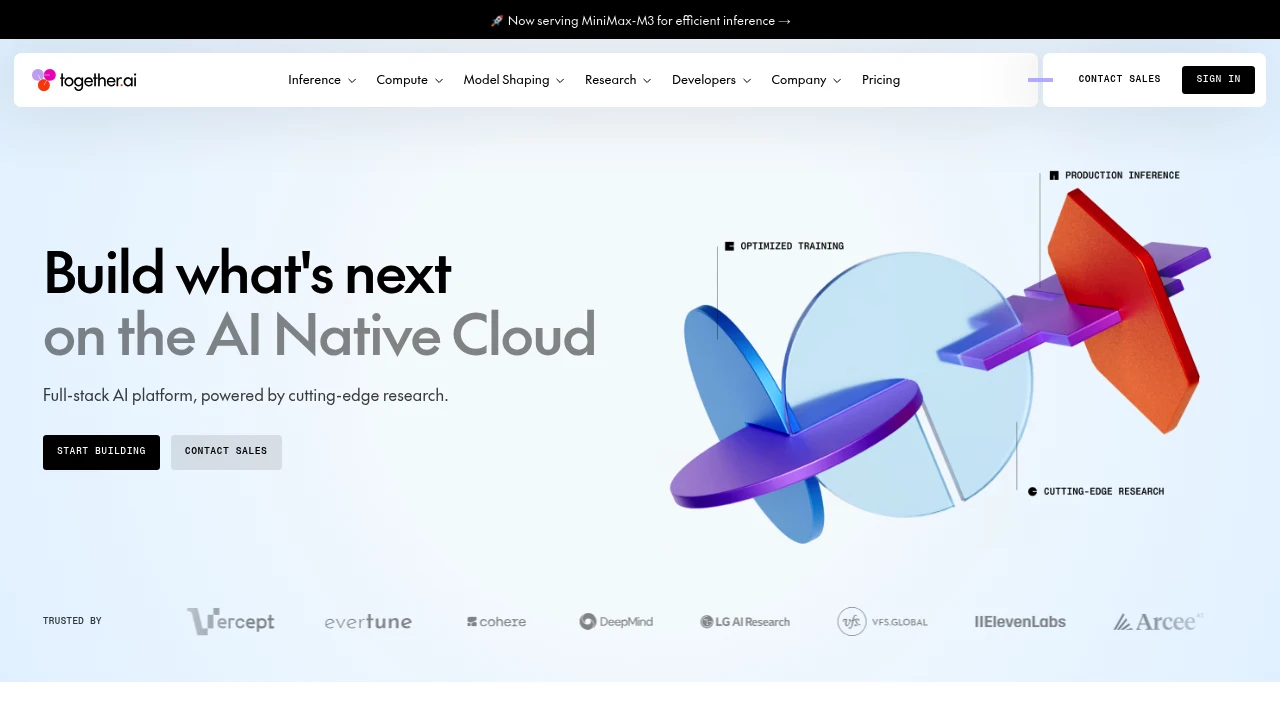
Together AI is an AI infrastructure cloud for teams building with open-source models. It combines inference, fine-tuning, GPU clusters, storage, and code sandboxes in one developer platform.
Key Highlights
- Serverless Inference for open-source models with no infrastructure to manage
- Batch Inference for asynchronous jobs, described at up to 30 billion tokens per model
- Dedicated Inference and containers for single-tenant model and media workloads
- GPU Clusters with NVIDIA H100, H200, and B200 capacity
- Fine-Tuning, Sandbox, and Managed Storage for model shaping, code execution, and storage
What Makes It Different
Together AI combines broad infrastructure with systems research. Its site claims 2x faster inference, 60% lower cost, and 90% faster pre-training through workload-specific optimization and the Together Kernel Collection. Instead of selling only an API, it lets teams move from serverless inference to dedicated endpoints or reserved clusters.
Features & Capabilities
Developers can run models on demand, submit batch jobs, deploy dedicated endpoints, or use containers for generative media. Compute spans self-serve clusters to thousands of GPUs, with object storage, parallel filesystems, and zero egress fees.
For model shaping, Together AI supports fine-tuning open-source models. The site says this can improve accuracy, reduce hallucinations, and control behavior without managing training infrastructure. Sandbox adds secure code execution and development environments.
User Ratings and Testimonials
Together AI does not publish a third-party rating, customer names, or customer reviews. The main buying caution is billing: estimates may combine token rates, GPU hours, sandbox compute, storage, and fine-tuning tokens.
Pricing & Value
The pricing page is usage-based and says teams can start free, but it does not document a full free plan. Published prices include:
- Serverless Inference: per 1M tokens, visible rows include $0.03 input/$0.12 output and $2.10 input/$4.40 output
- Dedicated Inference: 1x H100 80 GB at $6.49/hour, 1x HGX B200 180GB at $11.95/hour
- GPU Clusters: on-demand H100 at $5.49/hour, H200 at $6.79/hour, B200 at $9.95/hour
- Sandbox and Storage: $0.0446/hour per vCPU, $0.0149/hour per GiB RAM, $0.03 per 60 minute code session, and $0.16/GiB/month storage
- Fine-Tuning: up to 16B supervised fine-tuning starts at $0.48 per 1M tokens for LoRA and $0.54 for full fine-tuning
Looking for alternatives to other popular tools? Check out other posts in the alternatives series and flowtools.co, a directory of best AI tools with filters for tags and categories for easy browsing and discovery.

Hugging Face is the open hub where the machine learning community hosts, shares, and collaborates on models, datasets, and apps.
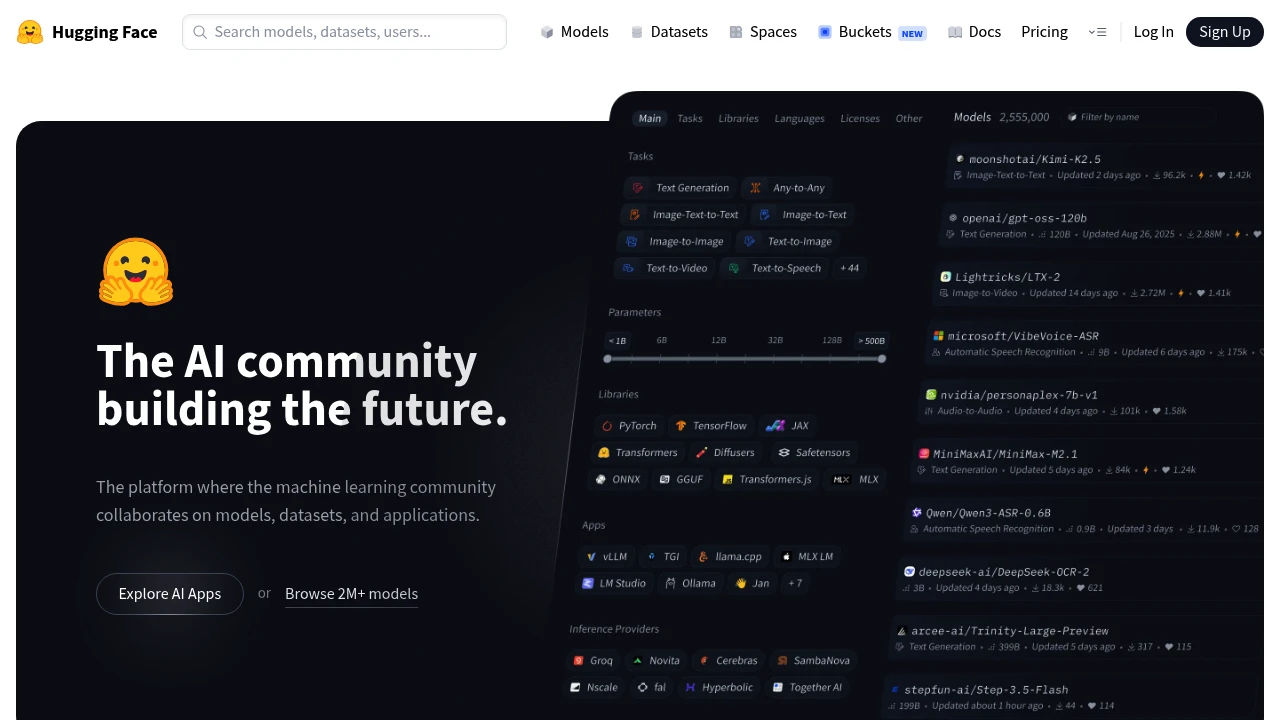
Hugging Face is an open platform where the machine learning community hosts, shares, and collaborates on models, datasets, and applications. It is built for ML engineers, researchers, and developers who want to find a pretrained model, publish their own work, or run AI in production. You can browse hundreds of thousands of public models for free, deploy a demo as a Space, or call models through a hosted API.
Key Highlights
- Host unlimited public models, datasets, and applications for free
- Access 45,000+ models from leading providers through one Inference Providers API, no service fees
- Run demos as Spaces, with free CPU and ZeroGPU tiers
- Git-based version control built for ML collaboration
- On-demand GPU compute starting at $0.60/hour
- Used by more than 50,000 organizations
What Makes It Different
Most ML platforms lock you into one cloud or one model family. Hugging Face is provider-neutral: the Hub hosts models from many vendors, and the Inference Providers API routes a single call to 45,000+ models across different backends. The whole stack is Git-based, so versioning a model or dataset works like versioning code. That made it the default place the community publishes and discovers work.
Features & Capabilities
The Hub is the core: explore and download models, browse datasets with a built-in viewer, and run interactive demos called Spaces. Everything is public by default and free to host, with private repositories on paid plans. You can build an ML profile and collaborate through pull requests and discussions.
For running models, it offers hosted Inference Endpoints on dedicated autoscaling infrastructure (from $0.033/hour) with no cold starts, Spaces hardware upgrades for GPUs, and per-TB storage. Paid plans add SSO, audit logs, and access controls for teams.
User Ratings and Testimonials
Hugging Face is widely regarded as the central hub of open machine learning, praised for the breadth of its model and dataset library and the ease of sharing work publicly. Developers value the free hosting and active community. Common criticisms are that documentation can lag behind fast-moving features, hosted inference costs add up at scale, and the sheer number of models makes quality hard to judge.
Pricing & Value
- Free: $0, unlimited public models, datasets, and Spaces, plus free CPU and ZeroGPU tiers
- PRO: $9/month, 10x private storage, 20x inference credits, more ZeroGPU quota, and Dev Mode
- Team: $20/month per user, with SSO, audit logs, storage regions, and resource groups
- Enterprise: $50/month per user, adding SCIM provisioning, advanced security, and dedicated support
Compute is billed separately: GPU Spaces and Inference Endpoints run by the hour, and storage is per TB. The free tier is generous enough to evaluate before paying for private hosting or compute.

Groq runs open AI models on its own LPU chips, giving developers very fast, low cost token inference through an OpenAI compatible API.
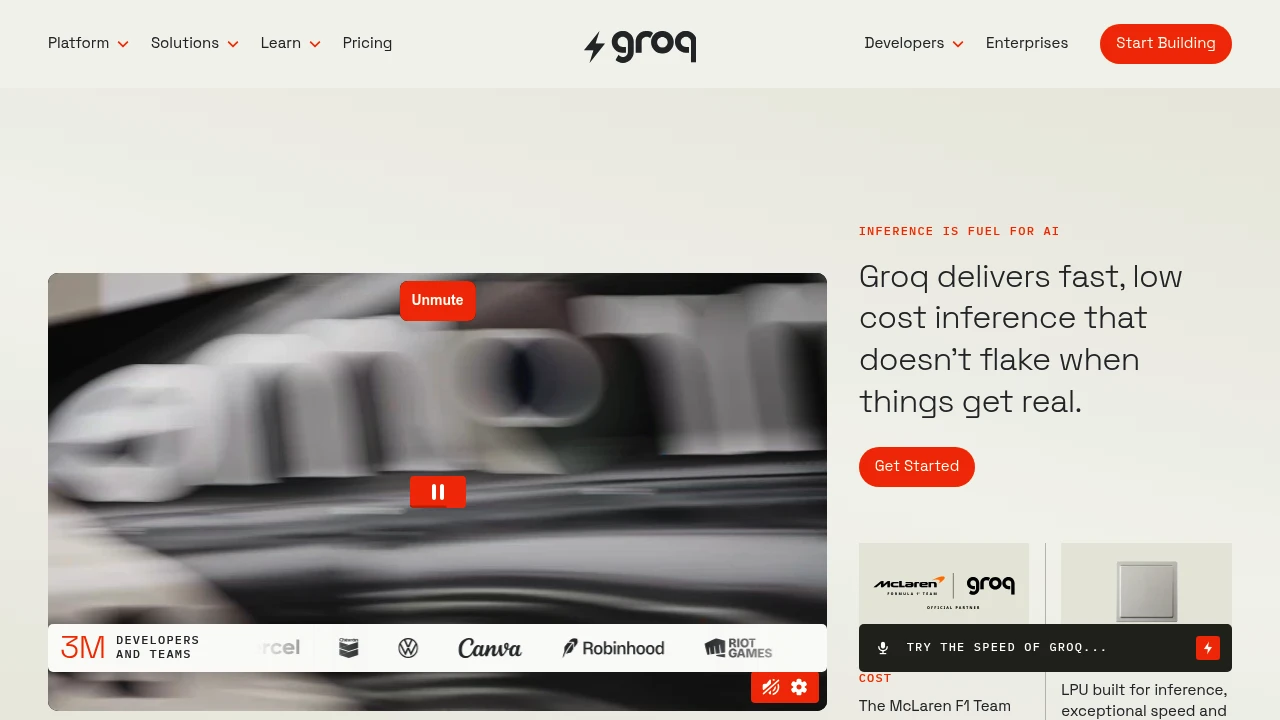
Groq runs open large language models on custom hardware built only for inference, so responses come back very fast at a predictable per token price. It is built for developers and teams who serve AI models in production and care about latency and cost. You reach the models through GroqCloud, an OpenAI compatible API you point existing code at in two lines.
Key Highlights
- Custom LPU chips, first designed in 2016 specifically for inference, not general GPUs
- GroqCloud hosts open models including GPT-OSS, Llama, Qwen3, Kimi K2, and Whisper
- OpenAI compatible API: change the base URL and key, keep your existing code
- Pay per token pricing in USD with no idle infrastructure charges
- Batch API runs async workloads at 50% lower cost, plus built-in online retrieval and code execution
What Makes It Different
Most inference providers run on GPUs alone. Groq designed its own chip, the LPU (Language Processing Unit), purpose-built for running models rather than training them. That hardware produces high token-per-second speeds, with Llama 3.1 8B Instant served at roughly 840 tokens per second. Pricing stays linear and published up front, with no surge pricing, so a model costs the same per million tokens at any volume.
Features & Capabilities
You call GroqCloud the same way you call OpenAI: set the base URL to the Groq endpoint, add your API key, and your existing client library works. You pick from a catalog of open models for chat, plus Whisper for transcription and text-to-speech voices. Compound systems route a query across models and call server-side tools (online retrieval, code execution, browser automation) billed by usage. Groq says 3 million developers and teams build on the platform, including the McLaren Formula 1 team.
User Ratings and Testimonials
Groq is widely recognized as one of the fastest inference providers, and the 2025 Artificial Analysis AI Adoption Survey lists it among providers developers use or consider. Fintool reported chat speed up 7.41x and costs down 89% after switching to GroqCloud. The main trade-off is scope: Groq hosts open models, not proprietary ones like GPT-4 or Claude, so teams needing those must look elsewhere.
Pricing & Value
Groq uses pay-as-you-go, per token pricing (all prices in USD per million tokens):
- Llama 3.1 8B Instant: $0.05 input and $0.08 output, the cheapest listed chat model
- GPT-OSS 20B: $0.075 input and $0.30 output
- GPT-OSS 120B: $0.15 input and $0.60 output
- Llama 3.3 70B Versatile: $0.59 input and $0.79 output
- Whisper Large v3 Turbo: $0.04 per hour of audio transcribed
New users start on a free tier before adding billing, and the Batch API plus prompt caching cut costs further for high-volume workloads. The predictable pricing is the main draw for teams that need to plan inference spend.

An inference cloud where developers call 1,000+ image, video, audio, and 3D models through one API, or rent GPUs by the hour.
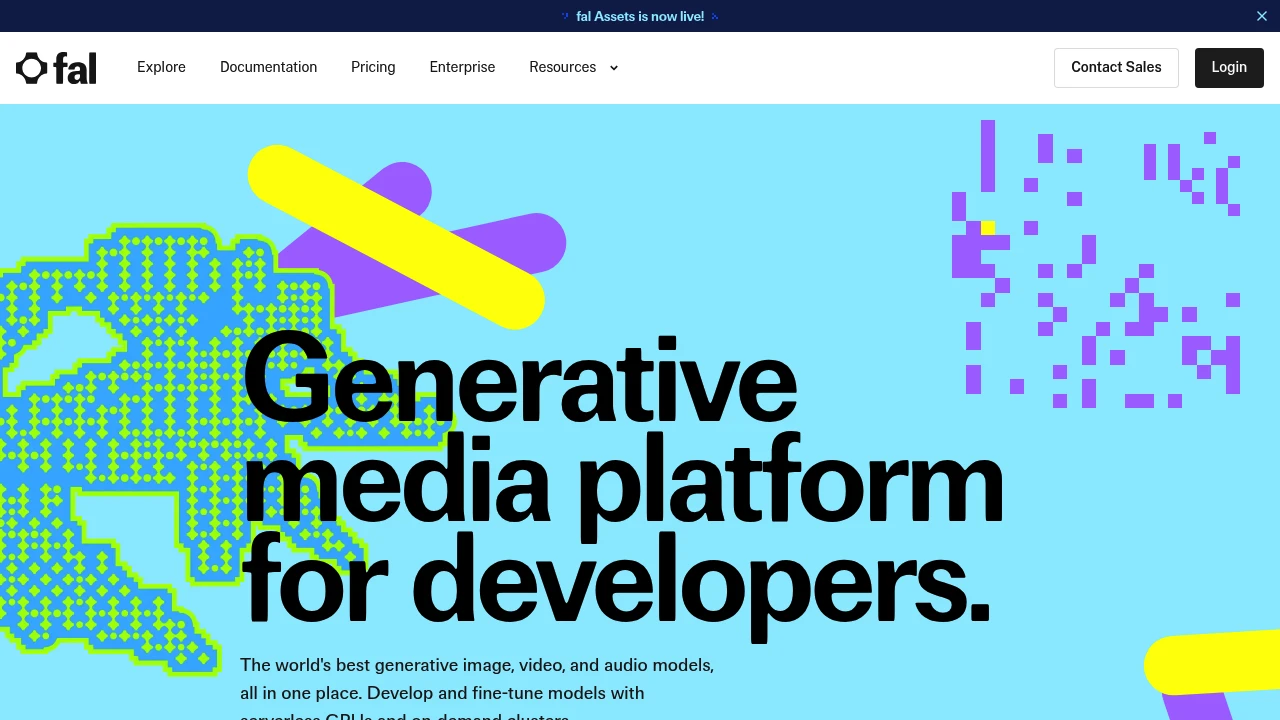
Fal.ai is a generative media inference cloud built for developers. It lets you call more than 1,000 production-ready image, video, audio, and 3D models (including FLUX, Kling, and Hailuo) through one unified API, with no MLOps or GPU setup. You can also deploy fine-tuned models on serverless GPUs or rent dedicated clusters.
Key Highlights
- One API and SDK to run 1,000+ open image, video, audio, and 3D models
- Serverless GPUs that scale from zero to thousands of instances with no cold starts
- fal Inference Engine, described as up to 10x faster for diffusion models
- Hourly GPU rentals (H100, H200, B200, B300, RTX PRO 6000) for custom workloads
- Pay-per-output billing on Model APIs, plus SOC 2 compliance and SSO for teams
What Makes It Different
Most teams either stitch together separate model vendors or run their own GPU infrastructure. Fal.ai collapses both into one platform: a hosted catalog of ready-to-call models plus the compute underneath them. Its fal Inference Engine is tuned for diffusion models and is marketed as up to 10x faster than alternatives, with a claimed 99.99% uptime at scale. Use serverless per-output pricing for quick integration, or rent GPUs by the hour to run private weights at lower marginal cost.
Features & Capabilities
The core workflow is a single API call: pick a model endpoint such as fal-ai/fast-sdxl, pass a prompt, and stream results back with queue updates and logs. Official JavaScript and Python clients let you ship a feature in minutes, and the gallery spans text-to-image, image-to-video, voice, and 3D.
Beyond hosted models, you can bring your own weights or LoRAs and deploy private endpoints with one click. For frontier work, dedicated clusters offer the latest NVIDIA hardware across global regions for large-scale training, plus usage analytics and 24/7 priority support.
User Ratings and Testimonials
Fal.ai reports being trusted by over 1,500,000 developers and publishes endorsements from Canva, Perplexity, and Quora, which says fal powers 40% of Poe's official image and video generation bots. Developers praise the catalog breadth and inference speed. The main criticisms are that usage-based costs can climb quickly at high volume, and that per-model pricing takes study to predict.
Pricing & Value
- Signup credits: New accounts get promotional credits to test the platform. fal is prepaid pay-as-you-go, not a permanent free plan
- Model APIs (per output): Image models from about $0.02 per megapixel or $0.03 per image; video models from about $0.05 per second of output
- GPU Compute (hourly): H100 from $1.89/hr, H200 from $2.10/hr, B200 from $3.49/hr, B300 from $4.49/hr, RTX PRO 6000 from $1.10/hr (list prices run higher)
Pay-per-output pricing suits teams adding a single generative feature; hourly GPU rentals pay off once volume justifies your own deployments.
Find and use the best AI models from any provider through one simple API. Compare prices and performance to optimize your prompts and save on costs.
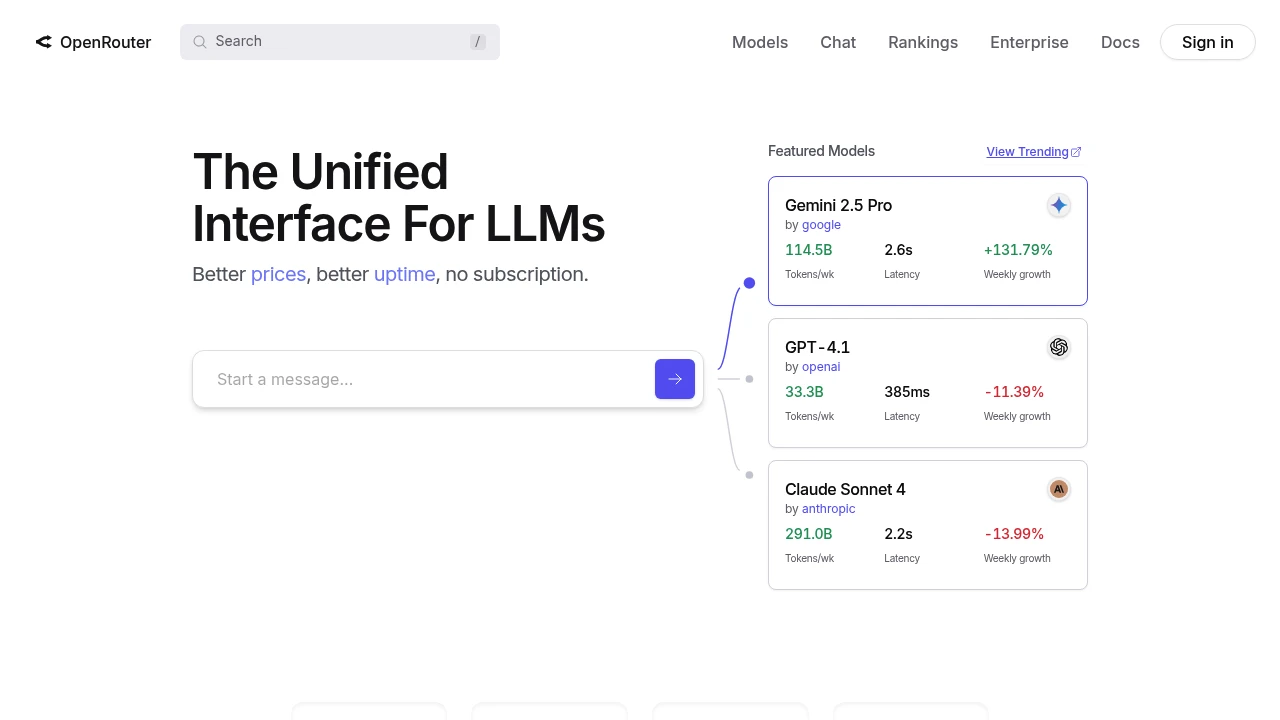
OpenRouter is a service that lets you access many large language models (LLMs) using just one API. It is for developers who want to use different AI models in their applications.
Key Highlights
-
Access to many popular LLMs with one API key.
-
Pay-as-you-go pricing model.
-
Standardized API format across all models.
-
Real-time performance and cost tracking.
What Makes It Different
OpenRouter simplifies using multiple LLMs. Instead of integrating with each model's API, developers use one. This makes it easy to switch models and compare performance.
Features & Capabilities
OpenRouter allows you to send requests to different LLMs. You can use it to power chatbots, generate text, or perform other AI tasks. The service handles the connection to each model provider.
Pricing & Value
OpenRouter charges based on the usage of each model. There are no monthly fees. This offers great value for developers. It gives them flexibility and helps them avoid vendor lock-in.
Similar proprietary alternatives:

 bisibility — Free beta: Track your website’s keywords, Google rankings, Search Console insights, and share of voice.


