Pydantic AI
Python developers use Pydantic AI to build typed GenAI agents, tools, and workflows with Pydantic validation.
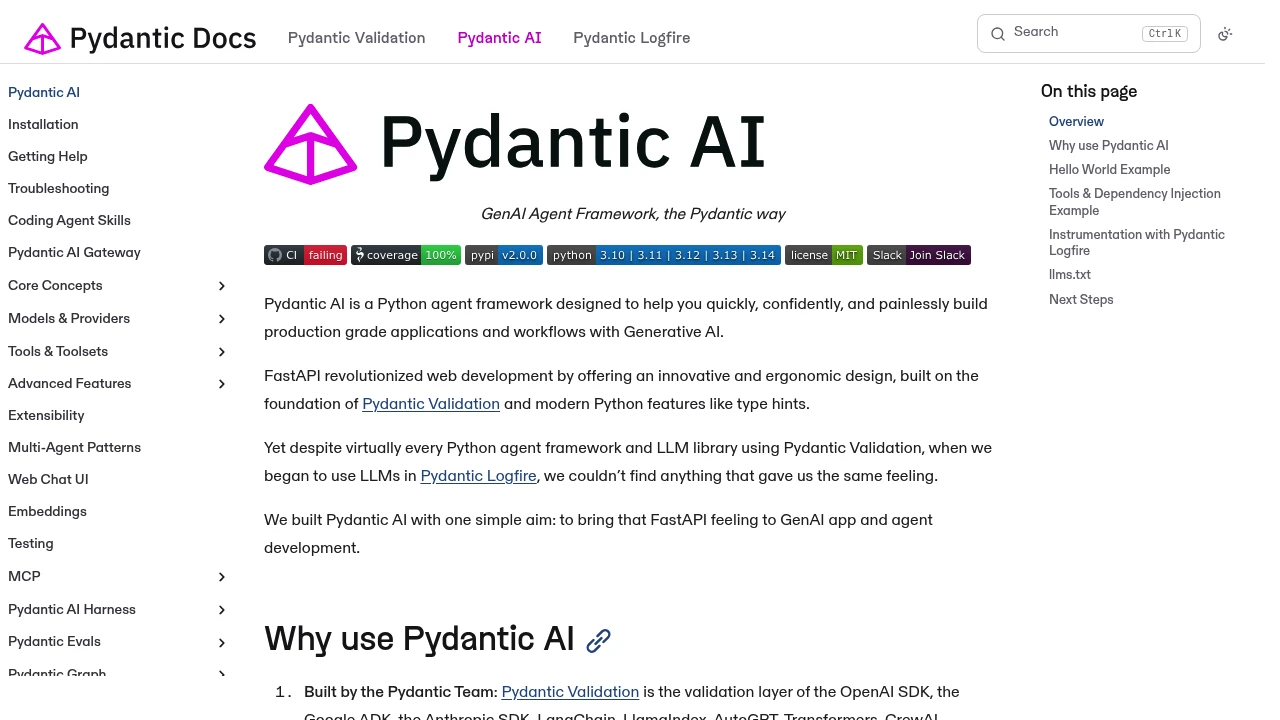
Pydantic AI is a Python agent framework from the Pydantic team for building production GenAI applications and workflows. It is built for developers who want the same typed, ergonomic feel that FastAPI brought to web apps, but for agents, tools, structured outputs, and model workflows.
Key Highlights
- Typed agents with Pydantic validation for outputs and tool arguments
- Model support across OpenAI, Anthropic, Gemini, Mistral, Bedrock, Ollama, LiteLLM, OpenRouter, and many more
- Dependency injection for passing data, services, and context into instructions and tools
- Built-in support for MCP, UI event streams, human approval, streamed outputs, and durable execution
- Evals and OpenTelemetry tracing through Pydantic Logfire or another OTel-compatible backend
What Makes It Different
Pydantic AI is opinionated around Python types instead of visual flow builders or prompt-only agent wrappers. Agents are generic over their dependency type and output type, so static type checkers and IDEs can catch mistakes before a run reaches the model.
The framework also leans on Pydantic for validation. Tool arguments become schemas sent to the model, invalid outputs can be retried, and final responses can be constrained to a known model such as a support ticket result, risk score, or structured answer.
Features & Capabilities
You define an agent, choose a model, add static or dynamic instructions, and register tools that the model can call while it works. Dependencies let each run receive customer IDs, database connections, or other app services without hiding that context in global state.
For larger systems, Pydantic AI adds composable capabilities, YAML or JSON agent specs, streamed structured outputs, graph support, evals, and durable agents that can recover across transient failures or restarts. MCP support lets agents connect to external tools and data, while UI event streams help build interactive agent experiences.
User Ratings and Testimonials
Public rating data is not prominent for this framework, so it is better judged by fit. It is strongest for Python teams that already use Pydantic, care about type hints, and want agent code they can test, trace, and review. The tradeoff is that it is not a no-code builder: teams still need to handle model keys, hosting, approval policies, and production monitoring.
Pricing & Value
- Framework: $0, open-source under the MIT license for building and running Python agents in your own application
- Usage costs: model calls, hosting, and optional observability costs depend on the providers you connect
Pydantic AI is best value for engineering teams that want a code-first framework rather than a hosted agent platform with bundled model usage.
FAQs
Pydantic validates Python data models. Pydantic AI uses that style to build LLM agents, tools, typed outputs, and evals.
It is strongest for Python teams that want typed agents and Pydantic validation. It is less suited to no-code users.
It is built and maintained by the Pydantic team, with the public repo under the Pydantic GitHub organization.
Developers use it to build Python LLM agents, structured outputs, tool calls, MCP integrations, evals, and durable workflows.
Use it for typed Python agents with provider flexibility, dependency injection, output validation, evals, and tracing.
Tags:

You might also like
 bisibility — Free beta: Track your website’s keywords, Google rankings, Search Console insights, and share of voice.