
Groq
Run supported language and speech models through GroqCloud APIs, with self-serve rates and Enterprise options.
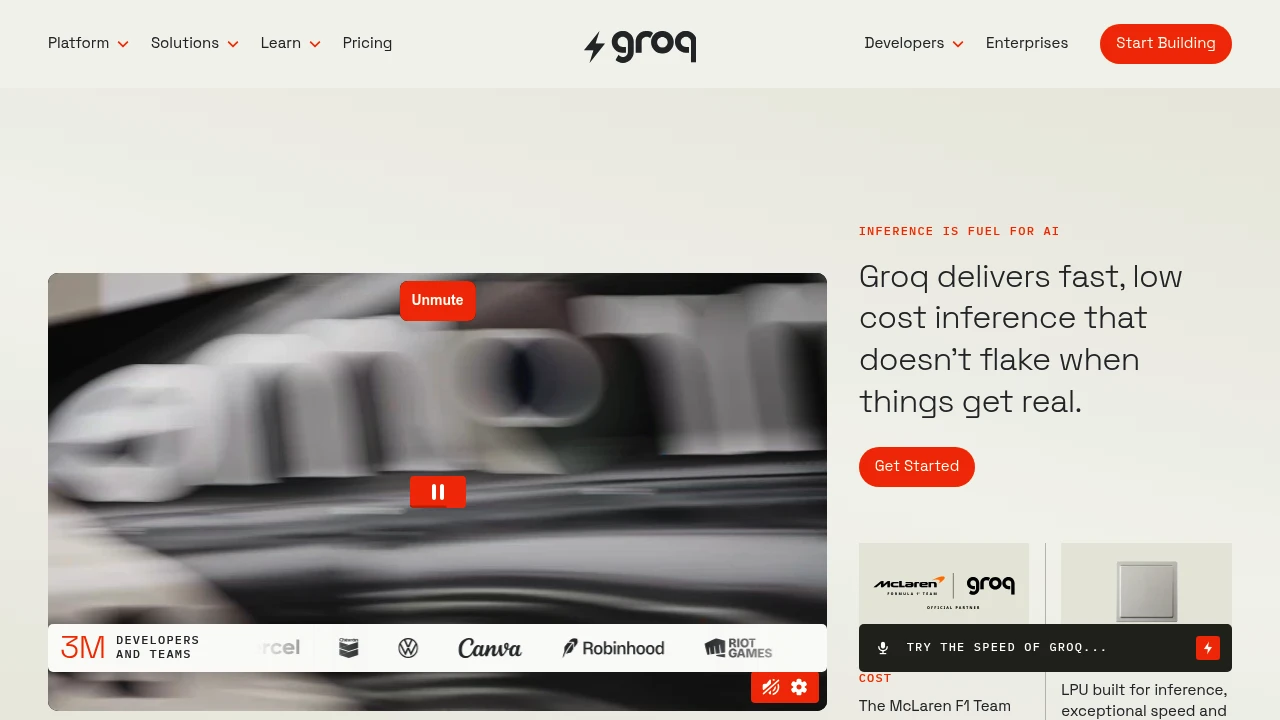
Groq runs open large language models on custom hardware built only for inference, so responses come back very fast at a predictable per token price. It is built for developers and teams who serve AI models in production and care about latency and cost. You reach the models through GroqCloud, an OpenAI compatible API you point existing code at in two lines.
Key Highlights
- Custom LPU chips, first designed in 2016 specifically for inference, not general GPUs
- GroqCloud hosts open models including GPT-OSS, Llama, Qwen3, Kimi K2, and Whisper
- OpenAI compatible API: change the base URL and key, keep your existing code
- Pay per token pricing in USD with no idle infrastructure charges
- Batch API runs async workloads at 50% lower cost, plus built-in online retrieval and code execution
What Makes It Different
Most inference providers run on GPUs alone. Groq designed its own chip, the LPU (Language Processing Unit), purpose-built for running models rather than training them. That hardware produces high token-per-second speeds, with Llama 3.1 8B Instant listed at 560 tokens per second in current documentation; actual performance depends on workload. Groq publishes self-serve unit rates for listed models. Enterprise pricing and volume terms are agreed separately.
Features & Capabilities
You call GroqCloud the same way you call OpenAI: set the base URL to the Groq endpoint, add your API key, and your existing client library works. You pick from a catalog of open models for chat, plus Whisper for transcription and text-to-speech voices. Compound systems route a query across models and call server-side tools (online retrieval, code execution, browser automation) billed by usage. Groq says 3 million developers and teams build on the platform, including the McLaren Formula 1 team.
User Ratings and Testimonials
Groq is widely recognized as one of the fastest inference providers, and the 2025 Artificial Analysis AI Adoption Survey lists it among providers developers use or consider. Fintool reported chat speed up 7.41x and costs down 89% after switching to GroqCloud. The main trade-off is scope: Groq hosts open models, not proprietary ones like GPT-4 or Claude, so teams needing those must look elsewhere.
Pricing & Value
Groq lists self-serve rates per million tokens, with some models available through Enterprise sales:
- Llama 3.1 8B Instant: Enterprise availability with pricing on request
- GPT-OSS 20B: $0.075 input and $0.30 output
- GPT-OSS 120B: $0.15 input and $0.60 output
- Llama 3.3 70B Versatile: Enterprise availability with pricing on request
- Whisper Large v3 Turbo: $0.04 per hour of audio transcribed
New users start on a free tier before adding billing, and the Batch API plus prompt caching cut costs further for high-volume workloads. The predictable pricing is the main draw for teams that need to plan inference spend.
Product facts
- Pricing
- Not yet verified
- Access
- Not yet verified
- Product status
- Not yet verified


FAQs
No. Groq is an independent, privately held company founded in 2016 by Jonathan Ross, with its own LPU chips and venture backing.
Running open AI models fast and cheaply. Developers use GroqCloud to serve chat, speech, and transcription through an OpenAI compatible API.
No. Groq is a US company headquartered in Mountain View, California, in Silicon Valley.
Not yet. Groq is still a private company funded by venture investors and has not announced an IPO date.
Inference is running an already-trained model to generate answers. Groq runs this step on its LPU chips for high token-per-second speed.
There is a free tier to start, but production use is pay-as-you-go, priced per million tokens in USD. The Batch API costs 50% less.
They are different things. Groq is inference infrastructure for open models, while ChatGPT is a consumer chatbot built on OpenAI's own models.
Groq and NVIDIA announced a non-exclusive inference-technology license in December 2025. Groq said it would remain independent.
You might also like

 bisibility — Free beta: Track your website’s keywords, Google rankings, Search Console insights, and share of voice.

