
Dograh
An open-source voice AI platform for developers building self-hosted call agents with visual workflows, APIs, and BYO models.
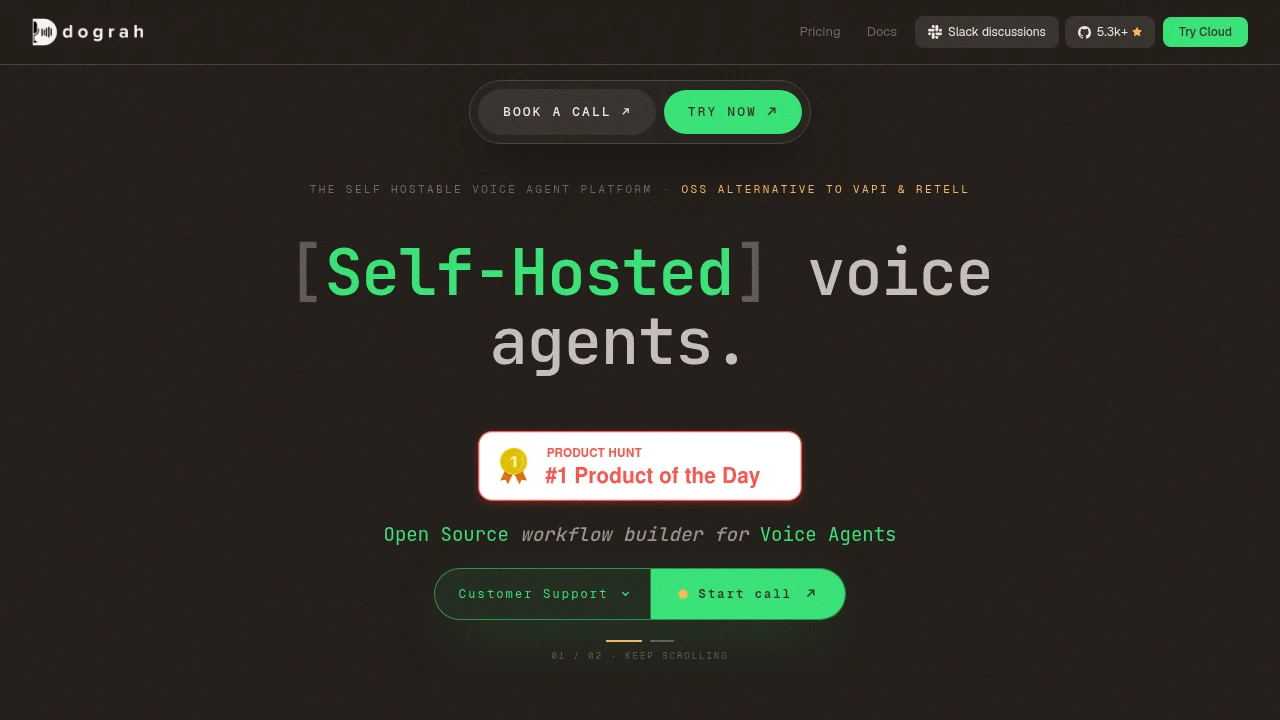
Dograh is an open-source voice AI platform for developers who want to build and operate phone agents on their own infrastructure. Its visual workflow builder connects conversation logic, models, tools, and telephony without hiding the underlying stack. Teams can self-host the BSD-2-Clause codebase or use Dograh's managed cloud.
Key Highlights
- Visual workflow builder for inbound and outbound voice agents
- Telephony integrations with human handoff and call transfer
- QA nodes, knowledge bases, tool calling, and webhooks
- REST API plus Node and Python SDKs
- MCP server for building and editing agents from coding tools
- Docker deployment with local or bring-your-own models
What Makes It Different
Dograh is positioned as a self-hosted alternative to Vapi and Retell AI. Unlike a closed hosted platform, it lets teams inspect and fork the code, deploy inside their own environment, and choose the speech-to-text, language, text-to-speech, and telephony providers in each workflow.
The clearest comparison is Dograh vs Vapi: both support programmable voice agents, but Dograh puts open-source deployment, model choice, and infrastructure control at the center. It also supports speech-to-speech pipelines when teams want to avoid the usual transcription, language model, and speech synthesis cascade.
Features & Capabilities
Developers can map call flows in the web UI, connect inbound numbers, launch outbound calls, and route conversations across agent, tool, QA, knowledge base, webhook, and end-call steps. Supported telephony setups can transfer a live call to a person when automation should hand off.
The REST API and Node and Python SDKs support programmatic agent creation and outbound calling. Dograh's MCP server lets compatible coding assistants inspect agents, retrieve node schemas, search documentation, and save workflow edits. For deployment, Docker Compose can run the API, UI, and supporting services locally or on a server, with bring-your-own cloud models or models hosted inside your own perimeter.
User Ratings and Testimonials
Dograh does not publish an aggregate product rating. Self-hosting gives teams ownership of data and infrastructure, but they also manage deployment, scaling, provider keys, and telephony configuration. Local speech-to-text and text-to-speech support is production-ready, while local language model swapping is beta.
Pricing & Value
- Open Source: Free forever, with the full self-hosted platform and no usage limits
- Pay as you go: $0.01 per minute platform fee, plus model and provider usage, with 10 concurrent calls included
- Custom Volume: Custom pricing for committed monthly volume, discounts, and priority support
- Enterprise: Custom pricing for private cloud or on-premises deployment, SSO, audit logs, compliance support, and custom SLAs
Self-hosting is the strongest value for teams that can run the stack, while managed plans trade infrastructure work for usage-based billing and support.
You might also like
 bisibility — Free beta: Track your website’s keywords, Google rankings, Search Console insights, and share of voice.

