
Vapi
Vapi is a voice AI platform for developers building, testing, and deploying phone agents at scale.
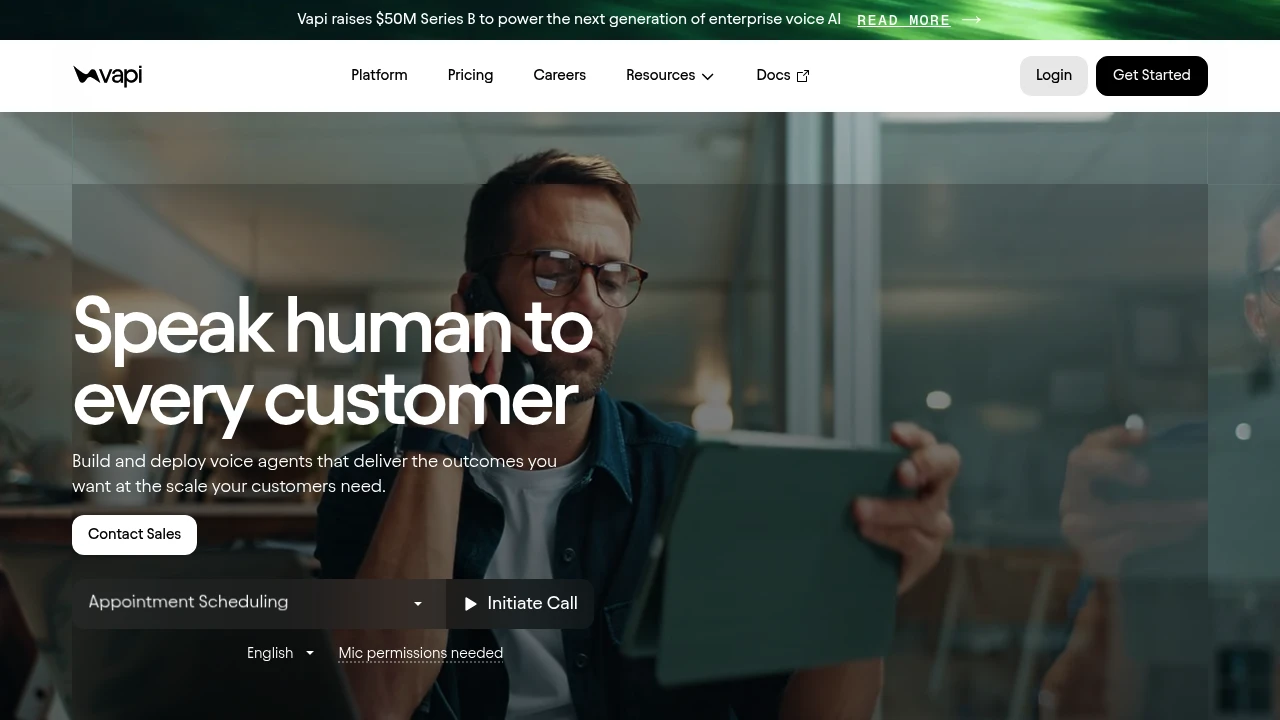
Vapi is an API-first voice AI platform for building phone agents that handle customer conversations. Developers use it to configure voice, call flow, telephony, integrations, monitoring, and deployment from one place.
Key Highlights
- Build, test, and deploy conversational voice AI agents for phone calls
- Configure voices, conversation flow, telephony, and integrations
- Use orchestration and real-time monitoring to improve agents after launch
- Scale to high-volume call programs with enterprise support options
- Add SSO, OAuth, RBAC, guardrails, SOC 2, HIPAA, and PCI on enterprise plans
What Makes It Different
Vapi is built around developer control rather than a fixed call-center script builder. Its API-first setup lets teams connect voice agents to their own systems, model providers, telephony, and workflows.
The enterprise pitch is operational: reserved capacity, support SLAs, dedicated deployment support, data residency, and sub-500ms latency for large call programs.
Features & Capabilities
Teams configure prompt, voice, conversation flow, telephony, and integrations, then use monitoring to inspect live calls and improve agents after launch.
Supported use cases include customer support, outbound selling, healthcare, marketplace, and staffing. Enterprise features include SSO, OAuth2, RBAC, AI guardrails, compliance options, reserved capacity, and a dedicated account team on Scale contracts.
User Ratings and Testimonials
Ring moved all inbound support volume to Vapi after a two-week path to production, with CSAT reported as improved. The Build tier still has practical limits: community and email support, 14 days of call history, 30 days of chat history, and enterprise controls on custom contracts.
Pricing & Value
- Build: usage based, with 60+ call minutes included, 10 concurrent calls, call hosting at $0.05/min, SMS or chat at $0.005/message, and model provider costs passed through at cost
- Concurrency add-on: $10/line/month for extra call concurrency on Build
- Compliance add-ons: HIPAA at $2000/month and Zero Data Retention at $1000/month
- Scale: annual contract with a fixed platform fee, committed volume, volume-based minute pricing, data residency, SSO, RBAC, SOC 2, HIPAA, PCI, support SLA, and a dedicated account team
Build is the practical starting point for testing phone agents with usage-based spend. Scale fits teams that need committed volume, custom retention, and named support.
FAQs
Vapi's Build tier includes 60+ call minutes, then usage-based billing applies. It is not listed as open-source or self-hosted.
Vapi lists SOC 2, HIPAA, PCI, SSO, RBAC, and AI guardrails for enterprise use. Security still depends on your setup.
Build costs $0.05/min for Vapi hosting plus model provider costs. SMS or chat is $0.005/message; Scale is annual custom pricing.
Vapi helps teams build, test, and deploy voice AI agents for phone calls, support, sales, and other customer conversations.

You might also like
 bisibility — Free beta: Track your website’s keywords, Google rankings, Search Console insights, and share of voice.

