Synthflow Alternatives
A curated collection of the 5 best alternatives to Synthflow.
How to choose a replacement
The main choice is how much of the voice-agent stack you want to configure yourself. A visual builder, a developer platform, and a self-hosted option can all serve phone workflows, but require different engineering and operational effort.
Compare by
- Visual configuration versus code and APIs
- Inbound and outbound calling requirements
- Transfers, interruption handling, and fallback paths
- Telephony, model, voice, and platform charges
Which alternative fits your workflow?
- Retell AI: A voice-agent platform for phone conversations and call workflows.
- Vapi: Developer-oriented voice-agent building blocks and APIs.
- Bland AI: AI phone agents for business calling workflows.
- ElevenLabs: Voice technology with an agent platform as part of a broader audio product.
- Dograh: An open-source voice-agent option for teams that want more stack control.
What to test before switching
Test a realistic call with interruptions, ambiguous answers, and a request to reach a person. Verify the integration action in your own system. Compare the complete call cost and operating work, including telephony and provider charges, rather than a single advertised per-minute component.


An open-source voice AI platform for developers building self-hosted call agents with visual workflows, APIs, and BYO models.
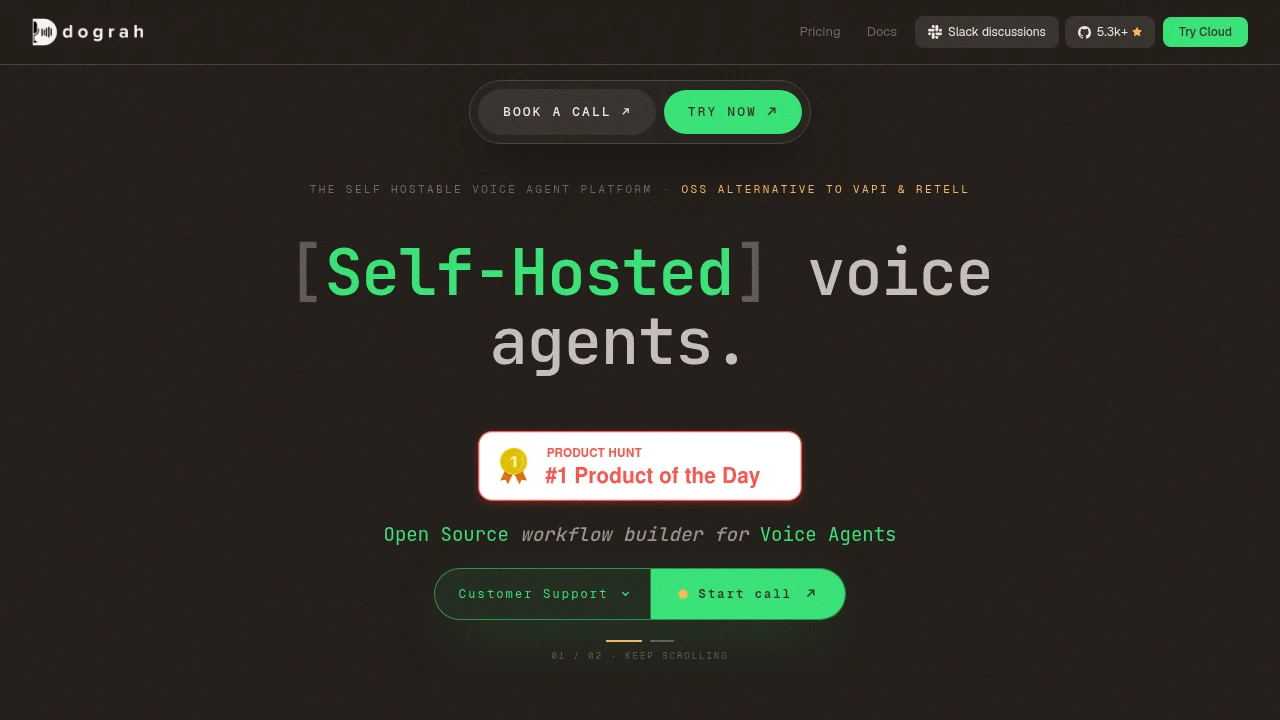
Dograh is an open-source voice AI platform for developers who want to build and operate phone agents on their own infrastructure. Its visual workflow builder connects conversation logic, models, tools, and telephony without hiding the underlying stack. Teams can self-host the BSD-2-Clause codebase or use Dograh's managed cloud.
Key Highlights
- Visual workflow builder for inbound and outbound voice agents
- Telephony integrations with human handoff and call transfer
- QA nodes, knowledge bases, tool calling, and webhooks
- REST API plus Node and Python SDKs
- MCP server for building and editing agents from coding tools
- Docker deployment with local or bring-your-own models
What Makes It Different
Dograh is positioned as a self-hosted alternative to Vapi and Retell AI. Unlike a closed hosted platform, it lets teams inspect and fork the code, deploy inside their own environment, and choose the speech-to-text, language, text-to-speech, and telephony providers in each workflow.
The clearest comparison is Dograh vs Vapi: both support programmable voice agents, but Dograh puts open-source deployment, model choice, and infrastructure control at the center. It also supports speech-to-speech pipelines when teams want to avoid the usual transcription, language model, and speech synthesis cascade.
Features & Capabilities
Developers can map call flows in the web UI, connect inbound numbers, launch outbound calls, and route conversations across agent, tool, QA, knowledge base, webhook, and end-call steps. Supported telephony setups can transfer a live call to a person when automation should hand off.
The REST API and Node and Python SDKs support programmatic agent creation and outbound calling. Dograh's MCP server lets compatible coding assistants inspect agents, retrieve node schemas, search documentation, and save workflow edits. For deployment, Docker Compose can run the API, UI, and supporting services locally or on a server, with bring-your-own cloud models or models hosted inside your own perimeter.
User Ratings and Testimonials
Dograh does not publish an aggregate product rating. Self-hosting gives teams ownership of data and infrastructure, but they also manage deployment, scaling, provider keys, and telephony configuration. Local speech-to-text and text-to-speech support is production-ready, while local language model swapping is beta.
Pricing & Value
- Open Source: Free forever, with the full self-hosted platform and no usage limits
- Pay as you go: $0.01 per minute platform fee, plus model and provider usage, with 10 concurrent calls included
- Custom Volume: Custom pricing for committed monthly volume, discounts, and priority support
- Enterprise: Custom pricing for private cloud or on-premises deployment, SSO, audit logs, compliance support, and custom SLAs
Self-hosting is the strongest value for teams that can run the stack, while managed plans trade infrastructure work for usage-based billing and support.
Looking for alternatives to other popular tools? Check out other posts in the alternatives series and flowtools.co, a directory of best AI tools with filters for tags and categories for easy browsing and discovery.

Bland AI helps regulated teams build, deploy, and monitor AI phone agents for production calls.
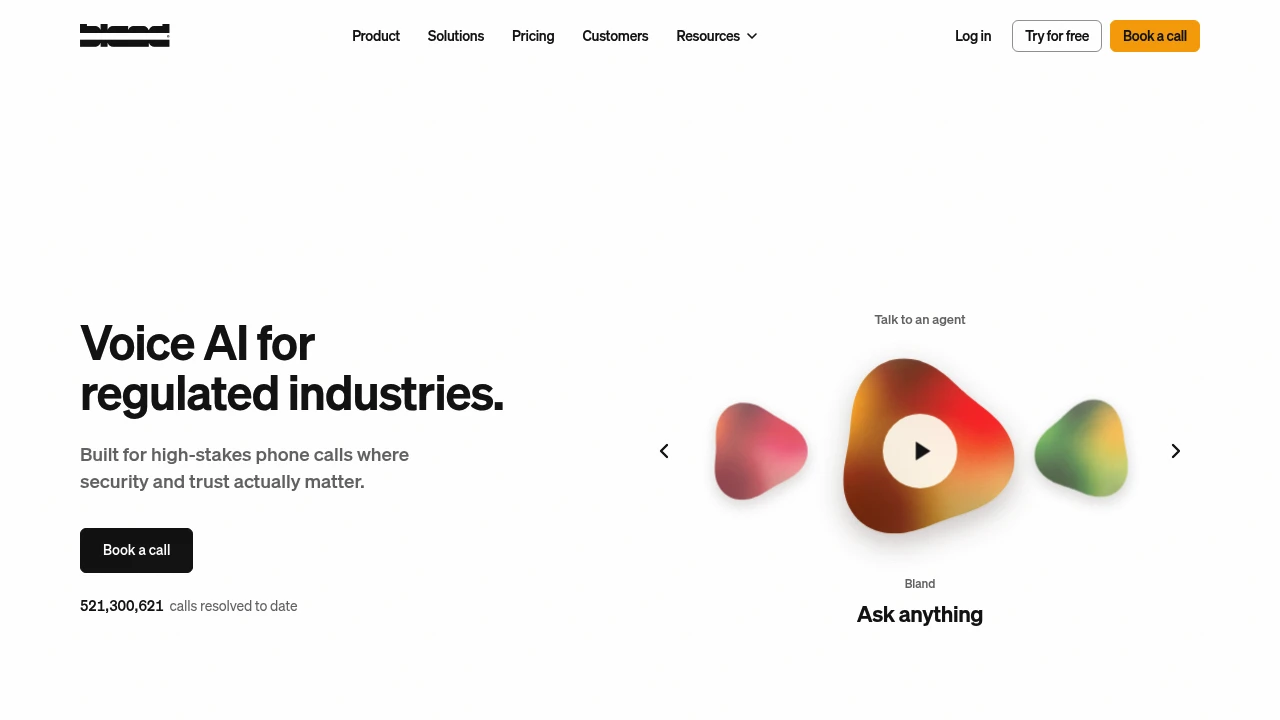
Bland AI is a voice AI platform for building, testing, and monitoring phone agents. It serves teams running customer conversations, including regulated operations. Developers can build pathways and integrations, while eligible Enterprise agreements add deployment, support, and compliance controls.
Key Highlights
- Phone agents with conversational pathways
- Scenario testing and live call monitoring
- Telephony, CRM, and scheduling integrations
- Plan-specific call concurrency and daily limits
- Enterprise BAA, SSO, and deployment options
What Makes It Different
Bland packages the language model, speech recognition, and speech synthesis into the voice talk-time rate. This does not include every cost in an implementation: transfers, carriers, outbound dialing, and other interaction types have separate billing rules. Plan eligibility also affects advanced features.
Features & Capabilities
Configure an agent, its pathways, voice, and integrations. Test representative scenarios, including incomplete information, transfers, and failed calls. Inspect live call outcomes and revise the flow before increasing volume.
Enterprise agreements can add data residency, on-premises or VPC deployment, and forward-deployed engineering support. BAA access is an Enterprise feature. HIPAA-eligible handling requires a signed BAA; encryption and security controls do not by themselves establish compliance for every workflow.
User Ratings and Testimonials
Bland features MyPlanAdvocate as a selected customer example. Evaluate response quality, handoffs, error recovery, and the call costs in your own workflow. Check concurrency and daily caps before planning a high-volume program.
Pricing & Value
Start has no platform fee, two starting credits, an inbound number, $0.14/minute talk time, and $0.05/transfer minute. It allows 10 concurrent calls and 100 calls/day. Build costs $299/month plus $0.12/minute talk time and $0.04/transfer minute, with 50 concurrent calls and 2,000 calls/day. Enterprise uses custom terms.
Carrier costs are separate. BYOT customers do not pay Bland transfer fees. Bland-provided outbound dialing has a $0.015 minimum per attempt, including failed calls. Norm is billed separately using tokens. Check the selected model, add-on, and interaction terms alongside the voice rate.

Vapi is a voice AI platform for developers building, testing, and deploying phone agents at scale.
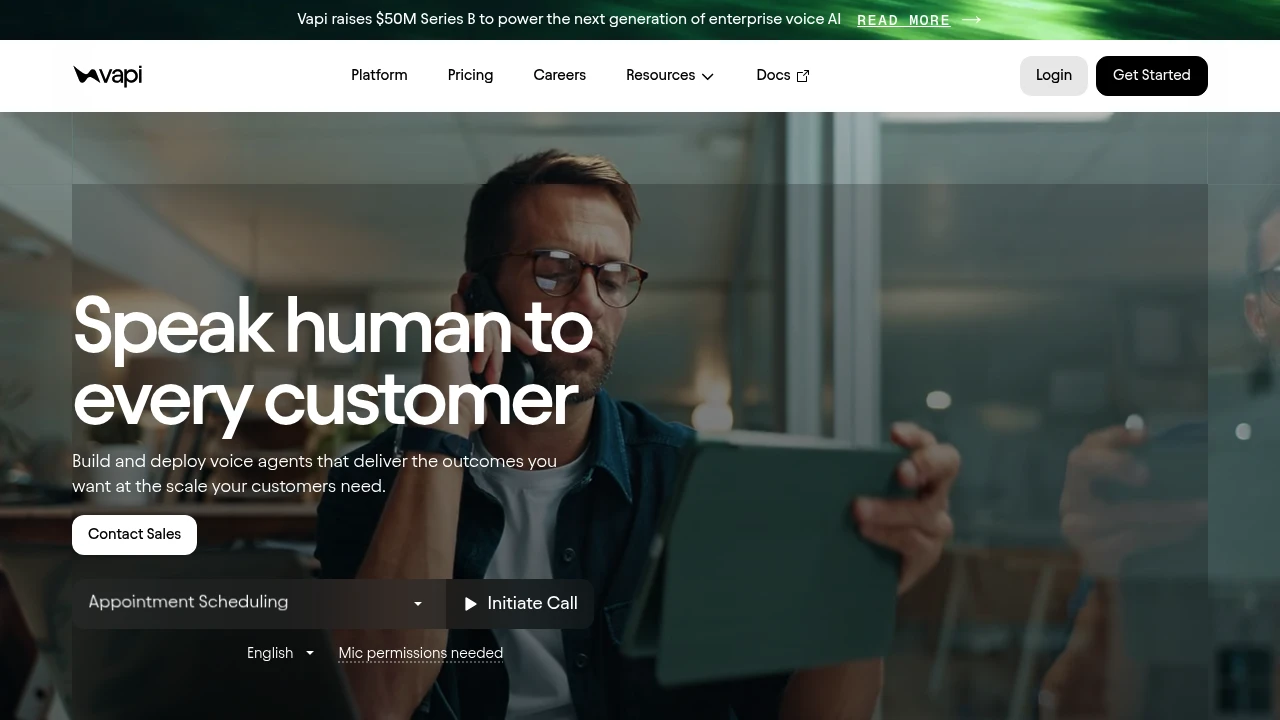
Vapi is an API-first voice AI platform for building phone agents that handle customer conversations. Developers use it to configure voice, call flow, telephony, integrations, monitoring, and deployment from one place.
Key Highlights
- Build, test, and deploy conversational voice AI agents for phone calls
- Configure voices, conversation flow, telephony, and integrations
- Use orchestration and real-time monitoring to improve agents after launch
- Scale to high-volume call programs with enterprise support options
- Compare retention, support, and governance in eligible Success Packages
What Makes It Different
Vapi is built around developer control rather than a fixed call-center script builder. Its API-first setup lets teams connect voice agents to their own systems, model providers, telephony, and workflows.
Success Packages add operational support and governance at different levels. Retention, concurrency, and support terms should be assessed alongside usage costs when planning a production call program.
Features & Capabilities
Teams configure prompt, voice, conversation flow, telephony, and integrations, then use monitoring to inspect live calls and improve agents after launch.
Supported use cases include customer support, outbound selling, healthcare, marketplace, and staffing. Enterprise features include SSO, OAuth2, RBAC, AI guardrails, compliance options, reserved capacity, and a dedicated account team on eligible Success Packages.
User Ratings and Testimonials
Test representative calls and inspect latency, handoffs, tool use, and error recovery. Usage-only access has peer support and email without an SLA. Support, retention, concurrency, and governance controls depend on the Success Package selected.
Pricing & Value
- Usage only: $5 one-time starting credits, 4 concurrent calls, 2 organizations, 1 included Vapi number, and 14-day raw-data retention
- Core Success Package: $29/month, with 10 concurrent calls, 30-day raw-data retention, and ZDR
- Pro Success Package: 10% of Vapi hosting fees, with a $999/month minimum
- Premier: custom pricing and package terms
Vapi hosting costs $0.05/minute plus model-provider and applicable transport costs. HIPAA eligible data handling is a $2,000/month add-on. Additional concurrency and organizations are available as add-ons. Compare usage costs with the package fee.

Retell AI is a voice agent platform for teams automating inbound and outbound call operations.
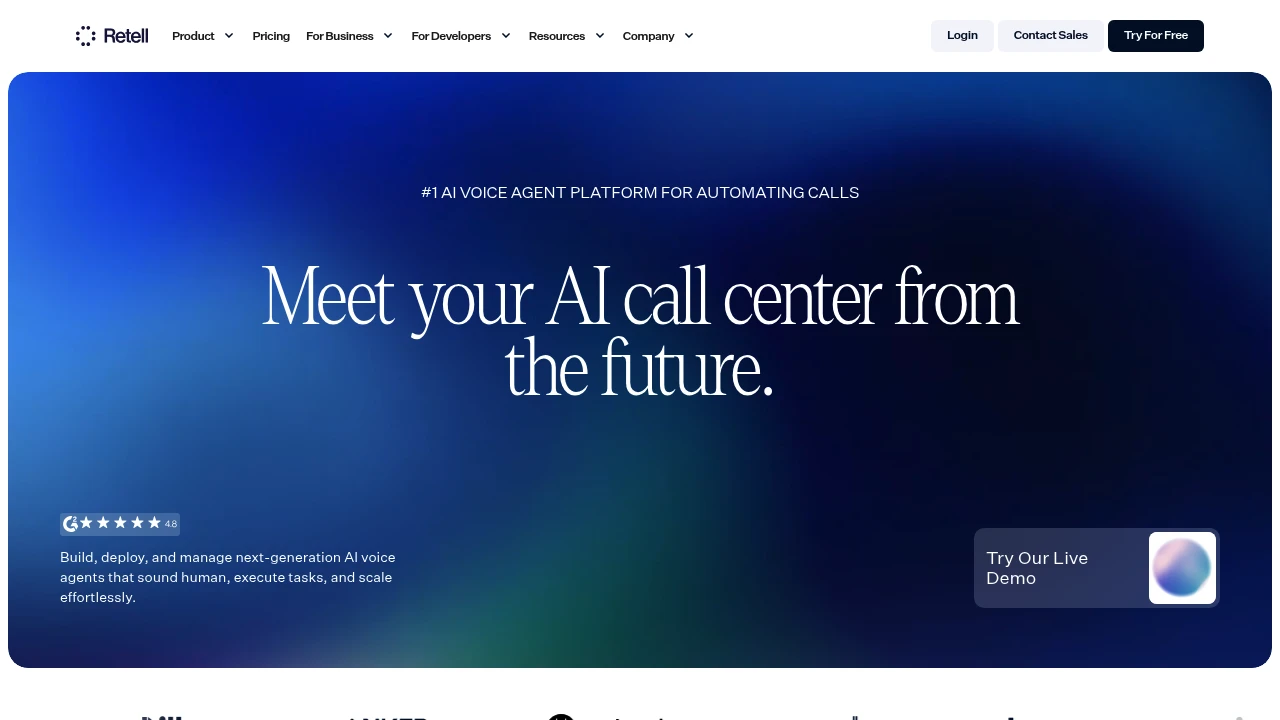
Retell AI is an AI voice agent platform for inbound and outbound call operations. Teams use it to build, deploy, test, and monitor agents that connect to business systems through functions, telephony, and APIs.
Key Highlights
- LLM-based voice agents for natural, multi-turn calls
- Turn-taking and voice orchestration; Retell advertises about 600 ms latency
- Drag-and-drop flows with guardrails, simulation testing, and QA
- Function calling, streaming RAG, SIP trunking, branded caller ID, verified numbers, analytics, webhooks, and API access
What Makes It Different
Retell AI is a production voice stack, not a generic chatbot builder. Its site contrasts it with IVR and IVA systems: instead of touch-tone menus or fixed intent maps, its voice agents use LLMs for multi-turn conversations, edge cases, and outbound calls. The orchestration layer lets agents complete appointments, payments, transfers, or CRM updates during a call.
Features & Capabilities
Teams can start from templates or configure call flows inside Retell AI's agentic framework. Demo use cases include receptionist, appointment setter, lead qualification, customer service, debt collection, and survey agents. Before launch, teams can run simulations, then review calls through analytics, transcripts, dashboards, and QA.
Agents can use custom functions, pull answers from a knowledge base, and work across voice call, chat, SMS, and API channels. Listed integrations include HubSpot, Twilio, Salesforce, Zapier, Avaya, Genesys, Five9, Amazon Connect, Telnyx, Make, and Cal.com.
User Ratings and Testimonials
Retell AI does not publish a third-party average rating. It includes customer quotes from Pine Park Health, SWTCH, and Medical Data Systems, with reported results around scheduling NPS, EV support costs, inbound call handling, transfer rate, and monthly collections.
The main watchout is cost predictability. Per-minute cost changes by LLM, text-to-speech provider, telephony, add-ons, and concurrency, while custom SSO, custom MSA/DPA terms, and 24/7 dedicated portal support sit in the Enterprise Plan.
Pricing & Value
- Pay as you go: starts at $0 with $10 in free credits, then metered usage. Retell advertises headline voice rates of $0.07-$0.31/min, but selected models and add-ons can exceed this range. Phone numbers and extra concurrency can carry monthly charges. AI Chat Agents advertise $0.002+/message. It includes platform access, templates, analytics, transcripts, simulation testing, webhooks, API access, 20 free concurrent calls, and email support.
- Enterprise Plan: custom pricing for AI Voice Agents and AI Chat Agents, with volume pricing, custom MSA/DPA terms, role-based access control, a dedicated stable server available as a paid add-on, custom SSO, higher concurrency, and 24/7 support with a dedicated portal.
Retell AI is strongest for teams that want usage-based voice automation with production telephony, testing, analytics, and enterprise options.
Generate speech and voiceovers with AI voices, cloning tools, and APIs, using credits shared across products.
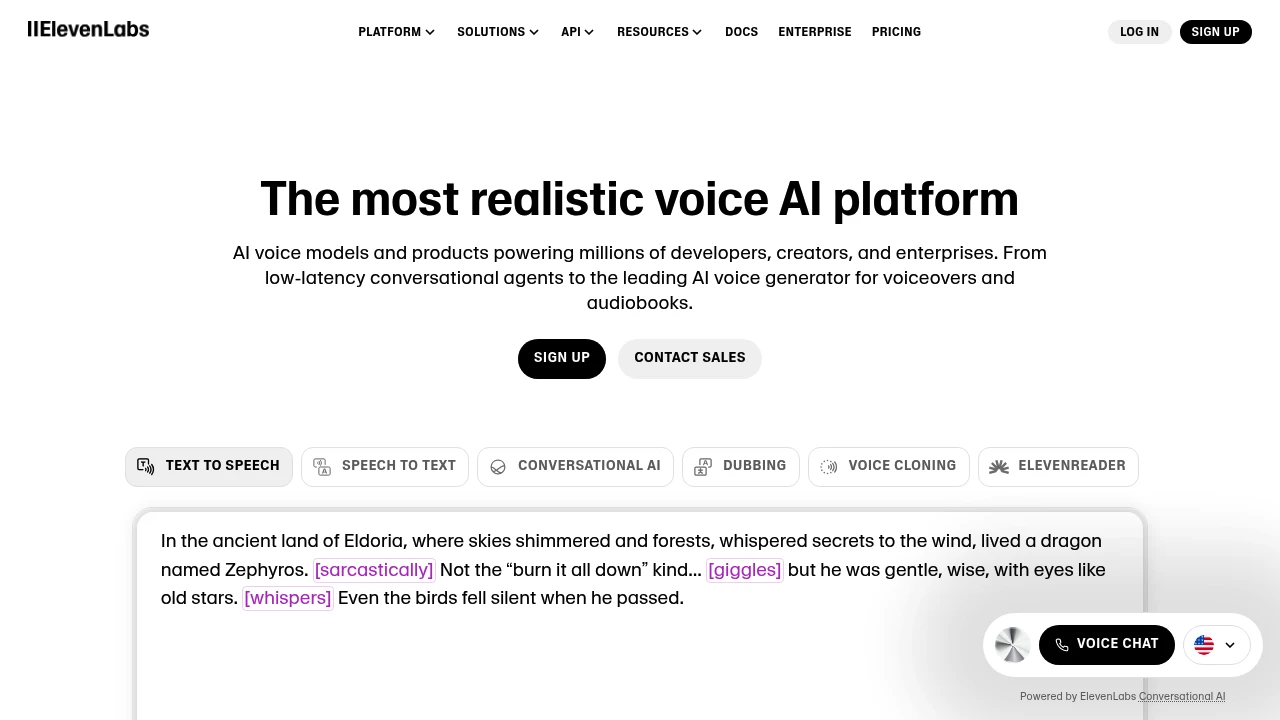
ElevenLabs is an AI-driven text-to-speech (TTS) and voice cloning platform. It creates natural-sounding audio in many languages.
It serves content creators, developers, and businesses that need quality voiceovers. This includes videos, podcasts, audiobooks, and more.
Key Highlights
- Realistic Voices: Generates voices that are highly natural and emotionally expressive.
- Voice Cloning: Instant Voice Cloning requires permission to use the voice. Professional Voice Cloning is limited to your own voice and requires verification.
- Multilingual Support: Supports a wide range of languages and accents.
- Easy-to-Use API: Integrate ElevenLabs' voice generation capabilities into your own applications.
What Makes It Different
ElevenLabs stands out for the exceptional quality and realism of its AI-generated voices. ElevenLabs' voices stand out from other TTS tools. They sound natural, not robotic. They capture the nuances of human speech, like intonation, pacing, and emotion. The platform's voice cloning tech makes it easy to create realistic and unique voiceovers.
Features & Capabilities
ElevenLabs offers a range of features for creating and customizing voiceovers. You can choose from a library of pre-made voices or clone your own. The platform allows you to adjust the voice's stability, clarity, and style to match your needs. It also offers a strong API. This helps developers add voice generation to their apps.
User Ratings and Testimonials
Evaluate voice quality with scripts containing your names, abbreviations, and pronunciation needs. Compare model credit consumption and review generated audio before delivery. A voice that suits one type of narration may not suit another.
Pricing & Value
ElevenLabs offers a free plan with 10,000 monthly credits and feature limits. Starter costs $6/month at the regular monthly rate; introductory promotions have separate terms. They provide more credits, voice cloning, and API access.
Heavy users may care about pricing. But, the quality of voiceovers adds great value for many uses.
Similar proprietary alternatives:

 bisibility — Free beta: Track your website’s keywords, Google rankings, Search Console insights, and share of voice.


