Jasper Alternatives
A curated collection of the 8 best alternatives to Jasper.
The best alternative to Jasper is Rytr. If that doesn't suit you, we've compiled a ranked list of other Jasper alternatives to help you find a suitable replacement. Other interesting alternatives to Jasper are: Writesonic, Copy.ai, Semrush and Surfer SEO.
Jasper alternatives are mainly AI Content Creation tools but may also be AI Marketing Tools tools or AI Agents tools. Browse these if you want a narrower list of alternatives or looking for a specific functionality of Jasper.


Rytr is an AI writing assistant for marketers, freelancers, and small teams that need quick copy in many tones.

Rytr is an AI writing assistant for copywriters, marketers, freelancers, and small teams that need draft content without starting from a blank page. It focuses on marketing copy, SEO text, long-form drafts, personal writing, and professional messages. Pick a use case, choose a tone, and generate copy that can mirror your style.
Key Highlights
- 40+ content use cases and templates for common writing jobs
- 20+ tones on the free plan, with custom tone options on paid plans
- Chrome extension for writing in other web tools
- Built-in plagiarism checks on paid plans
- Premium plan support for 40+ languages
- Free plan with 10k generated characters per month
What Makes It Different
Rytr is built around preset writing jobs instead of an open-ended chat box. The site groups its workflow into automatic editing, long-form content, SEO, creative writing, marketing, personal writing, and professional shortcuts. That suits users who want a fast draft for a known format.
Its tone feature is another focus. Rytr can analyze a writing sample and mirror that tone, while paid plans add personal tones for different projects, clients, or brands.
Features & Capabilities
Choose the content type, select a tone, and generate a draft. Rytr highlights 40+ use cases, 20+ tones on the free plan, and templates for repeat writing tasks.
The Chrome extension brings writing help into other browser-based tools. Paid plans add plagiarism checks, and Premium adds higher input limits, 40+ languages, 5 personal tones of voice, and 100 plagiarism checks per month.
User Ratings and Testimonials
Rytr publishes selected customer testimonials about speed and ease of use. Evaluate a real writing task for factual accuracy, tone, and revision effort rather than treating selected quotes as a prediction of your own result.
Test a representative writing task and review the result for facts, tone, and originality. The free plan caps generation at 10k characters per month; paid plans add plagiarism checks.
Pricing & Value
- Free: $0/month, with 10k characters per month, 40+ use cases, 20+ tones, and the Chrome extension
- Unlimited: $7.50/month under the annual billing option, with unlimited copy generation, 1 personalized tone of voice, and 50 plagiarism checks per month
- Premium: $24.16/month under the annual billing option, with 5 personal tones of voice, increased character input limits, 40+ languages, and 100 plagiarism checks per month
The free plan is useful for testing the workflow, while Unlimited fits frequent writing and Premium fits freelancers managing several brands or languages.
Looking for alternatives to other popular tools? Check out other posts in the alternatives series and flowtools.co, a directory of best AI tools with filters for tags and categories for easy browsing and discovery.

Writesonic helps marketing teams track AI search visibility, fix content and citation gaps, and prove business impact.

Writesonic is an AI search growth and content platform for marketing and SEO teams. It tracks how brands appear in AI answers, ranks the fixes that matter, and runs content, citation, and technical work.
Key Highlights
- Tracks daily AI search visibility, citations, and sentiment
- Starter, Basic, and Growth track ChatGPT, Gemini, and Google AI Overviews; Enterprise covers all 10 AI platforms
- Ranks content gaps, citation opportunities, and technical issues in Action Center
- Creates AI articles, FAQ blocks, comparison tables, and cite-ready passages
- Audits robots.txt, schema, indexing, and AI bot access, with Google Analytics, Google Search Console, Looker Studio, WordPress, APIs, and MCP integrations
What Makes It Different
Many AI visibility tools stop at monitoring. Writesonic also routes fixes through content, outreach, and technical actions. Its site centers the platform on GEO and AEO, backed by an AI Search Dataset of 2 billion+ AI conversations across 10 platforms, 50+ markets, and 50+ languages, updated weekly.
Features & Capabilities
Start by entering a brand, topic, or industry. Writesonic recommends or accepts tracked prompts and runs them across AI platforms. Higher tiers add Brand Explorer, Page Tracker, Prompt Explorer, alerts, ads monitoring, and AI search volume insights.
For execution, it rewrites pages for GEO, adds FAQ blocks and comparison tables, finds off-site mentions on Reddit, YouTube, blogs, and high-DR listicles, and drafts outreach. It measures fixes at Day 14 and Day 28 against citation share, AI traffic, conversions, and pipeline.
User Ratings and Testimonials
The homepage includes a selected customer testimonial from NP Digital about AI search visibility and content work. Treat that as an individual customer example. Test the platform against your own prompts, citations, and conversion measurements. Lower plans have smaller prompt and answer allowances; Enterprise adds broader platform coverage and organization controls.
Pricing & Value
- Starter: $79/month billed annually, ChatGPT, Gemini, and Google AI Overviews, 50 tracked prompts and 50 answers daily, 15 AI articles, 10 audits, 1 user, 1 project, and 10 trial workflow runs
- Basic: $199/month billed annually, ChatGPT, Gemini, and Google AI Overviews, 100 prompts, 300 answers daily, 25 articles, 20 audits, and 2 users
- Growth: $399/month billed annually, sentiment analysis, Action Center trial actions, 200 prompts, 600 answers daily, 50 articles, 50 audits, 3 users, and 2 projects
- Enterprise: Custom pricing, all 10 AI platforms, custom prompts, markets and languages, full Action Center, shopping and agentic commerce, custom users, SSO/SAML, and dedicated support
The site also advertises a 7-day free trial with no credit card.

Copy.ai is a GTM AI platform that runs sales, marketing, and ops content through AI workflows for revenue teams.

Copy.ai is a go-to-market (GTM) AI platform that helps sales, marketing, and operations teams produce content and automate repetitive work. It started as an AI copywriting tool and now centers on AI chat plus reusable workflows that combine research, content generation, and integrations. It targets revenue teams that want one platform for prospecting, content, and lead processing rather than separate point solutions.
Key Highlights
- AI chat with access to OpenAI, Anthropic, and Gemini models
- Reusable workflows that codify processes like account research and SEO articles
- Use cases for prospecting, content creation, inbound lead processing, and ABM
- Translation and localization at native-speaker level
- 2,000+ integrations and a model-agnostic design, with API access on higher tiers
What Makes It Different
Copy.ai positions itself as an "anti-point solution" platform. Instead of stitching together separate AI copilots, it runs everything through one workflow engine that chains research, generation, and integrations into a single repeatable process, unifying GTM data and best practices rather than scattering them across narrow tools.
Features & Capabilities
A workflow is a chain of AI-powered steps that codify a task such as drafting sales outreach, writing an SEO article, or enriching inbound leads. Workflows pull in account and contact research, generate content, and connect to other systems through 2,000+ integrations. The platform is model-agnostic, so teams can use OpenAI, Anthropic, and Google models in one place.
Beyond chat and writing, it covers full GTM use cases: a prospecting cockpit for outreach, account-based marketing assets, and deal coaching from sales transcripts. Workflow runs consume credits that scale with the steps generated.
User Ratings and Testimonials
Copy.ai says it is trusted by 17 million users. Customers cited on its site report concrete results: Lenovo's Roman Olney says automating agency workflows saved $16 million in a year, and a former Juniper Networks CMO reports generating 5x more meetings. The trade-off: the product has shifted from a simple writing tool toward enterprise GTM automation, so its credit-based pricing runs heavier than a basic AI writer.
Pricing & Value
- Free: $0, 2,000 words per month, access to Chat and Infobase, and 200 Workflow Credits for first-time users
- Chat: $29/month ($24/month billed annually), 5 seats, unlimited words in Chat, and access to OpenAI, Anthropic, and Gemini models
- Growth: $1,000/month ($12,000/year), 75 seats and 20,000 Workflow Credits/month
- Expansion: $2,000/month ($24,000/year), 150 seats and 45,000 Workflow Credits/month
- Scale: $3,000/month ($36,000/year), 200 seats and 75,000 Workflow Credits/month
- Enterprise: custom pricing with guided implementation, API access, and a designated support team
The Free and Chat plans let small teams test the writing side, while Growth and above target organizations running credit-based GTM workflows at scale.

Semrush is an SEO and online visibility platform for marketers tracking rankings, competitors, and brand presence in AI search.

Semrush is an SEO and online visibility platform that helps marketers measure and grow how their brand shows up across search. It is built for SEO specialists, agencies, content teams, and PPC managers who need keyword, competitor, backlink, and ranking data in one place. It now extends past classic SEO into AI search, tracking how brands get cited in answers from tools like ChatGPT.
Key Highlights
- Keyword research across 28 billion keywords, according to Semrush
- Backlink analysis across 43 trillion backlinks, according to Semrush
- Site audits and daily position tracking for technical and ranking health
- AI Visibility tools that monitor prompt-level mentions and AI share of voice
- Traffic and competitor analysis for any website or domain
- Content, local SEO, advertising, and social tools in one account
What Makes It Different
Semrush combines traditional SEO data with AI search visibility in a single platform, so you can see both your Google rankings and how often LLMs cite your brand. Semrush lists 808 million domain profiles and 142 geo databases. Compare coverage for the markets you need.
The AI Visibility toolkit is the newer differentiator. It tracks custom prompts, monitors AI sentiment about your brand, and benchmarks your AI market share against competitors as discovery shifts to chat assistants.
Features & Capabilities
The core workflow starts with entering a domain or keyword to pull rankings, traffic estimates, and competitor gaps. From there you can run site audits, track keyword positions daily, dissect a competitor's backlink profile, and find content topics that rank. Higher plans add cannibalization analysis, historical data, and multi-location tracking.
For teams, Semrush pulls Google Analytics and Search Console data into reports, offers API access on its top tier, and includes MCP access for AI workflows. Add-ons cover extra users and white-labeled client reporting.
User Ratings and Testimonials
Evaluate the tools with a domain and keyword set you know. Compare estimated traffic with your own analytics and inspect the data for your target market. Search-volume and competitor estimates provide context for decisions, while your site analytics measure your own actual results. Plan limits affect tracked sites, keywords, and AI prompts.
Pricing & Value
- SEO: $139/month ($117.33/month billed annually) for individuals, with 5 sites, 500 daily tracked keywords, site audits, position tracking, and AI search tracking
- Pro+: $299/month ($248.17/month billed annually), adding 15 sites, 1,500 keywords, historical data, MCP access, and 100 daily AI prompts
- Advanced: $549/month ($455.67/month billed annually), with 40 sites, 5,000 keywords, SEO share of voice, API access, and 200 daily AI prompts
A 7-day free trial lets you test paid features first, and annual billing saves up to 17 percent. Enterprise plans with full LLM coverage are quote-based.

An SEO and AI search optimization platform that helps marketing teams write, audit, and rank content across Google and AI engines.

Surfer SEO is a content optimization platform that turns SERP and AI search data into concrete writing guidelines. It is built for marketing teams, agencies, and SEOs who want content for Google and AI search visibility like ChatGPT, Gemini, and Perplexity. You research a keyword, write in the editor, and Surfer scores your draft against the top-ranking pages.
Key Highlights
- Content Editor with live, competition-based on-page guidelines and a Content Score
- AI visibility tracking that shows whether ChatGPT, Perplexity, Gemini, and Google AI Overviews mention your brand
- SERP Analyzer to compare your page against top competitors
- Surfy, an AI writing assistant, plus an AI detector and Humanizer
- Content Audit, keyword research, topical maps, and cannibalization reports
- Integrations with WordPress, Google Docs, Contentful, and Zapier
What Makes It Different
Surfer's recommendations come from reverse-engineering the pages that already rank, analyzing what the company describes as over 500 web and AI signals rather than fixed keyword density rules. The Content Score gives writers one measurable target.
Its 2026 repositioning adds AI search to that workflow. Beyond Google rankings, Surfer tracks how large language models answer real prompts, flags when a competitor takes a mention, and suggests fixes.
Features & Capabilities
The core loop is diagnose, fix, and monitor. You audit existing content for quick wins, build briefs, then write in the Content Editor where guidelines update as you type. AI visibility tracking watches named prompts across ChatGPT, Perplexity, Google AI Mode, and Gemini, with mention gap and brand sentiment views.
For teams, Surfer adds brand workspaces, custom voices and templates, live collaboration, and ranking drop alerts. Higher plans add 1-click internal linking and API access.
User Ratings and Testimonials
Surfer publishes customer examples and reports 150,000+ customers. These are vendor claims. Evaluate the Content Editor and AI visibility tracking with your content, and compare annual cost, document allowances, and prompt limits with the expected workload.
Pricing & Value
Prices are billed yearly (USD per month). There is no free plan.
- Discovery: $49/month, optimize 120 documents per annual billing cycle, track 10 pages, Surfy and Humanizer
- Standard: $99/month, 360 documents per annual billing cycle, track 25 AI prompts refreshed weekly, 3 seats
- Pro: $182/month, 5 brand workspaces, 50 AI prompts refreshed daily, internal linking
- Peace of Mind: $299/month billed yearly, with unlimited documents subject to the fair usage policy, 100 AI prompts daily, API access
- Enterprise: custom pricing, limits, SSO, white-label options, and dedicated support
Surfer fits teams that publish regularly and want one workflow for Google and AI search visibility. Lighter users may find Discovery enough; agencies tend to pick Pro.

WRITER helps enterprise teams build AI agents, connect knowledge, and manage repeat workflows with governance controls.
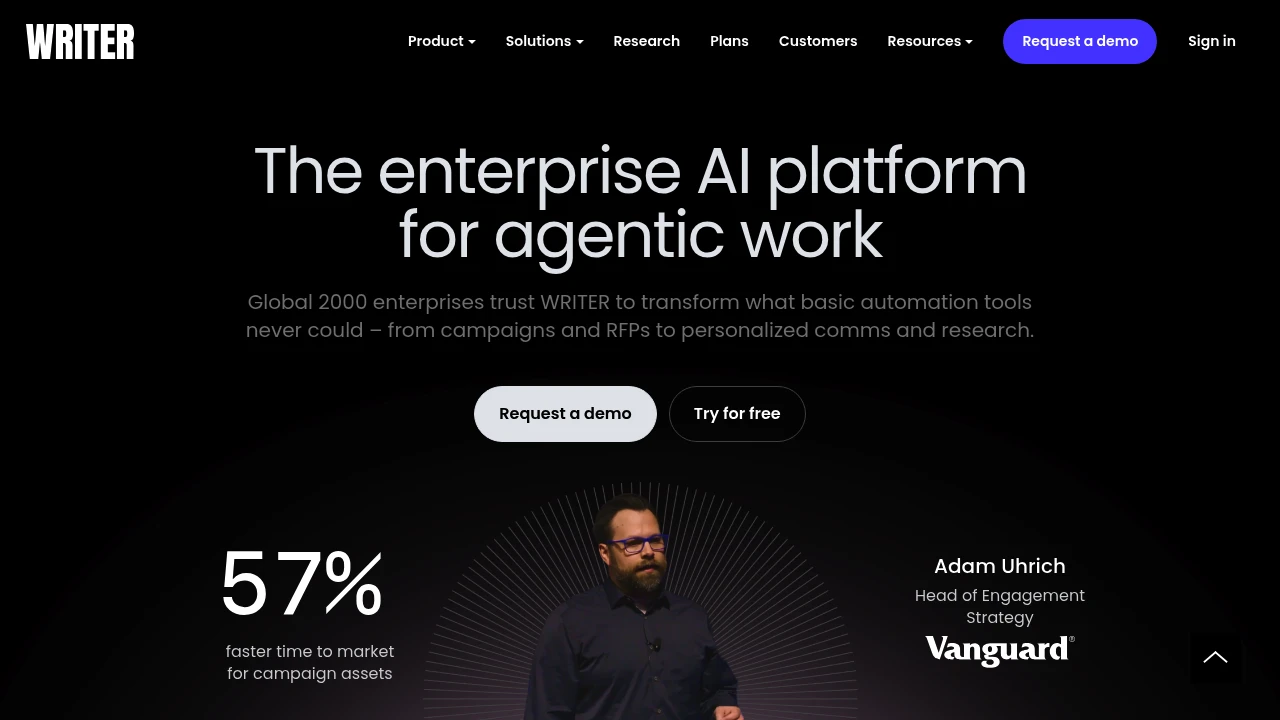
WRITER is an enterprise AI platform for agents, knowledge-grounded workflows, and governance. Teams use its agent interface and playbooks to organize repeat work. Starter provides a smaller workspace for trying the product, while Enterprise adds broader data access and administrative control.
Key Highlights
- WRITER Agent for chat and automation
- Playbooks for repeatable work
- Knowledge Graph for connected information
- Connectors to bring data into workflows
- Enterprise orchestration and governance controls
What Makes It Different
The platform combines an agent interface with workflow and knowledge features. This is useful when an organization wants to manage several repeated tasks rather than distribute isolated prompts. The distinction between Starter and Enterprise affects the number of users, available connectors, and the scope of governance.
Features & Capabilities
Teams can create playbooks, work with connected information, and use canvas editing for outputs. Personality and voice profiles help define how content is written. Review produced work and configure access around the information a task actually needs.
Enterprise adds advanced orchestration, approvals, administrative controls, cross-team workflows, and fuller Knowledge Graph access. Governance, observability, and auditability support operational oversight; they do not remove the need to test a workflow before wider use.
User Ratings and Testimonials
WRITER publishes customer names and enterprise examples. Judge the product with a contained workflow using the information and review process your team expects to use. Compare output accuracy, connector behavior, and approval handling before expanding access across departments.
Pricing & Value
Starter supports up to five users and five playbooks, basic connectors, and limited Knowledge Graph access. It offers a 14-day trial without a credit card. Starter uses per-seat billing and fixed credit limits; Enterprise terms are arranged with sales. Compare the current offer and expected workflow volume before choosing a subscription.
Looking for alternatives to other popular tools? Check out other posts in the alternatives series and flowtools.co, a directory of best AI tools with filters for tags and categories for easy browsing and discovery.

Create marketing copy with brand voice controls, performance scoring, and tools for testing messages.

Anyword is an AI copy platform for marketers writing ads, emails, social posts, and website content. It combines drafting with brand voice settings and predictive performance scores. Teams can use these scores to compare messages before running a campaign.
Key Highlights
- Performance predictions for generated copy
- Brand voice settings and marketing templates
- Blog Wizard with a plagiarism checker
- Content intelligence across marketing channels
- Higher tiers with custom models and campaign data
What Makes It Different
Anyword pairs generation with copy evaluation. Instead of choosing a draft only by how it sounds, a marketer can compare predicted performance and edit the message. A prediction is an estimate, so actual campaign results still need measurement against the audience and channel.
Features & Capabilities
Marketers can create variations from a brief, apply a brand voice, and refine copy in the editor. Templates support common marketing formats, while Blog Wizard helps with longer articles. The Chrome extension provides another way to work with copy.
Data-Driven adds real-time predictions for manual edits. Business plans add historical campaign comparisons and custom models. Prediction allowances, data rows, seats, and brand controls differ by subscription.
User Ratings and Testimonials
Anyword publishes customer examples. Evaluate the scores alongside a real campaign test: a high predicted score does not guarantee conversions. Check whether its templates, editing controls, and data connections match the channels used by your team.
Pricing & Value
- Starter: $49/month or $39/month billed yearly
- Data-Driven: $99/month or $79/month billed yearly
- Business and Enterprise: custom pricing
A seven-day free trial is available. Paid plans differ in performance prediction and data allowances; the trial is distinct from a permanent free subscription.

Contentpen drafts articles with brand-voice controls, SEO and AEO tools, publishing integrations, and visibility tracking.

Contentpen is an AI writing and publishing platform for marketers producing articles. It combines brand-voice controls with SEO and AEO tools and AI visibility tracking. Teams can develop drafts, review the result, and publish through supported website integrations.
Key Highlights
- Draft articles with a defined brand voice
- Research keywords and content gaps
- Use SEO and AEO writing tools
- Track selected AI visibility prompts
- Publish through supported CMS integrations
What Makes It Different
The platform joins article creation with publishing and visibility tools. Brand-voice settings use supplied knowledge and existing content to guide drafts. This gives a team a starting point for repeated writing, but it does not guarantee search rankings or outperforming competitors.
Features & Capabilities
Choose a topic, supply the material needed for the article, and revise the draft. Inspect facts, examples, links, and tone before approving publication. The platform includes internal link suggestions and tools for analyzing content gaps.
Supported publishing connections include WordPress, Webflow, Wix, Shopify, and Ghost. Google Search Console integration brings performance data into the workflow. Plan limits control article volume and the number of AI visibility prompts tracked.
User Ratings and Testimonials
Contentpen displays selected customer testimonials about writing and publishing workflows. These are individual accounts rather than proof of a ranking outcome for every site. Test a few articles against your editorial standards and monitor their performance over time.
Pricing & Value
The monthly offer lists Starter at $49 for 12 articles, Premium at $99 for 40, Scale at $249 for 75, and Agency at $449 for 150. Annual Starter is displayed from $39/month. Paid plans include a 7-day trial. Compare article and visibility allowances before choosing a tier, and keep human review in the publication process.
Similar proprietary alternatives:

 bisibility — Free beta: Track your website’s keywords, Google rankings, Search Console insights, and share of voice.


