Surfer SEO Alternatives
A curated collection of the 4 best alternatives to Surfer SEO.
The best alternative to Surfer SEO is Writesonic. If that doesn't suit you, we've compiled a ranked list of other Surfer SEO alternatives to help you find a suitable replacement. Other interesting alternatives to Surfer SEO are: Semrush, Wellows and Contentpen.
Surfer SEO alternatives are mainly AI Marketing Tools tools but may also be AI Search Visibility & GEO tools or AI Content Creation tools. Browse these if you want a narrower list of alternatives or looking for a specific functionality of Surfer SEO.


Writesonic helps marketing teams track AI search visibility, fix content and citation gaps, and prove business impact.
Writesonic is an AI search growth and content platform for marketing and SEO teams. It tracks how brands appear in AI answers, ranks the fixes that matter, and runs content, citation, and technical work.
Key Highlights
- Tracks daily AI search visibility, citations, and sentiment
- Starter, Basic, and Growth track ChatGPT, Gemini, and Google AI Overviews; Enterprise covers all 10 AI platforms
- Ranks content gaps, citation opportunities, and technical issues in Action Center
- Creates AI articles, FAQ blocks, comparison tables, and cite-ready passages
- Audits robots.txt, schema, indexing, and AI bot access, with Google Analytics, Google Search Console, Looker Studio, WordPress, APIs, and MCP integrations
What Makes It Different
Many AI visibility tools stop at monitoring. Writesonic also routes fixes through content, outreach, and technical actions. Its site centers the platform on GEO and AEO, backed by an AI Search Dataset of 2 billion+ AI conversations across 10 platforms, 50+ markets, and 50+ languages, updated weekly.
Features & Capabilities
Start by entering a brand, topic, or industry. Writesonic recommends or accepts tracked prompts and runs them across AI platforms. Higher tiers add Brand Explorer, Page Tracker, Prompt Explorer, alerts, ads monitoring, and AI search volume insights.
For execution, it rewrites pages for GEO, adds FAQ blocks and comparison tables, finds off-site mentions on Reddit, YouTube, blogs, and high-DR listicles, and drafts outreach. It measures fixes at Day 14 and Day 28 against citation share, AI traffic, conversions, and pipeline.
User Ratings and Testimonials
The homepage includes a selected customer testimonial from NP Digital about AI search visibility and content work. Treat that as an individual customer example. Test the platform against your own prompts, citations, and conversion measurements. Lower plans have smaller prompt and answer allowances; Enterprise adds broader platform coverage and organization controls.
Pricing & Value
- Starter: $79/month billed annually, ChatGPT, Gemini, and Google AI Overviews, 50 tracked prompts and 50 answers daily, 15 AI articles, 10 audits, 1 user, 1 project, and 10 trial workflow runs
- Basic: $199/month billed annually, ChatGPT, Gemini, and Google AI Overviews, 100 prompts, 300 answers daily, 25 articles, 20 audits, and 2 users
- Growth: $399/month billed annually, sentiment analysis, Action Center trial actions, 200 prompts, 600 answers daily, 50 articles, 50 audits, 3 users, and 2 projects
- Enterprise: Custom pricing, all 10 AI platforms, custom prompts, markets and languages, full Action Center, shopping and agentic commerce, custom users, SSO/SAML, and dedicated support
The site also advertises a 7-day free trial with no credit card.
Looking for alternatives to other popular tools? Check out other posts in the alternatives series and flowtools.co, a directory of best AI tools with filters for tags and categories for easy browsing and discovery.

Semrush is an SEO and online visibility platform for marketers tracking rankings, competitors, and brand presence in AI search.
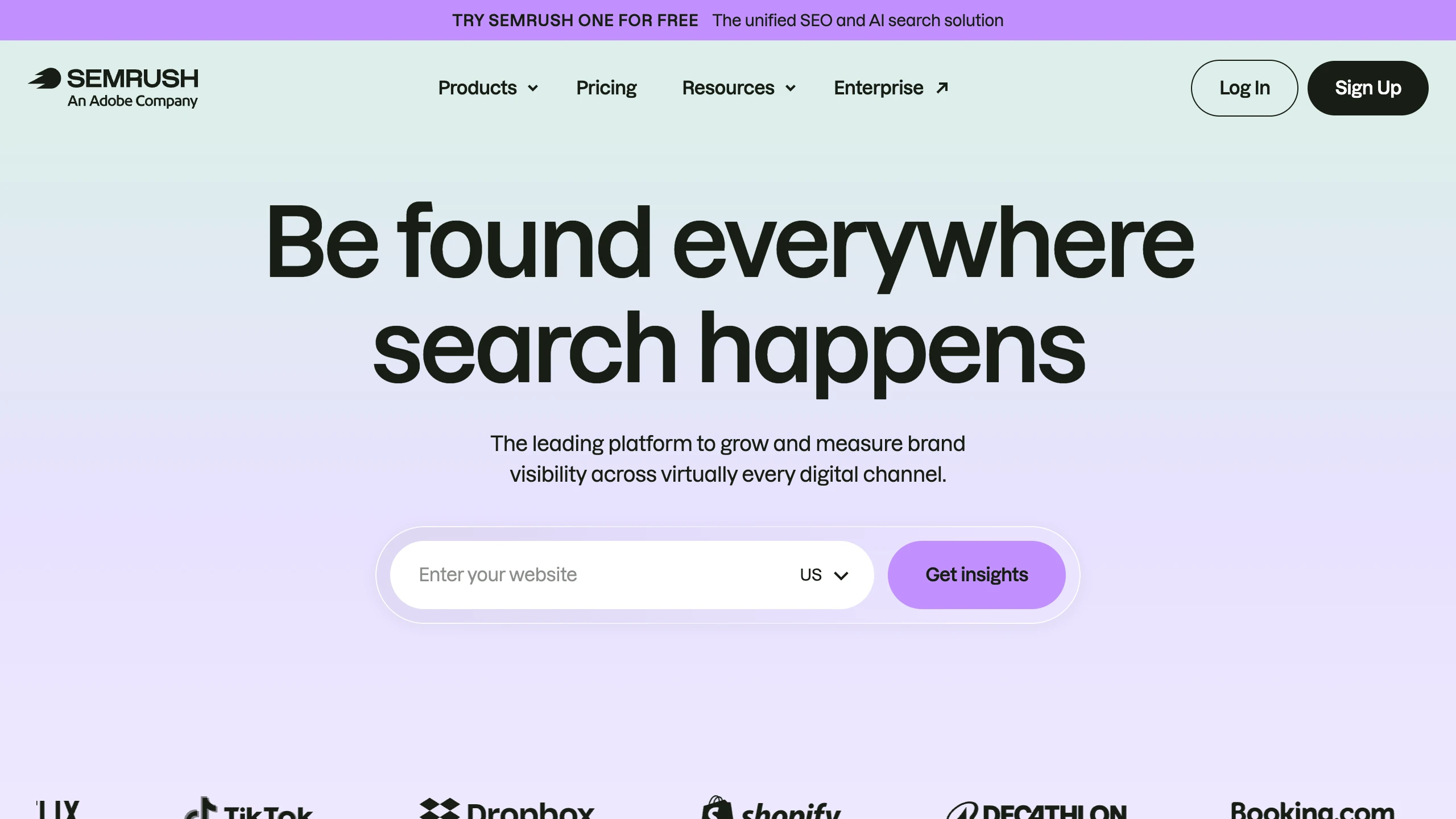
Semrush is an SEO and online visibility platform that helps marketers measure and grow how their brand shows up across search. It is built for SEO specialists, agencies, content teams, and PPC managers who need keyword, competitor, backlink, and ranking data in one place. It now extends past classic SEO into AI search, tracking how brands get cited in answers from tools like ChatGPT.
Key Highlights
- Keyword research across 28 billion keywords, according to Semrush
- Backlink analysis across 43 trillion backlinks, according to Semrush
- Site audits and daily position tracking for technical and ranking health
- AI Visibility tools that monitor prompt-level mentions and AI share of voice
- Traffic and competitor analysis for any website or domain
- Content, local SEO, advertising, and social tools in one account
What Makes It Different
Semrush combines traditional SEO data with AI search visibility in a single platform, so you can see both your Google rankings and how often LLMs cite your brand. Semrush lists 808 million domain profiles and 142 geo databases. Compare coverage for the markets you need.
The AI Visibility toolkit is the newer differentiator. It tracks custom prompts, monitors AI sentiment about your brand, and benchmarks your AI market share against competitors as discovery shifts to chat assistants.
Features & Capabilities
The core workflow starts with entering a domain or keyword to pull rankings, traffic estimates, and competitor gaps. From there you can run site audits, track keyword positions daily, dissect a competitor's backlink profile, and find content topics that rank. Higher plans add cannibalization analysis, historical data, and multi-location tracking.
For teams, Semrush pulls Google Analytics and Search Console data into reports, offers API access on its top tier, and includes MCP access for AI workflows. Add-ons cover extra users and white-labeled client reporting.
User Ratings and Testimonials
Evaluate the tools with a domain and keyword set you know. Compare estimated traffic with your own analytics and inspect the data for your target market. Search-volume and competitor estimates provide context for decisions, while your site analytics measure your own actual results. Plan limits affect tracked sites, keywords, and AI prompts.
Pricing & Value
- SEO: $139/month ($117.33/month billed annually) for individuals, with 5 sites, 500 daily tracked keywords, site audits, position tracking, and AI search tracking
- Pro+: $299/month ($248.17/month billed annually), adding 15 sites, 1,500 keywords, historical data, MCP access, and 100 daily AI prompts
- Advanced: $549/month ($455.67/month billed annually), with 40 sites, 5,000 keywords, SEO share of voice, API access, and 200 daily AI prompts
A 7-day free trial lets you test paid features first, and annual billing saves up to 17 percent. Enterprise plans with full LLM coverage are quote-based.

Monitor brand mentions, citations, competitors, and visibility across selected prompts and AI search engines.
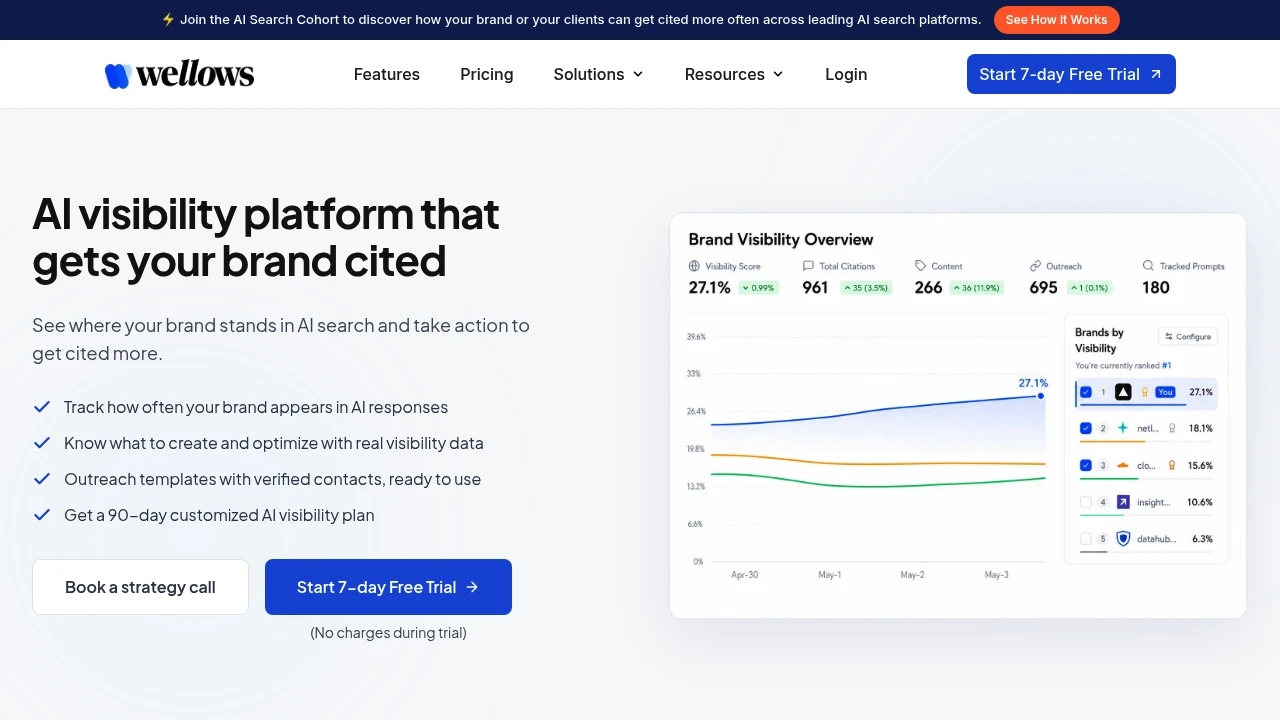
Wellows is an AI search visibility platform for tracking how a brand appears in collected answers and cited sources. Marketing teams can monitor selected prompts across AI engines and inspect mentions, citations, and competitors. It measures observed outputs rather than exposing how a model internally interprets a brand.
Key Highlights
- AI visibility tracking for selected prompts
- Brand mentions and citation information
- Competitor comparisons within monitored answers
- Sentiment and visibility views
- Tools for investigating potential content improvements
What Makes It Different
Wellows focuses on the answer and citation layer of AI search. A team can compare where its brand appears and where competing brands receive attention. The observed sample depends on the prompts and engines being tracked; it is not a complete measure of every possible response an AI service might produce.
Features & Capabilities
Set up the brand and relevant prompts, then review the resulting visibility information. The platform brings mentions, citations, sentiment, and related signals into its reporting workflow. Teams can use those views to choose areas for further investigation.
Recommendations and content workflows can support optimization work. Review the referenced answers and pages before deciding what to change, and compare subsequent observations against the same monitoring scope. Different prompts or engine behavior can produce different results.
User Ratings and Testimonials
Wellows publishes examples of AI visibility work and related outcomes. Such examples concern particular brands and monitoring periods. Evaluate the tool using prompts that matter to your audience, check the cited pages, and track changes over time. No visibility tool can guarantee that an AI engine will cite a particular page.
Pricing & Value
All four self-serve plans include unlimited projects, prompts, and seats, with all five supported AI engines. The shared answer balance sets usage, rather than a hard prompt or seat cap.
- Basic: $29/month, 1,800 answers
- Standard: $97/month, 6,500 answers
- Growth: $249/month, 18,000 answers
- Scale: $497/month, 36,000 answers
One prompt on one engine on one day consumes one answer. Collection pauses when the balance runs out, and unused answers do not roll over. A 7-day trial is offered.

Contentpen drafts articles with brand-voice controls, SEO and AEO tools, publishing integrations, and visibility tracking.
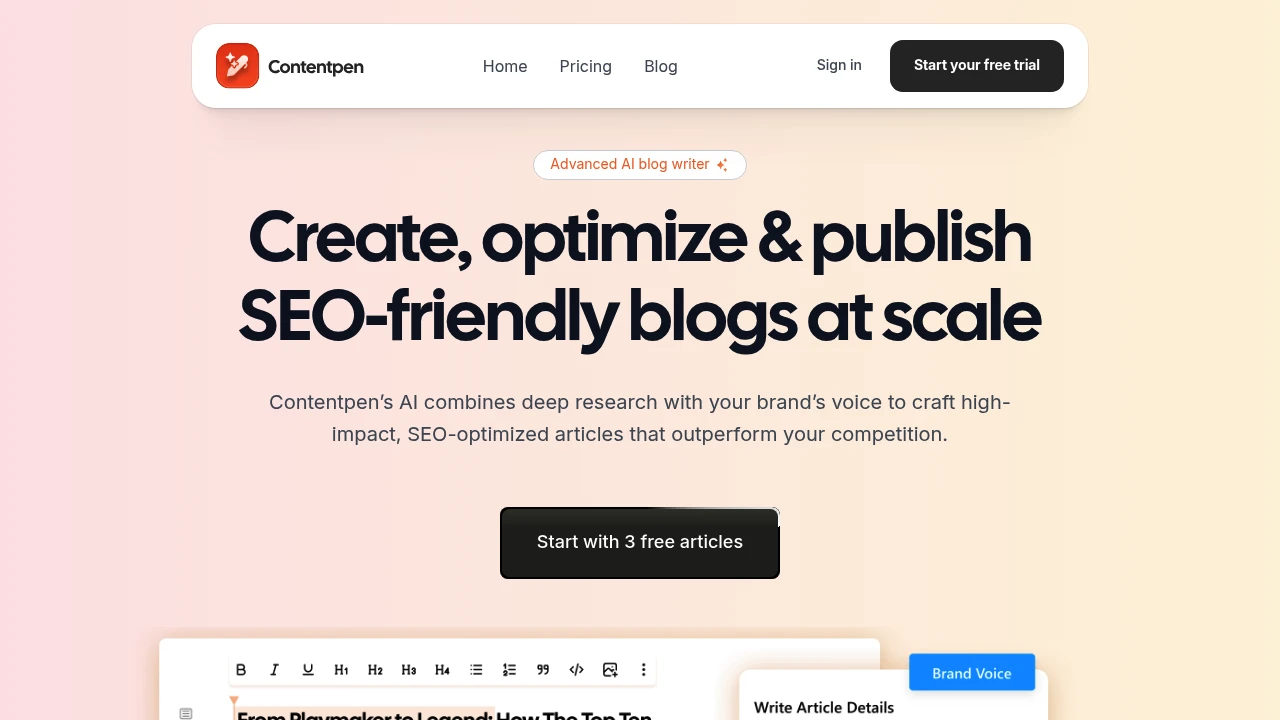
Contentpen is an AI writing and publishing platform for marketers producing articles. It combines brand-voice controls with SEO and AEO tools and AI visibility tracking. Teams can develop drafts, review the result, and publish through supported website integrations.
Key Highlights
- Draft articles with a defined brand voice
- Research keywords and content gaps
- Use SEO and AEO writing tools
- Track selected AI visibility prompts
- Publish through supported CMS integrations
What Makes It Different
The platform joins article creation with publishing and visibility tools. Brand-voice settings use supplied knowledge and existing content to guide drafts. This gives a team a starting point for repeated writing, but it does not guarantee search rankings or outperforming competitors.
Features & Capabilities
Choose a topic, supply the material needed for the article, and revise the draft. Inspect facts, examples, links, and tone before approving publication. The platform includes internal link suggestions and tools for analyzing content gaps.
Supported publishing connections include WordPress, Webflow, Wix, Shopify, and Ghost. Google Search Console integration brings performance data into the workflow. Plan limits control article volume and the number of AI visibility prompts tracked.
User Ratings and Testimonials
Contentpen displays selected customer testimonials about writing and publishing workflows. These are individual accounts rather than proof of a ranking outcome for every site. Test a few articles against your editorial standards and monitor their performance over time.
Pricing & Value
The monthly offer lists Starter at $49 for 12 articles, Premium at $99 for 40, Scale at $249 for 75, and Agency at $449 for 150. Annual Starter is displayed from $39/month. Paid plans include a 7-day trial. Compare article and visibility allowances before choosing a tier, and keep human review in the publication process.
This month’s top products
Ranked by total paid bids this month.
Similar proprietary alternatives:

 bisibility — Free beta: Track your website’s keywords, Google rankings, Search Console insights, and share of voice.


