Consensus Alternatives
A curated collection of the 6 best alternatives to Consensus.
The best alternative to Consensus is Elicit. If that doesn't suit you, we've compiled a ranked list of other Consensus alternatives to help you find a suitable replacement. Other interesting alternatives to Consensus are: Scite, ResearchRabbit, SciSpace and NotebookLM.
Consensus alternatives are mainly AI Research Assistants tools but may also be AI Chats tools or AI Search Engines tools. Browse these if you want a narrower list of alternatives or looking for a specific functionality of Consensus.


Automate time-consuming research tasks like summarizing papers, extracting data, and synthesizing your findings.
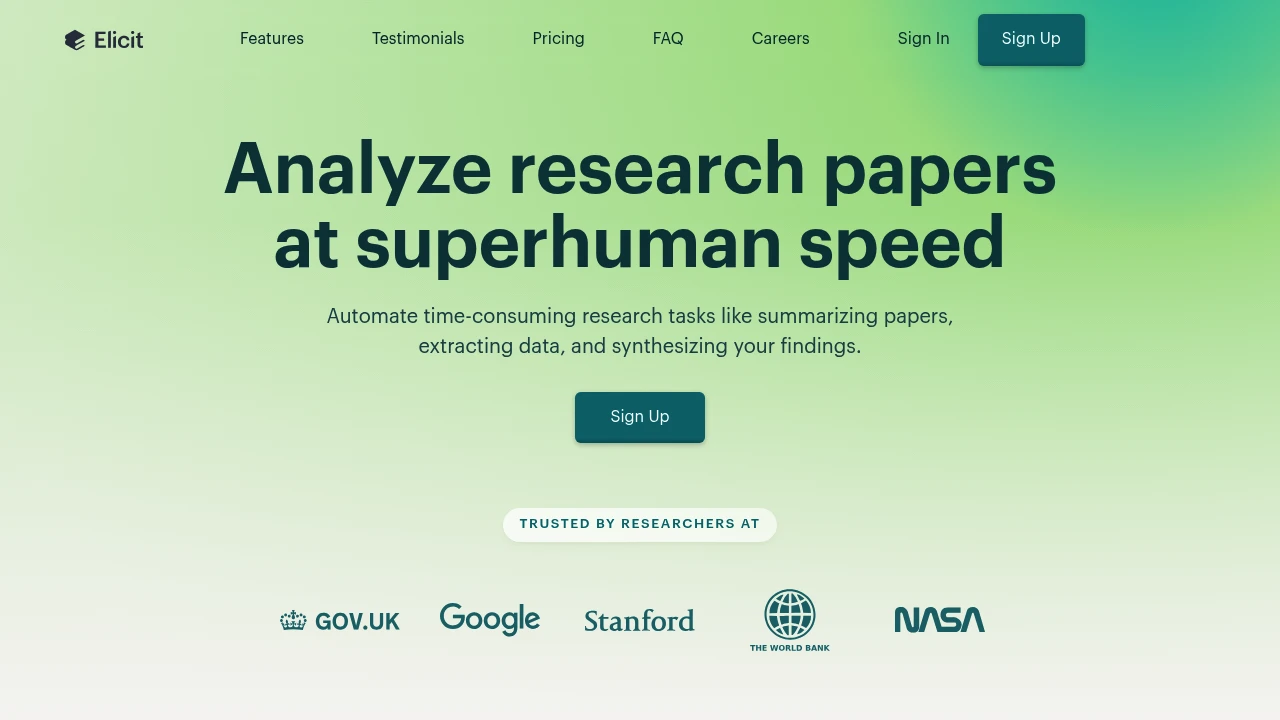
Elicit transforms academic research by using AI to automate literature reviews and extract data from over 125 million research papers.
This research assistant helps academics, researchers, and students quickly find relevant studies and pull key information without manually reading through hundreds of papers. Built for anyone who needs to process large amounts of academic literature efficiently.
Key Highlights
- Access to 125+ million academic papers and research studies
- Automated data extraction saves hours of manual work
- AI-powered search finds relevant papers quickly
- Systematic review workflows for comprehensive research
- Clinical trials database for medical research
- Real-time collaboration features for research teams
- Free tier available with core functionality
What Makes It Different
Elicit focuses specifically on academic research rather than general AI assistance. It understands research methodology and can extract structured data from papers automatically. The tool connects directly to academic databases and uses AI trained on scientific literature to provide more accurate results than general search engines.
Features & Capabilities
The platform offers automated research report generation that summarizes findings across multiple papers. Users can search through academic databases using natural language queries and get relevant results ranked by relevance.
The data extraction feature pulls specific information like study methods, sample sizes, and key findings into structured tables. Research teams can collaborate in real-time and set up alerts for new papers in their field. The systematic review workflow guides users through the complete research process from search to analysis.
Pricing & Value
Elicit offers several pricing plans:
- Basic: Free with automated research reports, unlimited search across 125+ million papers, and data extraction from 20 papers per month
- Plus: $12/month with chat and summaries for 8 papers at once, clinical trials search, and data extraction from 50 papers per month
- Pro: $49/month with systematic review workflows, 10 research alerts, and data extraction from 200 papers per month
- Team: $79 per user per month with live collaboration, admin panel, and pooled usage limits across team members
- Enterprise: Custom pricing with volume discounts, training, and custom workflow development
The Basic plan is completely free with no trial limitations, making it accessible for casual research needs. The main value of Elicit is its ability to automate literature reviews and extract data from academic papers at scale.
Looking for alternatives to other popular tools? Check out other posts in the alternatives series and flowtools.co, a directory of best AI tools with filters for tags and categories for easy browsing and discovery.

Discover facts, figures, and relevant research from the world's largest collection of full-text scholarly content.
Scite transforms how researchers verify claims and track citations using AI-powered analysis. This research assistant helps academics, scientists, and professionals find supporting evidence for their work through smart citation tracking. It's built for anyone who needs reliable, fact-checked research insights.
Key Highlights
- AI-powered citation analysis and verification
- Full-text search across academic papers
- Contextual citation reports
- Smart claim verification
- Research assistant capabilities
- Annual billing saves 40%
What Makes It Different
Scite goes beyond basic citation counting. It analyzes how papers cite each other and whether citations support or contradict claims. This context-aware approach helps researchers understand the real impact and reliability of scientific findings.
Features & Capabilities
The platform offers comprehensive research tools including an AI assistant for research queries, full-text search across academic databases, and detailed citation reports. Users can verify scientific claims, track how research evolves over time, and identify supporting or contradicting evidence. The system works across multiple disciplines and integrates with existing research workflows.
Pricing & Value
Scite offers several pricing plans:
- Personal: $20/month with Scite Assistant, full-text search, and contextual citation reports
- Organization: Custom pricing with upgraded AI models, expanded assistant capabilities, and shared dashboards
Save 40% when paid annually.

ResearchRabbit helps researchers find related papers, map citations, and organize literature reviews.
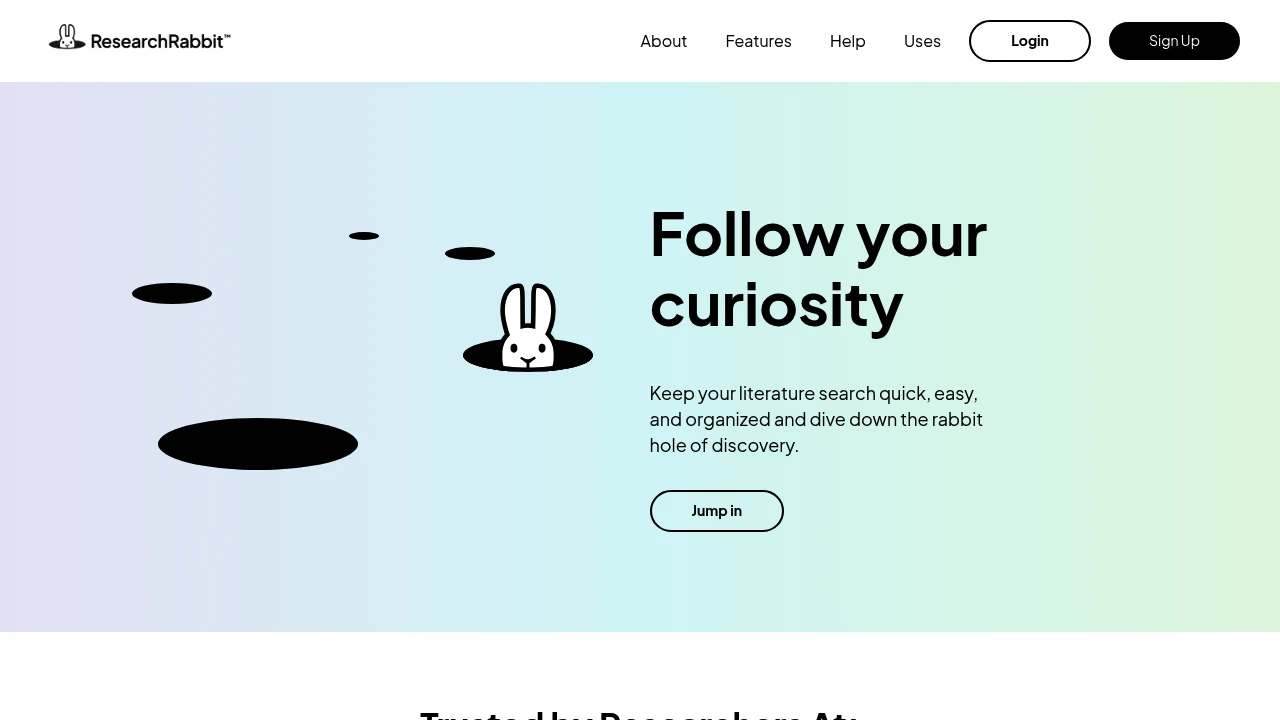
ResearchRabbit is an AI research assistant for academic literature discovery. It helps students, researchers, and research groups start from one paper, find related work, follow authors, and keep review collections organized.
Key Highlights
- Start from one paper and expand into related works, authors, and topics
- Visualizations show how papers, authors, and topics connect
- Collections keep papers, notes, and ideas organized
- Free Forever plan includes unlimited searches, collections, and sharing
- ResearchRabbit+ adds higher seed limits, advanced controls, projects, and faster support
What Makes It Different
ResearchRabbit is built around discovery paths, not only keyword search. You begin with a paper, then branch into connected articles, authors, and topics as the map grows. That helps when a literature review is still forming and you need to see clusters instead of checking a static list one result at a time.
Features & Capabilities
The main workflow is collection-based. You gather papers, add related works and authors, keep notes with your materials, and use visual maps to understand the field. ResearchRabbit says its index covers more than 280 million academic articles on the pricing page.
For collaboration, the free tier includes shared collections. Larger projects can move to ResearchRabbit+ for up to 300 seed articles, advanced search controls, multiple projects, and faster support. Institutions can contact the company for LibKey integration, user management, usage statistics, and dedicated support.
User Ratings and Testimonials
No public average rating is listed in the local sources. The homepage includes researcher testimonials that praise citation maps, visual sorting by year, Zotero-connected workflows, and clear paper clusters.
The main limitation is also clear from pricing: the free plan uses up to 50 seed articles and core search settings. Large-scale reviews, multiple projects, and advanced controls sit behind ResearchRabbit+.
Pricing & Value
- Free: $0 forever, with unlimited searches across 280+ million articles, unlimited libraries and collections, sharing, up to 50 seed articles, and core search settings
- ResearchRabbit+: $10/month default U.S. pricing, with country-based discounts in 100+ countries, up to 300 seed articles, advanced controls, projects, and faster support
- Institution: Contact sales, with volume discounts, LibKey integration, user management, usage statistics, and dedicated support
The free plan is enough for focused literature reviews, while ResearchRabbit+ is aimed at researchers handling larger discovery projects.

SciSpace helps academics review literature, chat with PDFs, paraphrase text, and write papers with cited sources.
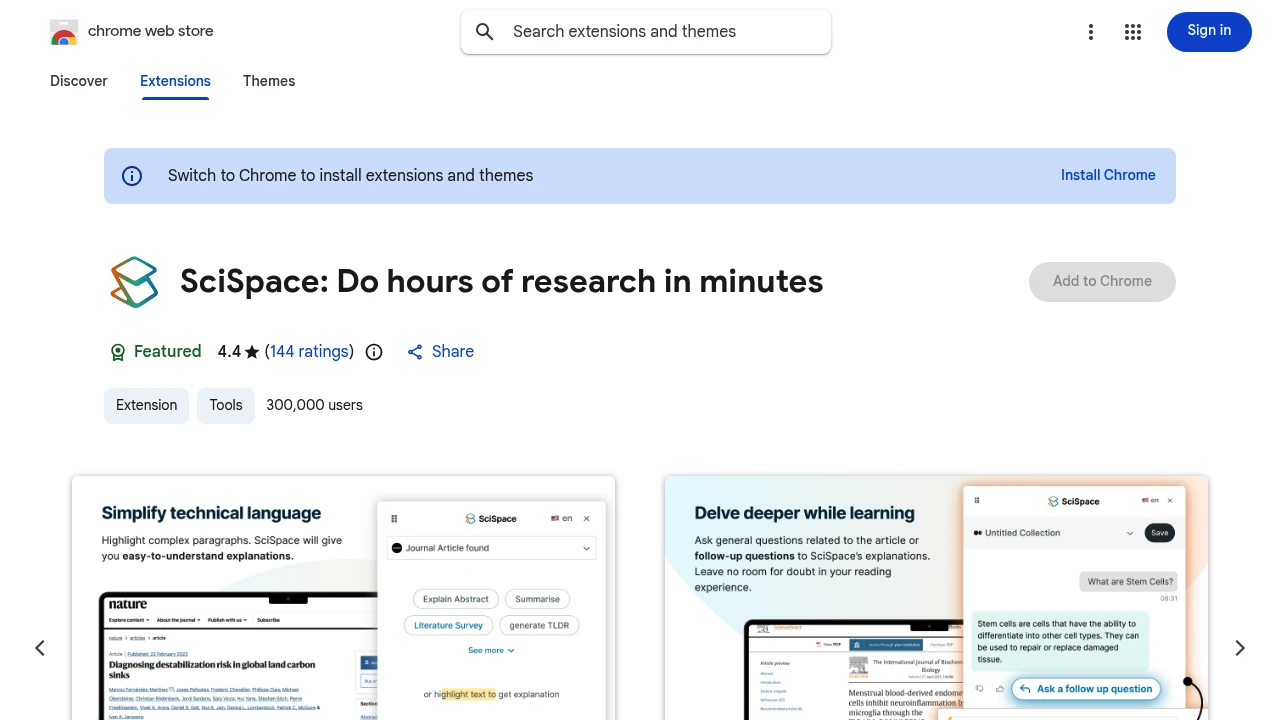
SciSpace is an AI research workspace for students, PhDs, and researchers who need to find, read, and write from academic sources. It combines literature review, PDF chat, paraphrasing, citation generation, and paper drafting in one web app, with results tied back to cited sources.
Key Highlights
- Search a large academic paper library for literature review work
- Chat with PDFs and ask questions about research papers
- Draft papers, diagrams, presentations, and cited research outputs
- Use paraphrasing, AI detection, and citation generation tools
- Paid plans add credits, stronger models, and more parallel queries
What Makes It Different
SciSpace is not just a general chatbot pointed at academic work. Its site positions the product as a research agent for citation-backed results, with specific workflows for paper search, literature review, PDF analysis, writing, diagrams, and presentations. That matters when the user needs a clear path from question to source.
Features & Capabilities
The main workflow starts with a research question or paper. You can search papers, run a literature review, chat with PDFs, and turn findings into drafts, citations, diagrams, or presentations.
The pricing FAQ lists Literature Review, Chat with PDF, Paraphraser, AI Detector, and Citation Generator as platform tools. Paid plans increase monthly agent credits, model access, and parallel agent queries.
User Ratings and Testimonials
SciSpace says it is trusted by more than 1M students, PhDs, and researchers. SciSpace includes testimonials, but does not publish a third-party rating or full review quote. The visible caveat is that serious use is credit-based, and published paid prices are annual billing rates.
Pricing & Value
- Premium: $12/month billed annually, with 1,200 monthly credits, unlimited Literature Review search, Pro Model Access, 4 parallel agent queries, unlimited exports, and Biomedical Agent Access
- Advanced: $70/month billed annually, with 10,000 monthly credits, everything in Premium, Expert Model Access, and 8 parallel agent queries
- Max: $160/month billed annually, with 40,000 monthly credits, everything in Advanced, priority support, 16 parallel agent queries, and priority access to new features
- Enterprise: custom pricing, with Advanced features plus admin-managed access, shared credit pools, SSO/SCIM, consolidated billing, dedicated support, and customizable integrations and limits
The pricing page says users can cancel anytime and that all plans have a 24-hour money-back guarantee. SciSpace offers free signup, but does not list detailed free-plan limits.

NotebookLM grounds answers in your own sources (PDFs, docs, sites, and videos) and turns them into summaries, mind maps, and Audio Overviews.
NotebookLM is Google's AI research tool and thinking partner that works only from sources you give it. It is built for students, researchers, and professionals who want grounded, citable answers about their own material rather than the open web. You upload documents and media, and NotebookLM becomes an expert on exactly that content, powered by Google's Gemini models.
Key Highlights
- Grounds every answer in your uploaded sources, with citations
- Accepts PDFs, Google Docs/Slides, websites, YouTube videos, and audio
- Audio Overviews that turn your sources into a podcast-style discussion
- Mind maps and summaries that surface connections across documents
- Notebooks you can organize and share
- Built on the latest Gemini multimodal models
What Makes It Different
Unlike a general chatbot, NotebookLM is deliberately constrained to your sources, which dramatically reduces hallucination and makes answers traceable back to the original text. The Audio Overview feature, a surprisingly natural two-host conversation about your material, has no real equivalent elsewhere.
Features & Capabilities
You create a notebook, upload sources, and then ask questions, request summaries, or generate study guides, and each response cites the passages it used. Mind maps help you see how ideas across documents relate.
Audio Overviews convert a notebook into a listenable discussion, and you can steer or interact with them, which is useful for reviewing material hands-free.
User Ratings and Testimonials
Users praise NotebookLM for trustworthy, source-grounded answers and for the genuinely useful Audio Overviews. Criticisms include source and length limits on the free tier and that, by design, it will not answer beyond what you upload.
Pricing & Value
- Free: full core features with standard source and notebook limits
- NotebookLM Plus: higher limits and sharing, included with Google AI Premium and eligible Google Workspace plans
For most people the free tier is remarkably capable, making NotebookLM one of the best-value research tools available.
Perplexity is a tool. A direct line to the world’s knowledge - compressed, cited, and made clear
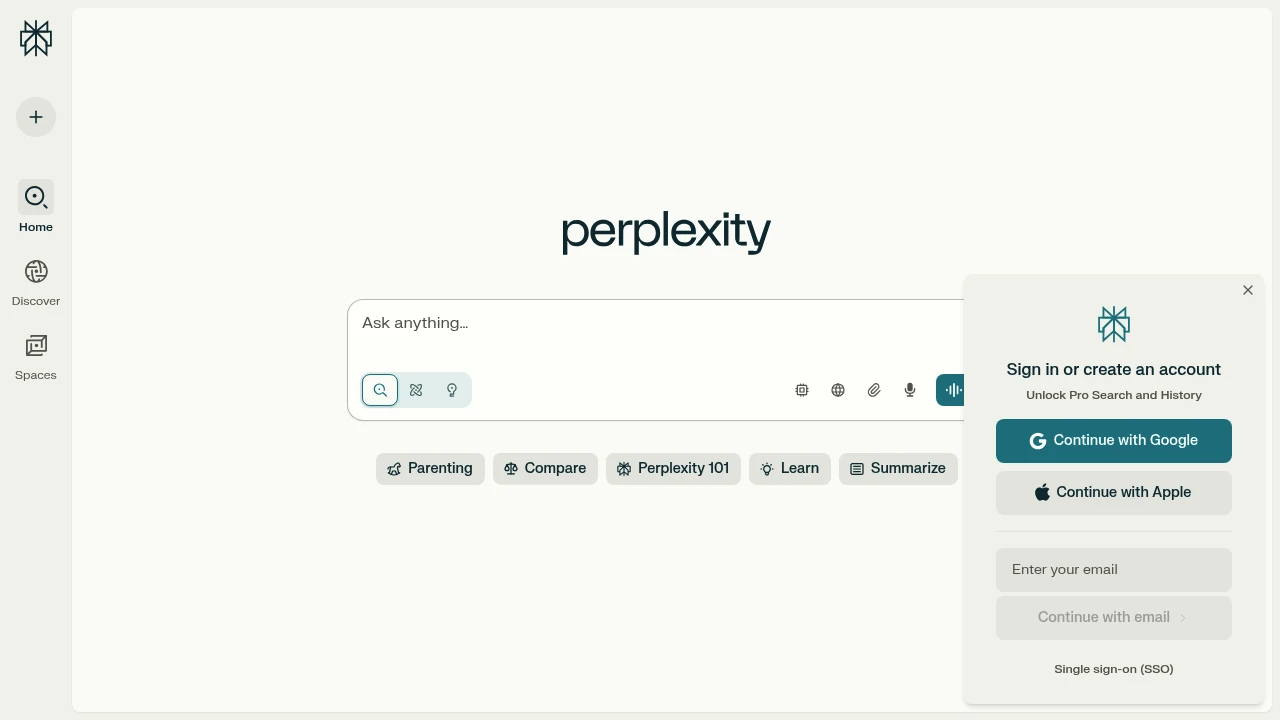
Perplexity combines the power of AI with real-time web search to give you accurate, cited responses. It's built for researchers, professionals, and anyone who needs reliable information fast.
Key Highlights
- Cited sources - Every answer comes with references you can verify
- Real-time information - Access current data, not outdated training material
- Multiple AI models - Switch between different AI engines for varied perspectives
- File analysis - Upload and analyze documents, images, and data
- Simple interface - Clean design that gets straight to the point
What Makes It Different
Perplexity stands apart by combining search with AI reasoning. While other AI tools give you answers from training data, Perplexity searches the web first, then uses AI to synthesize current information.
The citation system lets you fact-check every claim, making it more trustworthy than standard chatbots.
Features & Capabilities
Core Search Functions:
- AI-powered web search with source citations
- Real-time information retrieval
- Multi-model AI access (GPT-4, Claude, others)
- Follow-up question capabilities
File & Media Support:
- Document upload and analysis
- Image processing and generation
- Data visualization tools
- File repository for teams
Research Tools:
- Academic paper search
- News and current events tracking
- Technical documentation lookup
- Market research capabilities
User Ratings and Testimonials
Perplexity has an average rating of 4.7 out of 5 stars from 51 reviews on G2.
Users praise the cited sources that come with every answer. They find it easy to verify information and check where data comes from. The platform saves time by giving direct answers instead of making users search through multiple websites. Many appreciate switching between different AI models and accessing real-time information.
Some users note that follow-up questions can be less accurate. Others mention responses are sometimes too short or the tool gets confused when updating questions. A few find the authentication process annoying and want better team collaboration features.
Pricing & Value
Perplexity offers several pricing plans:
- Free (Standard): Includes 5 Pro searches per day, unlimited basic searches, and 3 file attachments daily with limited file uploads.
- Pro: $20/month for unlimited Pro searches, access to advanced AI models, and unlimited file uploads with image generation.
- Enterprise Pro: $40/month per seat with all Pro features plus organization-wide file repository, seat management, and dedicated support.
- Max: $200/month for unlimited access to advanced AI models, unlimited Labs queries, and early access to new products like Comet browser.
- Sonar API: Pay-as-you-go pricing for developers integrating Perplexity into their own products.
The Free plan offers a good starting point for light users to test the platform.
The main value of Perplexity is its ability to provide AI-powered search with real-time information and advanced reasoning capabilities for research and productivity tasks.
Similar proprietary alternatives:

 bisibility — Free beta: Track your website’s keywords, Google rankings, Search Console insights, and share of voice.


