GPTZero Alternatives
A curated collection of the 5 best alternatives to GPTZero.
The best alternative to GPTZero is Copyleaks. If that doesn't suit you, we've compiled a ranked list of other GPTZero alternatives to help you find a suitable replacement. Other interesting alternatives to GPTZero are: Pangram Labs, ZeroGPT, Winston AI and Originality.ai.
GPTZero alternatives are mainly AI Content Detection tools but may also be AI Writing Assistants tools. Browse these if you want a narrower list of alternatives or looking for a specific functionality of GPTZero.


Copyleaks helps enterprises and schools detect AI-generated content, plagiarism, and unauthorized content reuse.

Copyleaks is a content integrity platform for enterprises, publishers, developers, and schools. It checks text, code, images, audio, and video for AI generation, plagiarism, unauthorized reuse, and compliance risks. It fits teams that need detection inside existing workflows.
Key Highlights
- AI text detection across 30+ languages and major models including ChatGPT, Gemini, DeepSeek, and Claude
- Plagiarism checks in 100+ languages across web, journal, document, and code sources
- Combined AI and plagiarism reports for text scans with AI Logic
- API Integration, LMS integrations, browser extensions, and Google Docs add-on
- Enterprise controls for private cloud, regional hosting, roles, policies, and analytics
What Makes It Different
Copyleaks is positioned as a unified detection system, not just a web AI checker. The same platform covers text, code, images, audio, and video, with use cases for IP compliance, academic integrity, GenAI governance, code plagiarism, AI model training, and unauthorized LLM usage.
Features & Capabilities
Users can upload multiple files, save scans, scan inside Google Docs, and use the Shared Data Hub, a secure library of user-submitted documents for matching. Image detection reports AI presence, while text scans can include both AI and plagiarism checks.
The plagiarism layer cites 60T+ websites and search engines, 16,000+ open-access journals, 1M+ internal documents, and 20+ code repositories. Pro adds advanced filters, sitemap-based website scanning, cross-language translation detection, analytics, and up to 25 included seats.
User Ratings and Testimonials
The sources do not include a public star rating. Copyleaks cites over 99% AI detection accuracy from internal English-language datasets and lists PCI DSS, SOC 2, SOC 3, and GDPR certifications. A Moodle US testimonial says the product helps instructors detect AI-generated student work; the accuracy claim is still vendor-sourced.
Pricing & Value
- Free tools: $0, AI-powered tools for individuals
- Personal: $16.99/month, or $13.99/month billed annually, with AI and plagiarism detection, browser extensions, Google Docs add-on, and 100 monthly unified credits
- Pro: $99.99/month, or $74.99/month billed annually, with 25 seats, advanced filters, website scanning, cross-language translation detection, analytics, and 1,000 monthly unified credits
- Enterprise: Custom pricing, with API integration, organization-wide policies, analytics, role-based access, hosting options, and customer success
- Education: Custom pricing based on full-time students, with AI and plagiarism detection, grammar check, LMS integrations, analytics, onboarding, and private cloud options
One unified credit covers up to 250 words or 1 image.
Looking for alternatives to other popular tools? Check out other posts in the alternatives series and flowtools.co, a directory of best AI tools with filters for tags and categories for easy browsing and discovery.

Pangram Labs checks text for AI writing, AI assistance, and plagiarism for educators, publishers, and teams.

Pangram Labs is an AI-text detector and plagiarism checker for essays, articles, user posts, and documents. It helps educators, publishers, legal, HR, and enterprise teams check for AI-generated writing, AI assistance, and copied text in one workflow.
Key Highlights
- Detects AI writing from ChatGPT, Claude, Gemini, Llama, Grok, Mistral, and other major models
- Highlights AI-assisted text and adds plagiarism detection on paid scans
- Supports file upload, OCR, PDF, DOCX, RTF, and up to 100 files at a time
- Offers Chrome, Google Docs, LMS integrations, API credits, and 20+ language support
What Makes It Different
Pangram says it uses a proprietary classifier trained on large human and AI writing datasets, with hard negative mining, active learning, and retraining as new models appear. It also says it does not rely on perplexity or burstiness alone, which can flag simple human writing.
The company cites third-party verification from the University of Chicago and the University of Maryland. Pangram reports 99.7% accuracy on its tested AI-generated samples; benchmark results depend on the sample set so scores should be interpreted with the benchmark and human review.
Features & Capabilities
Paste text or upload files, run the scan, then review scores, highlighted segments, and history. Pangram can mark text as human, AI-generated, or AI-assisted, including drafts edited by Grammarly, QuillBot, or an LLM.
For schools and organizations, Pangram connects to Canvas, Brightspace, Moodle, Google Classroom, Google Docs, and Chrome. Developers can buy API credits, while institutions can use LMS integrations with usage trends, plagiarism checks, and data controls.
User Ratings and Testimonials
Pangram's homepage includes testimonials from educators, Wiki Education, LessWrong, and Qwoted that praise low false positives. One educator says a Pangram flag should start a conversation, not act as automatic proof of misconduct.
Pricing & Value
- Free: $0, up to 2,000 words per day, AI assistance detection, file upload, OCR, Chrome, and Google Docs
- Individual: $20/month, up to 300,000 words per month, a 7-day free trial, plagiarism checks, and automatic scans
- Professional: $65/month, up to 1,500,000 words per month, plus $200 of monthly API credits, plagiarism checks, and automatic scans
- Educational Institution and Enterprise: custom pricing for LMS deployment, unlimited checks or high-volume processing, compliance, and support
The free plan is enough to test daily checks, while paid plans add scan volume and plagiarism features for classrooms, publishers, and teams.

ZeroGPT detects AI-written text for educators, writers, and teams, with sentence highlights, reports, and API access.

ZeroGPT is an AI content detector for text that may come from ChatGPT, GPT-5, Gemini, Grok, DeepSeek, Claude, or other LLMs. It is built for educators, writers, and teams that need a fast AI-writing signal before review.
Key Highlights
- Highlights sentences marked as AI and shows an AI percentage gauge
- Supports pasted text, file upload, paid batch checks, and PDF reports
- Includes plagiarism, paraphrasing, summarizing, grammar, translation, and word-count tools
- Offers API access for detection, plagiarism, text transformation, grammar, chatbot, and translation
- Works on the web, with WhatsApp and Telegram after dashboard setup
What Makes It Different
ZeroGPT centers its pitch on DeepAnalyse Technology, a multi-stage model that analyzes text at different levels to estimate whether it was written by AI. The site says the model is trained on internet text, educational datasets, and proprietary synthetic AI datasets.
The product is broader than a single checker. It combines AI detection, plagiarism checking, AI humanizing, paraphrasing, summarizing, grammar correction, translation, email generation, and ZeroCHAT.
Features & Capabilities
The main detector accepts pasted text or uploaded files. The comparison table lists up to 15,000 characters per AI detection on Free, while paid tiers raise that limit to 100,000, 150,000, or 350,000 characters. Paid plans also add batch files, detection history without saved text, and PDF reports.
For organizations, ZeroGPT provides pay-as-you-go API plans. The API covers document, paragraph, and sentence-level AI detection, batched file checks, plagiarism detection, paraphrasing, summarizing, grammar, translation, and chatbot access.
User Ratings and Testimonials
ZeroGPT does not publish a third-party average rating or named customer testimonials. The site says millions of users trust the detector and says the model is designed to minimize false positives and false negatives, but those are vendor claims.
Pricing & Value
- Free: $0 forever, no credit card needed, with 15,000 characters per AI detection and no batch files
- Pro: $7.99/month when billed yearly ($95.88/year), with 100,000 characters per detection, 50 batch files, PDF reports, and detection history
- Plus: $14.99/month when billed yearly ($179.88/year), with 100,000 characters per detection, 60 batch files, and 35,000 plagiarism words per month
- Max: $18.99/month when billed yearly ($227.88/year), with 150,000 characters per detection, 75 batch files, larger writing limits, and ZeroCHAT-5 prompts
- Enterprise and API: Enterprise is a custom quote. API detection starts at $0.034 per 1,000 words on the Beginner pay-as-you-go plan
The free plan is enough for quick checks, while paid plans add larger limits, batch processing, PDF reports, and more allowance for the bundled writing tools.

Assess text and images with AI detection, plagiarism tools, OCR, and reports, then review scores with other evidence.
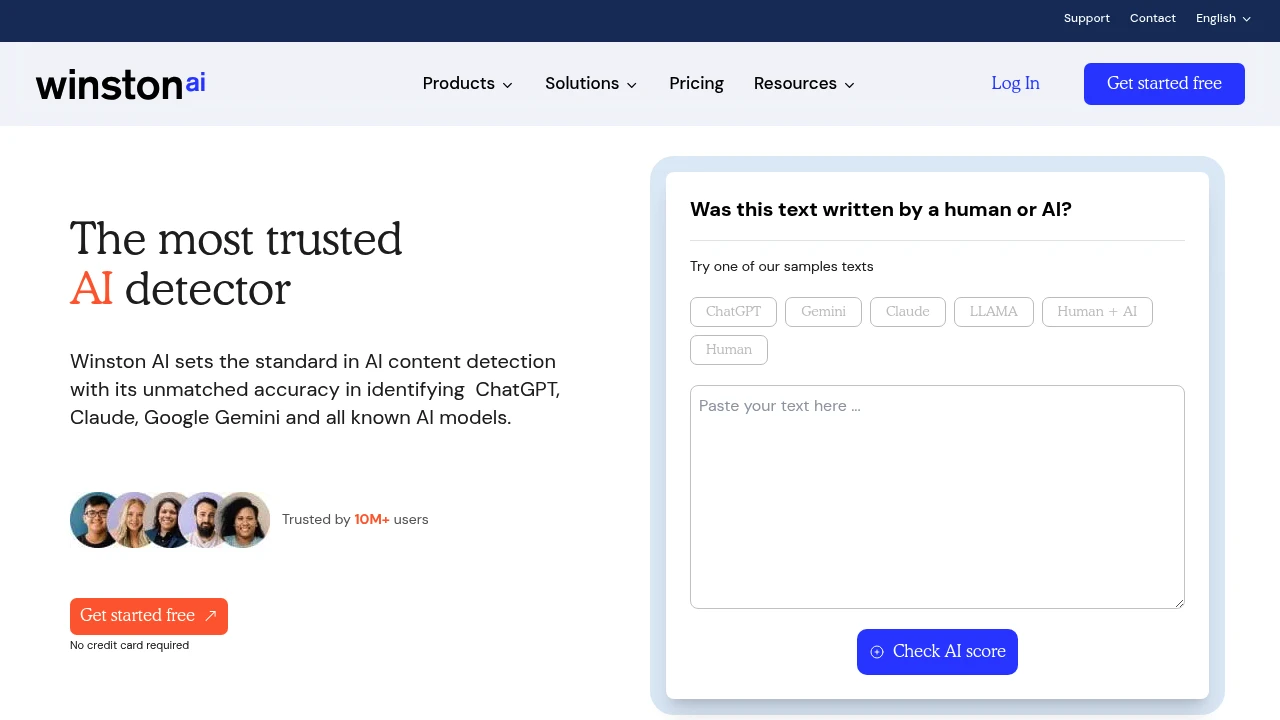
Winston AI provides tools for assessing text and images, including AI-content detection and plagiarism checks. Editors, educators, and writers can upload material, inspect results, and produce reports. A detection score is an estimate that needs interpretation alongside other evidence about how the material was created.
Key Highlights
- AI-content detection for text
- AI-image and deepfake checks
- Plagiarism detection on eligible plans
- OCR for scanned documents and handwriting
- Shareable PDF reports and team features
What Makes It Different
AI detection and plagiarism checks answer different questions. A plagiarism result concerns matching material, while an AI score estimates characteristics associated with generated content. Neither alone proves authorship or explains why a passage looks the way it does.
Features & Capabilities
Upload or paste material, run the relevant check, and examine the result in context. OCR can extract text from pictures and scanned documents. Reports let a team share findings and discuss the material being reviewed.
The available tools and team allowances vary by plan. Where a result could affect a person, compare it with drafts, attribution, and other relevant information before making a decision. Review the underlying passage rather than relying only on an overall score.
User Ratings and Testimonials
Try the tools on examples whose origin you already know, including edited human writing and generated text. Advertised accuracy figures describe vendor tests and are not a guarantee for every document. False positives and missed detections remain reasons to use several forms of evidence.
Pricing & Value
Free access is advertised as a 14-day trial with 2,000 credits. Paid Essential, Advanced, and Elite plans include 100,000, 200,000, and 500,000 monthly credits respectively. Monthly and annual billing, feature differences, and top-ups affect the total. Temporary discount codes have separate eligibility and duration terms.

Check text for AI-writing signals, plagiarism, and readability, with content-review tools for publishers.
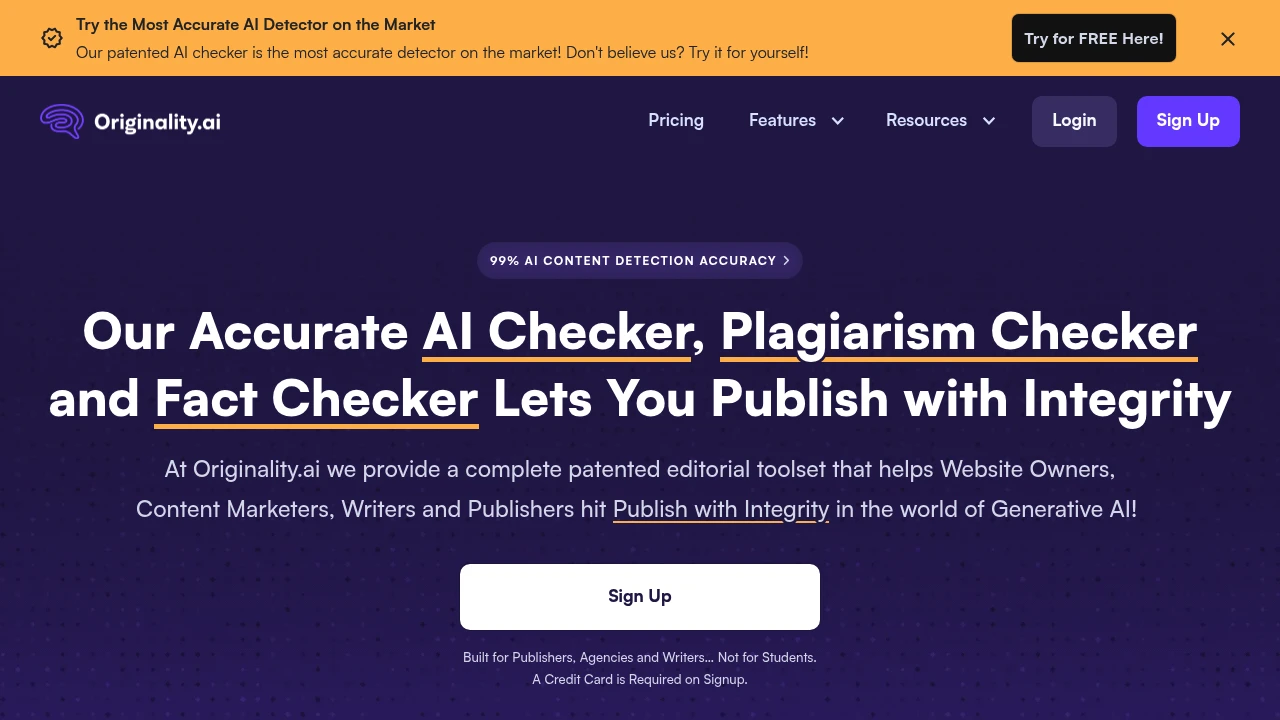
Originality.ai is a complete platform for content verification. It checks for AI-writing signals, checks for plagiarism, and looks for fact-checking problems. Designed for content creators, publishers, and SEO experts who need content-review tools.
Key Highlights
- AI detection with vendor-published accuracy studies; performance varies and false positives are possible
- Combines AI detection, plagiarism checking, and fact verification in one tool
- Real-time scanning with browser extension and API access
- Team collaboration features with shared credits and reporting
- Checks text associated with multiple AI-writing models
- Bulk scanning capabilities for large content volumes
- Readability scoring and content optimization suggestions
What Makes It Different
Originality.ai does more than detect AI. It offers a complete suite for content verification. Those include AI detection, checking for plagiarism, and checking factual claims.
Its team-focused approach makes it different from individual-use tools. It uses shared credit pools and collaborative workflows.
The platform gives detailed confidence scores instead of just yes or no answers.
Features & Capabilities
- AI Content Detection: It checks text for AI-generated content. This includes major AI models like ChatGPT, Claude, Gemini, and more. It provides percentage-based confidence scores.
- Plagiarism Detection: Looks at web pages and academic works to find any copied text.
- Fact Checking: Checks claims and statements for potential factual problems; review the findings against reliable sources.
- Team Management: Share credits with team members. Assign roles and track usage through detailed reports.
- Browser Extension: Chrome extension for real-time scanning of web content and documents.
- API Integration: Developers can integrate detection capabilities into existing workflows and applications.
- Bulk Processing: You can upload many files or paste large text for batch analysis.
- Content Optimization: Readability scores and suggestions to improve content quality.
User Ratings and Testimonials
Detection results need context. False positives and missed AI-written passages are possible, so inspect the text and writing history rather than treat a score as a verdict. Evaluate plagiarism and readability checks separately from AI classification.
Pricing & Value
Pay-as-you-go credits: one-time purchases with a 2-year expiry; available features and purchase amounts depend on the selected offer
Pro Plan: $14.95/month
- 2,000 credits per month
- Team management features
- Chrome extension
- File upload capabilities
- Full site URL scanning
Enterprise Plan: $179/month
- 15,000 credits per month
- API access for workflow integration
- Dedicated customer success manager
- Priority support
- 365 days scan history
Basic offers limited AI detection only. Paid plans add content checks and workflow features with different credit costs. The pay-as-you-go option suits light users who like one-time payments. Monthly plans offer better value for those who need regular content verification.
Similar proprietary alternatives:

 bisibility — Free beta: Track your website’s keywords, Google rankings, Search Console insights, and share of voice.


