LangChain Alternatives
A curated collection of the 5 best alternatives to LangChain.
How to choose a replacement
LangChain spans more than one layer of an agent stack. Decide whether you are replacing data retrieval, application orchestration, tool execution, or the wider development workflow. Frameworks can also be combined, so migration is not always an all-or-nothing decision.
Compare by
- Data retrieval versus general agent orchestration
- State, retries, and human approval points
- Python or TypeScript application fit
- Tracing, evaluation, and deployment requirements
Which alternative fits your workflow?
- LlamaIndex: Data-centric agent and retrieval workflows.
- CrewAI: Role-based agents and multi-agent workflow coordination.
- Pydantic AI: Python agents with typed inputs, outputs, and tools.
- Mastra: A TypeScript-oriented agent application framework.
- Agno: Agent and multi-agent application development.
What to test before switching
Implement a narrow workflow with one tool failure, one retrieval step, and one approval checkpoint. Inspect the state and logs after interruption. Compare the code and operational components you still own rather than relying on the number of integrations advertised.


An open-source framework for developers building AI agents, data retrieval pipelines, and multi-step workflows.
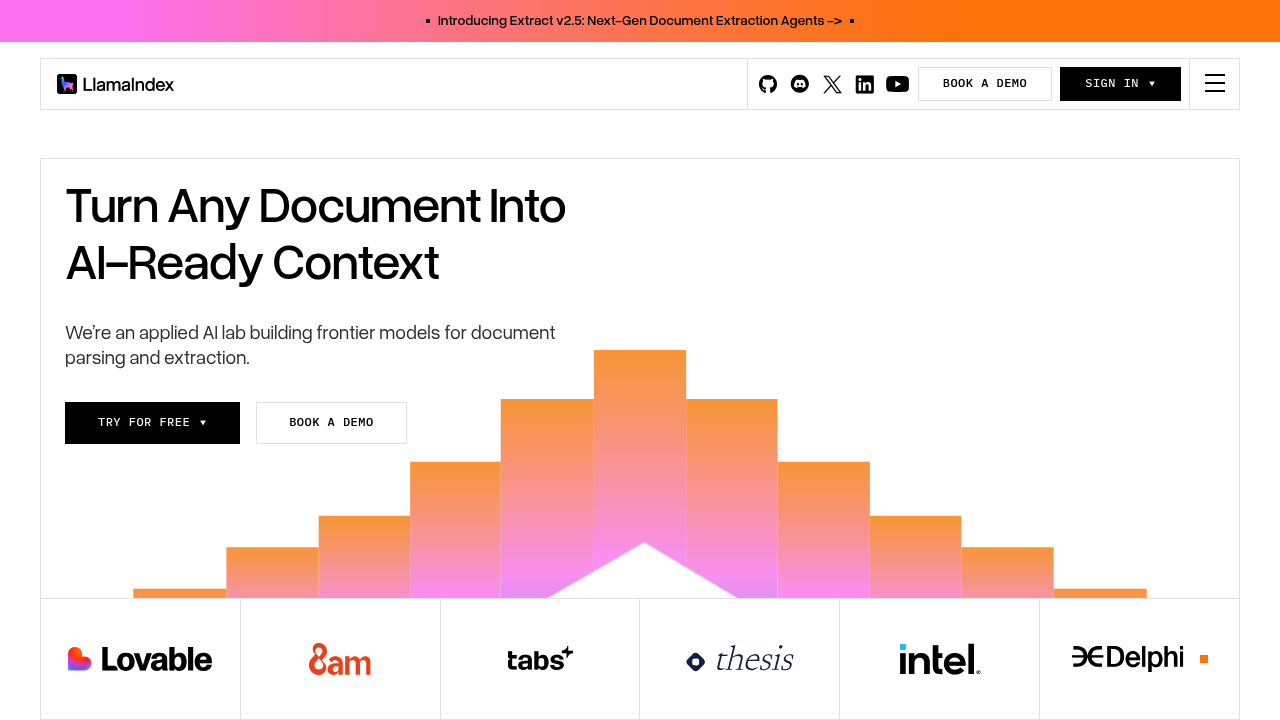
LlamaIndex is an open-source framework for developers building AI agents over their own data. It combines retrieval-augmented generation (RAG), tools, memory, and workflows for applications such as internal knowledge assistants.
Key Highlights
- Python and TypeScript SDKs
- Data connectors, indexes, and retrievers
- Tool-calling agents and multi-agent coordination
- Asynchronous, event-driven Workflows
- Human-in-the-loop steps and state management
What Makes It Different
A query engine can become one of an agent's tools, connecting document retrieval to actions. Developers can customize connectors, indexes, retrieval, and model integrations, while Workflows controls how steps interact.
Features & Capabilities
Load documents, build an index, and expose it through a query engine. In Python, FunctionAgent uses tools such as ordinary functions or query engines; AgentWorkflow coordinates multiple agents. Model integrations include hosted providers and local options such as Ollama.
Workflows connects steps through events, with loops, branching, parallel paths, and human review. The framework can use LlamaParse for complex document processing, but that hosted service has separate pricing. Open-source access does not include unlimited hosted parsing or model usage.
User Ratings and Testimonials
Phil Mui of Salesforce praises retrieval customization and community support. Agent reliability still depends on the model; smaller local models can be less reliable. The maintainers now prioritize LlamaParse, a product direction to consider when planning framework adoption.
Pricing & Value
- LlamaIndex framework: Free, MIT-licensed software you run yourself. Budget separately for infrastructure and any paid model APIs.
The separate hosted platform is now called LlamaParse, formerly LlamaCloud. Its US plans cover document services:
- Free: $0/month with 10,000 monthly credits.
- Starter: $50/month with 40,000 credits and pay-as-you-go usage.
- Pro: $500/month with 400,000 credits and priority support.
- Enterprise: Custom pricing, volume discounts, SSO, and hybrid cloud deployment.
Choose the framework for control over your application; add hosted services when their document-processing capabilities fit your workload.
Looking for alternatives to other popular tools? Check out other posts in the alternatives series and flowtools.co, a directory of best AI tools with filters for tags and categories for easy browsing and discovery.

Build agents with an open-source SDK, run them through AgentOS, and manage sessions, tools, and knowledge.
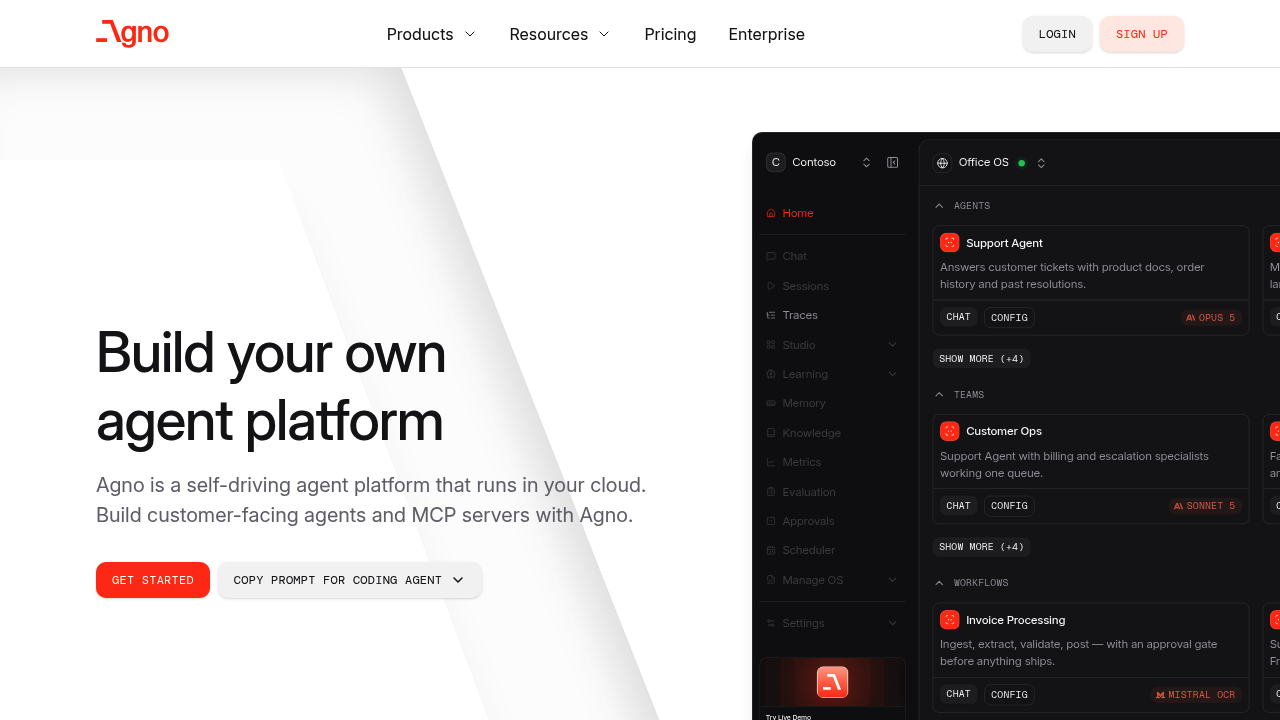
Agno is an agent development platform that combines an SDK, the AgentOS runtime, and a control plane. It continues the product formerly called Phidata. Developers can build agents and teams, serve them through APIs or MCP, and operate the runtime in their own cloud or local environment.
Key Highlights
- Open-source Python SDK and AgentOS runtime
- Agents, teams, workflows, and structured outputs
- Knowledge, memory, and database-backed sessions
- REST APIs and MCP access to deployed agents
- Control plane for inspecting and operating runs
What Makes It Different
Build, run, and operate are separate layers. AgentOS can serve agents built with Agno or other supported frameworks, while the control plane connects to that runtime. The SDK repository uses Apache 2.0 licensing. Hosted control-plane plans do not replace the developer's own infrastructure or model-provider account.
Features & Capabilities
Define an agent's model, instructions, knowledge, and tools in code. Python functions can become callable tools, while teams and workflows organize tasks across agents. Persistent storage keeps sessions and memory available between requests rather than depending on an in-process conversation.
AgentOS exposes the agents as services through REST and MCP, with runtime features for scheduling, approvals, and durable execution. The control plane provides chat, session inspection, traces, and evaluations. Data remains in the runtime's database, and deployment templates support common container and cloud environments.
User Ratings and Testimonials
Vendor-published customer accounts from Thinqpoint and Key Data praise development speed and documentation. These are specific experiences, not guarantees for every architecture. Evaluate tool failures, state persistence, and restart recovery with the workload your service will actually run.
Pricing & Value
- Free: open-source SDK/runtime and control-plane access to local AgentOS instances.
- Pro: $150/month for one live AgentOS connection and three team seats.
- Enterprise: custom governance and support terms.
Pro add-ons cost $30/month per extra seat and $95/month per extra live connection. A 14-day Pro trial is available. Agno does not meter runtime events on these plans, but model calls and your hosting remain separate costs.

Python developers use Pydantic AI to build typed GenAI agents, tools, and workflows with Pydantic validation.
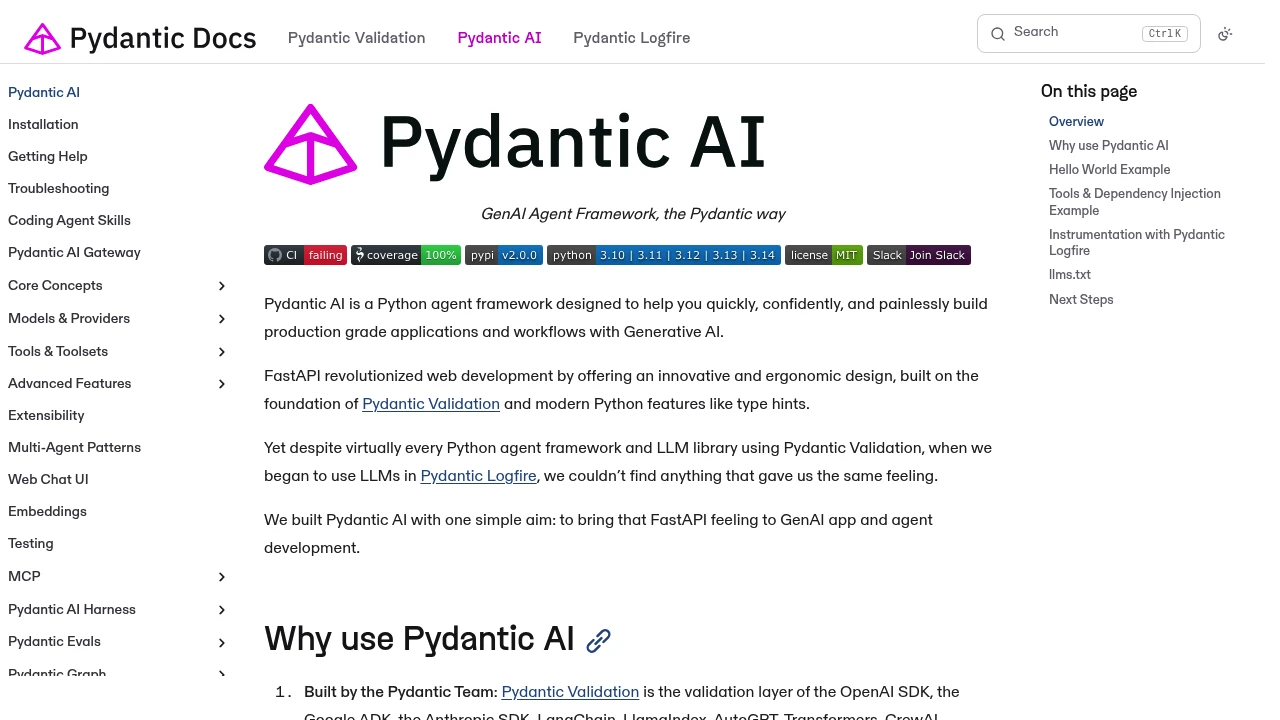
Pydantic AI is a Python agent framework from the Pydantic team for building production GenAI applications and workflows. It is built for developers who want the same typed, ergonomic feel that FastAPI brought to web apps, but for agents, tools, structured outputs, and model workflows.
Key Highlights
- Typed agents with Pydantic validation for outputs and tool arguments
- Model support across OpenAI, Anthropic, Gemini, Mistral, Bedrock, Ollama, LiteLLM, OpenRouter, and many more
- Dependency injection for passing data, services, and context into instructions and tools
- Built-in support for MCP, UI event streams, human approval, streamed outputs, and durable execution
- Evals and OpenTelemetry tracing through Pydantic Logfire or another OTel-compatible backend
What Makes It Different
Pydantic AI is opinionated around Python types instead of visual flow builders or prompt-only agent wrappers. Agents are generic over their dependency type and output type, so static type checkers and IDEs can catch mistakes before a run reaches the model.
The framework also leans on Pydantic for validation. Tool arguments become schemas sent to the model, invalid outputs can be retried, and final responses can be constrained to a known model such as a support ticket result, risk score, or structured answer.
Features & Capabilities
You define an agent, choose a model, add static or dynamic instructions, and register tools that the model can call while it works. Dependencies let each run receive customer IDs, database connections, or other app services without hiding that context in global state.
For larger systems, Pydantic AI adds composable capabilities, YAML or JSON agent specs, streamed structured outputs, graph support, evals, and durable agents that can recover across transient failures or restarts. MCP support lets agents connect to external tools and data, while UI event streams help build interactive agent experiences.
User Ratings and Testimonials
Public rating data is not prominent for this framework, so it is better judged by fit. It is strongest for Python teams that already use Pydantic, care about type hints, and want agent code they can test, trace, and review. The tradeoff is that it is not a no-code builder: teams still need to handle model keys, hosting, approval policies, and production monitoring.
Pricing & Value
- Framework: $0, open-source under the MIT license for building and running Python agents in your own application
- Usage costs: model calls, hosting, and optional observability costs depend on the providers you connect
Pydantic AI is best value for engineering teams that want a code-first framework rather than a hosted agent platform with bundled model usage.

Mastra is an open-source TypeScript framework for developers building AI agents, workflows, memory, MCP, and observability.
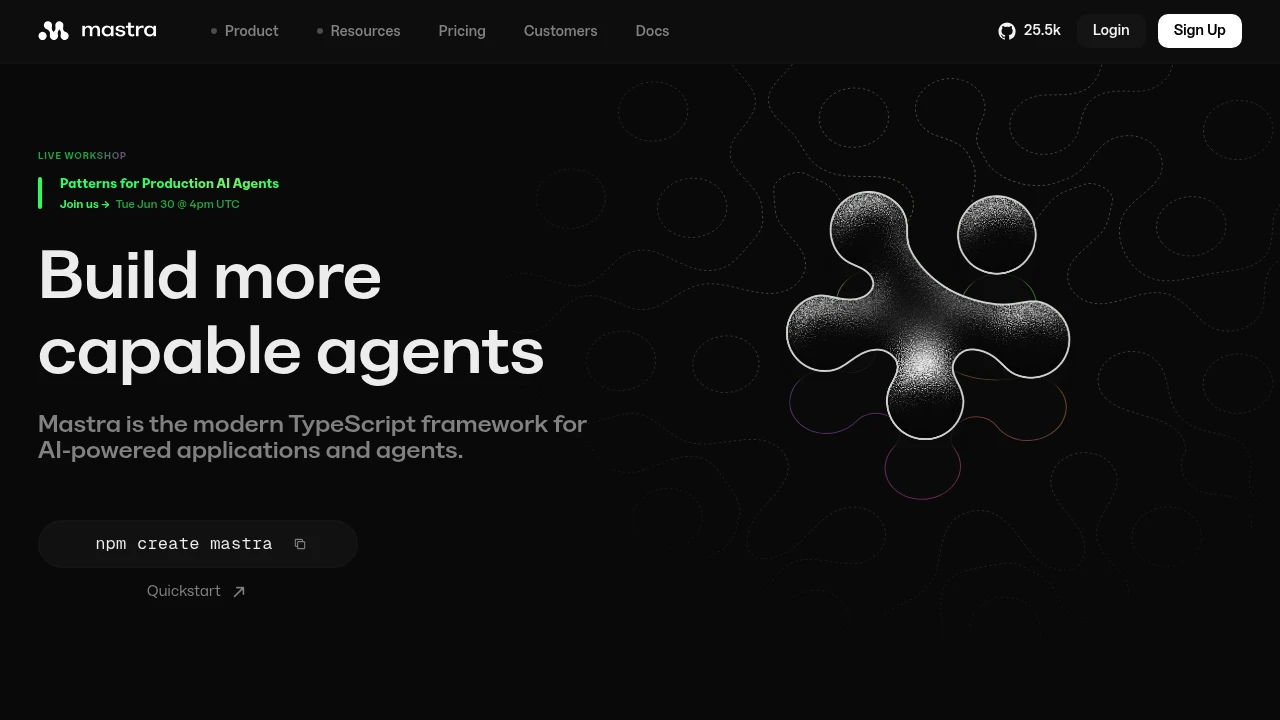
Mastra is an open-source TypeScript framework for building AI agents and AI-powered apps. It packages typed agents, graph workflows, memory, MCP support, and observability for JavaScript teams that want agent logic inside an existing app stack instead of a separate Python service.
Key Highlights
- Define agents with instructions, models, tools, memory, and runtime behavior
- Build workflows with branches, parallel steps, stored pauses, and human approval
- Add conversation history, retrieval, working memory, and semantic memory
- Route models through one interface with 90+ providers
- Author MCP servers and track evals, traces, token usage, and guardrails
What Makes It Different
Mastra treats agent development as a TypeScript app problem. Agents, workflows, memory, server endpoints, and observability can live beside React, Next.js, Node.js, Hono, Express, Fastify, or standalone server code. The graph workflow engine handles multi-step processes, pauses, branches, and parallel work, while MCP support exposes agents, tools, and resources to other systems.
Features & Capabilities
Developers define an agent with instructions, a model, tools, and runtime behavior, then connect it to app flows. Mastra supports internal Slack-style agents, customer-facing task agents, and AI SREs. Memory combines message history with retrieval and persistent state, while observability covers evals, metrics, datasets, traces, token usage, and guardrails.
Deployment options include any Node.js-compatible environment, built-in deployers for Vercel, Netlify, and Cloudflare, a standalone Hono server, or existing web frameworks.
User Ratings and Testimonials
Mastra publishes customer examples rather than review-site scores. Marsh uses LenAI agentic search powered by Mastra, and MongoDB uses Mastra agents for CI logs. The tradeoff is audience fit: non-technical teams need developers, not just a visual builder.
Pricing & Value
- Starter Platform: $0/month, 100K observability events, 24 CPU hours, 15 days retention, unlimited users, deployments, and projects
- Teams Platform: $250/month, 1M observability events, 250 CPU hours, 6 months retention, multiple teams, SSO, and SOC 2 docs
- Enterprise Platform: Custom pricing for volume, retention, RBAC, audit logs, support, uptime SLAs, and dedicated support
- Self-hosted Free: $0/month under Apache 2.0, with agents, workflows, and observational memory anywhere
- Self-hosted Enterprise: Custom pricing for enterprise controls, VPC deployment, and flat annual pricing
Starter covers prototypes. Teams and Enterprise add retention, SSO, compliance docs, and production support.

CrewAI is an open-source framework and platform for building multi-agent AI workflows, for developers and enterprise teams.
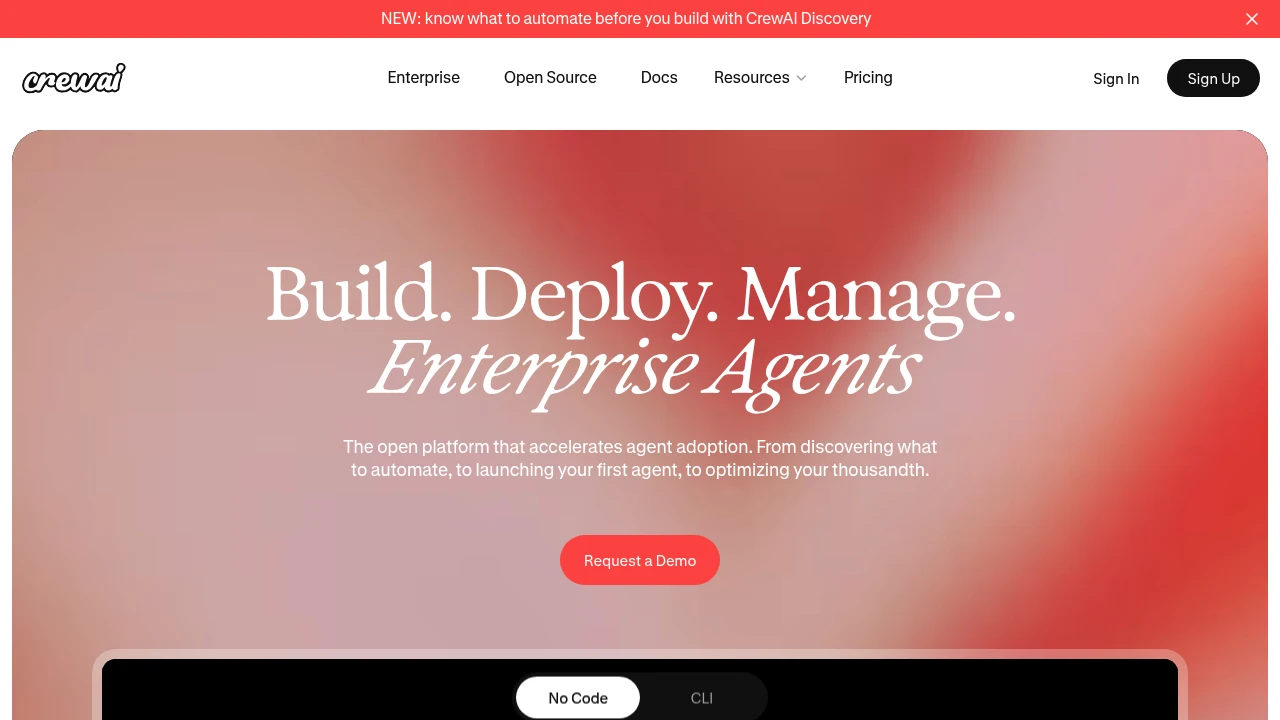
CrewAI is an open-source framework and platform for building multi-agent AI systems, where several role-based agents work together to complete a task. It is built for developers and enterprise teams who want to move from a single prompt to production agents that can be observed and governed. You can start in the Python framework or a no-code visual editor, then deploy and manage the result.
Key Highlights
- Role-based agents that split and coordinate complex work
- Open-source Python framework with a code-first API for full control
- No-code visual editor that exports to Python
- CLI for building multi-agent orchestrations
- Control Plane for tracing every LLM call, tool call, and memory read
- Export workflows as an MCP server or a UI component
What Makes It Different
CrewAI separates the open-source framework from the managed platform, so you can prototype locally and then run the same workflow in production. Its Control Plane sits in the execution path of every workflow, so each agent interaction is observable, with full cost accounting, immutable audit trails, and human-in-the-loop approval gates.
It also frames agents as a lifecycle. Discovery scans your tickets, chats, and apps to rank automation opportunities by effort and value, and Optimize turns each production run into training data to improve accuracy.
Features & Capabilities
You define agents with roles, give them tools, and orchestrate them into deterministic workflows. The framework offers a code-first API, while the visual Studio editor lets non-developers build the same crews and export them to Python. GitHub integration, standard tools and triggers, and workflow templates are included on every plan.
For production, CrewAI adds tracing, OpenTelemetry support, runtime model swapping, guardrails, hallucination scores, and cron scheduling. Runtime hooks can inject PII redaction and policy checks at each LLM and tool call, and evaluation integrates with Arize, Galileo, DataDog, and Patronus.
User Ratings and Testimonials
Evaluate agent roles, handoffs, and tool behavior with representative tasks. Multiple agents add coordination and debugging work. The company reports use by 65% of the Fortune 500; that vendor statistic does not establish the reliability of an individual workflow.
Pricing & Value
- Free: $0, with the visual editor and AI copilot, GitHub integration, and 50 workflow executions per month
- Enterprise: Custom pricing, adds enterprise connectors, SSO, role-based access control, dedicated support, with 45-day onboarding; forward-deployed engineering and training are available a la carte
The open-source framework is free to self-host, and the Free plan is enough to build and test a workflow. Enterprise targets teams running agents in production at scale.
Similar proprietary alternatives:

 bisibility — Free beta: Track your website’s keywords, Google rankings, Search Console insights, and share of voice.


