ElevenLabs Alternatives
A curated collection of the 6 best alternatives to ElevenLabs.
The best alternative to ElevenLabs is Murf. If that doesn't suit you, we've compiled a ranked list of other ElevenLabs alternatives to help you find a suitable replacement. Other interesting alternatives to ElevenLabs are: Resemble AI, Retell AI, Cartesia and SpeechifyAI.
ElevenLabs alternatives are mainly AI Voice tools. Browse these if you want a narrower list of alternatives or looking for a specific functionality of ElevenLabs.


Murf is an AI voice generator for creators, teams, and developers making voiceovers, dubbing, and voice agent speech.
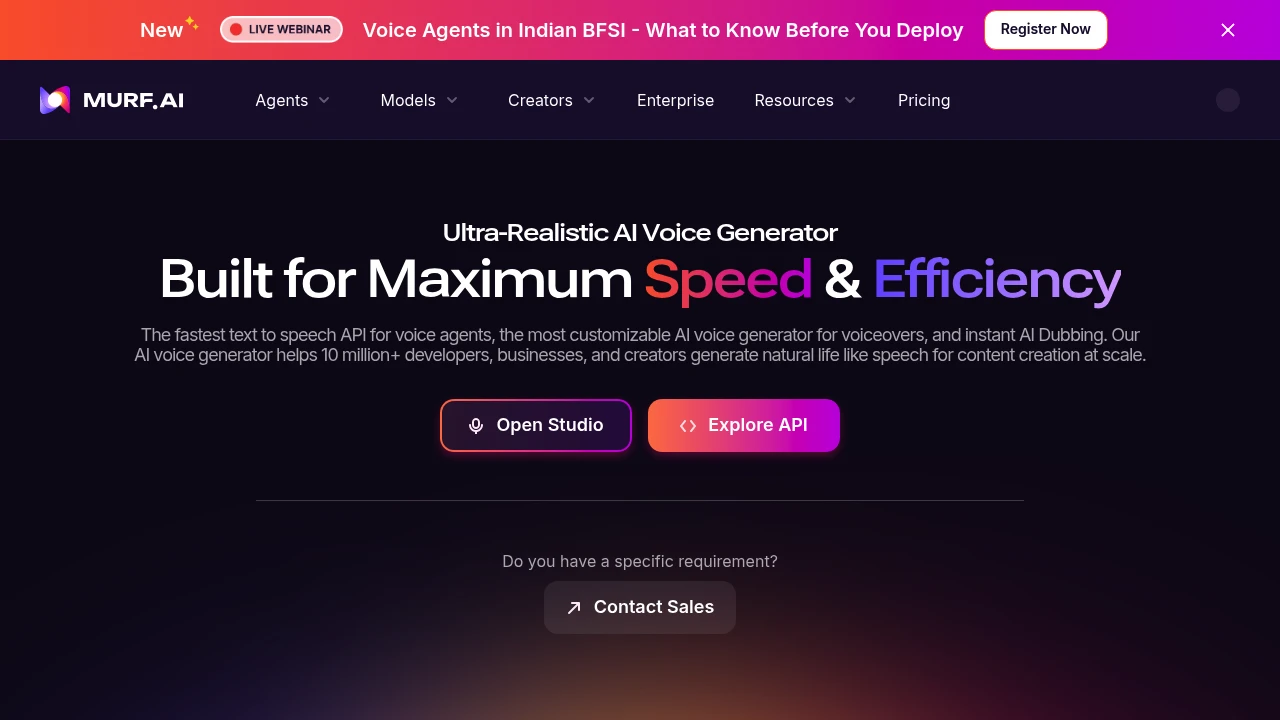
Murf is an AI voice generator and text-to-speech studio for voiceovers, dubbing, and real-time voice agent audio. It serves creators, learning teams, localization teams, and developers who need lifelike speech without booking a recording session.
Key Highlights
- 200+ voices across 35+ languages for narration, training, ads, podcasts, and accessibility content
- Murf Falcon TTS API for voice agents, with 130 ms time-to-first-audio and $0.01/min pricing
- Studio controls for pitch, speed, intonation, custom pronunciation, and voice style
- AI dubbing in 40+ languages, with editing tools and expert linguistic review
- Integrations with Canva, PowerPoint, and Captivate
- Security claims include SOC 2, ISO 27001, GDPR, HIPAA, and 11-region data residency
What Makes It Different
Murf is not only a voiceover editor. The homepage separates Falcon for real-time conversations from Gen2 for controllable content production. Falcon is aimed at customer support, sales, booking, recruiting, and helpdesk agents, while Gen2 focuses on tone, pacing, emphasis, and pronunciation control for finished voiceovers. Murf also says its voices are created with permission from professional voice actors, who earn royalties when their voices are used.
Features & Capabilities
In Murf Studio, users can paste a script, choose a voice, adjust delivery, manage pronunciation, and export audio on paid plans. The product also supports voice cloning and a Say It My Way feature, where users record a rendition so the AI can reflect their tone and inflection.
For developers, Murf Falcon provides text-to-speech for live voice agents. For video teams, Murf's dubbing workflow translates content into multiple languages while preserving the original voice, meaning, and tone. The same product family covers e-learning, YouTube videos, product demos, corporate communication, audiobooks, and game audio.
User Ratings and Testimonials
Murf is rated 4.7/5 on G2 from 1,000+ reviews, according to the homepage. Customer quotes on the site praise faster voiceover production, API integration, transparent model training, and Spanish versions of English videos.
The page does not surface independent complaints. The practical caveats come from Murf's own FAQ: the free plan has limited 10-minute voice generation, no commercial license, and voices can only be downloaded on paid plans.
Pricing & Value
- Free: limited 10-minute voice generation, no commercial license, and downloads only on paid plans
- Paid Studio plans: unlock commercial projects, downloads, team workflows, and larger voice generation budgets; current plan totals should be confirmed before buying
- Enterprise: custom sales plan for broader access, security, and support
- Murf Falcon API: $0.01/min for voice agent speech, with pay-as-you-go API pricing also exposed for developers
The free plan is enough to test voice quality, but commercial projects, downloads, team workflows, and larger voice generation budgets require a paid plan.
Looking for alternatives to other popular tools? Check out other posts in the alternatives series and flowtools.co, a directory of best AI tools with filters for tags and categories for easy browsing and discovery.

Resemble AI helps teams clone voices, generate speech, watermark media, and detect deepfakes across audio, image, and video.
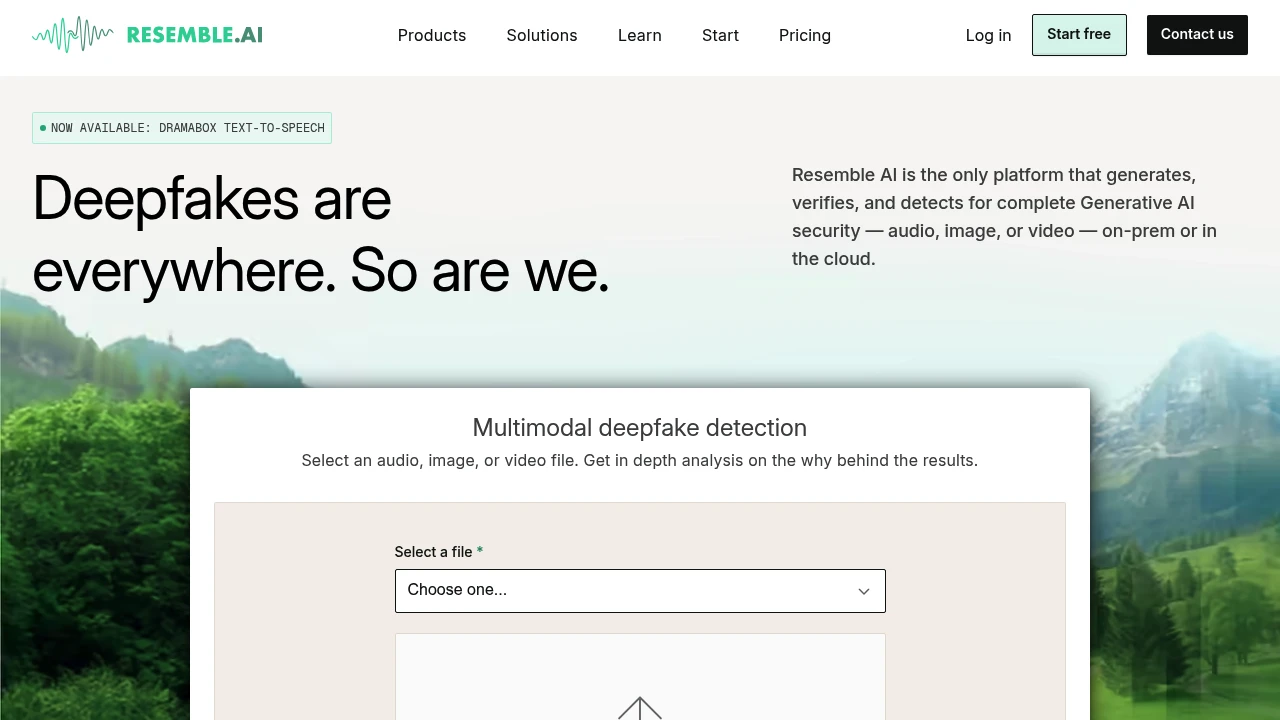
Resemble AI is a secure voice AI and generative media security platform. It combines voice generation, watermarking, and deepfake detection across audio, image, and video. Teams can use it in the cloud or on-prem, with API access included on Flex.
Key Highlights
- Generate text-to-speech, voice agents, voice changing, transcription, enhancement, and audio edits
- Clone voices, design voices, and add rapid or pro voice clones
- Verify media with invisible watermark encode and decode workflows
- Detect audio, image, and video deepfakes, with intelligence analysis available
What Makes It Different
Resemble AI is built around Generate, Verify, and Detect, so synthetic voice creation, media watermarking, and abuse detection live in one platform. That is the main difference from voice-only tools.
The detection scope is broader than audio. The homepage says Resemble AI covers audio, image, and video, with zero-day model coverage tested against 160+ generative AI models. It also lists a Deepfake Detector Chrome extension and Deepfake Incident Database.
Features & Capabilities
For voice work, Resemble AI covers text-to-speech, voice agents, AI voice changing, speech-to-text, audio enhancement, and audio editing. Flex includes voice cloning, full API access, and add-ons for seats, clones, and voice design.
Security workflows include watermark encode, watermark decode, identity search, and deepfake detection for audio, video, and images. Detection can add audio, video, and image intelligence analysis for extra context.
User Ratings and Testimonials
Resemble AI does not publish a third-party rating or quoted customer reviews. The strongest buyer signal is product scope: generation, watermarking, detection, governance, and compliance in one stack. The caution is pricing complexity, because Flex is usage-based and Enterprise requires a quote.
Pricing & Value
- Flex plan: $0 to start, pay per consumption, credits never expire, all voice AI models, voice cloning, deepfake detection, and API access
- Enterprise: Custom pricing, with volume discounts up to 80%, higher concurrency limits, enterprise SLA and SOC 2, SSO or SAML, custom model training, dedicated support, and on-prem deployment
- Flex add-ons: Team seats at $20/month per user, rapid voice clone at $2/month per voice, pro voice clone at $5/month per voice, and voice design at $2/month per voice
- Usage rates: Text-to-speech and AI voice changer at $0.0005 per second, voice agents at $0.001 per second, audio detection and image detection at $0.04 per second, and video detection at $0.07 per second
Resemble AI fits teams that want voice generation and deepfake controls together.

Retell AI is a voice agent platform for teams automating inbound and outbound call operations.
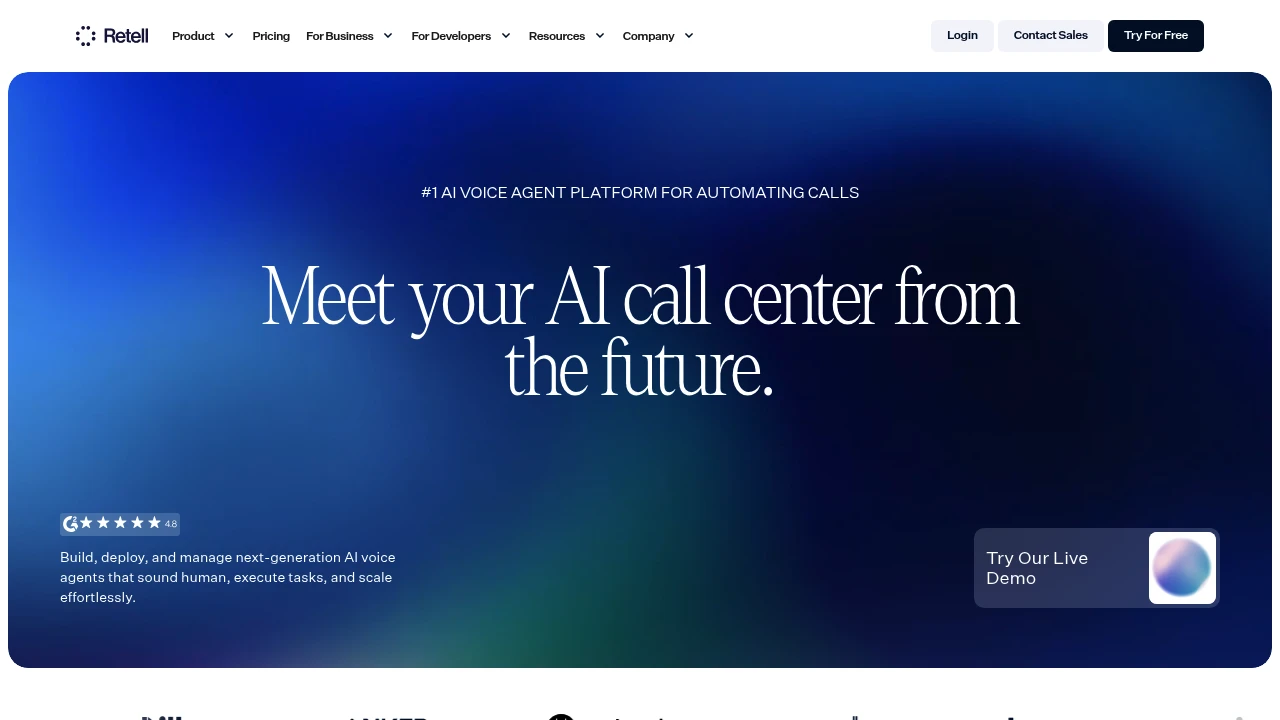
Retell AI is an AI voice agent platform for inbound and outbound call operations. Teams use it to build, deploy, test, and monitor agents that connect to business systems through functions, telephony, and APIs.
Key Highlights
- LLM-based voice agents for natural, multi-turn calls
- Turn-taking and voice orchestration with about 600 ms latency
- Drag-and-drop flows with guardrails, simulation testing, and QA
- Function calling, streaming RAG, SIP trunking, branded caller ID, verified numbers, analytics, webhooks, and API access
What Makes It Different
Retell AI is a production voice stack, not a generic chatbot builder. Its site contrasts it with IVR and IVA systems: instead of touch-tone menus or fixed intent maps, its 3rd Gen Voice AI uses LLMs for multi-turn conversations, edge cases, and outbound calls. The orchestration layer lets agents complete appointments, payments, transfers, or CRM updates during a call.
Features & Capabilities
Teams can start from templates or configure call flows inside Retell AI's agentic framework. Demo use cases include receptionist, appointment setter, lead qualification, customer service, debt collection, and survey agents. Before launch, teams can run simulations, then review calls through analytics, transcripts, dashboards, and QA.
Agents can use custom functions, pull answers from a knowledge base, and work across voice call, chat, SMS, and API channels. Listed integrations include HubSpot, Twilio, Salesforce, Zapier, Avaya, Genesys, Five9, Amazon Connect, Telnyx, Make, and Cal.com.
User Ratings and Testimonials
Retell AI does not publish a third-party average rating. It includes customer quotes from Pine Park Health, SWTCH, and Medical Data Systems, with reported results around scheduling NPS, EV support costs, inbound call handling, transfer rate, and monthly collections.
The main watchout is cost predictability. Per-minute cost changes by LLM, text-to-speech provider, telephony, add-ons, and concurrency, while custom SSO, custom MSA/DPA terms, and 24/7 dedicated portal support sit in the Enterprise Plan.
Pricing & Value
- Pay as you go: starts at $0 with $10 in free credits, then $0.07-$0.31/min for AI Voice Agents and $0.002+/message for AI Chat Agents. It includes platform access, templates, analytics, transcripts, simulation testing, webhooks, API access, 20 free concurrent calls, and email support.
- Enterprise Plan: custom pricing for AI Voice Agents and AI Chat Agents, with volume pricing, custom MSA/DPA terms, role-based access control, a dedicated stable server, custom SSO, higher concurrency, and 24/7 support with a dedicated portal.
Retell AI is strongest for teams that want usage-based voice automation with production telephony, testing, analytics, and enterprise options.

Cartesia is a low-latency voice AI platform with streaming text-to-speech, speech-to-text, and voice agents for developers.
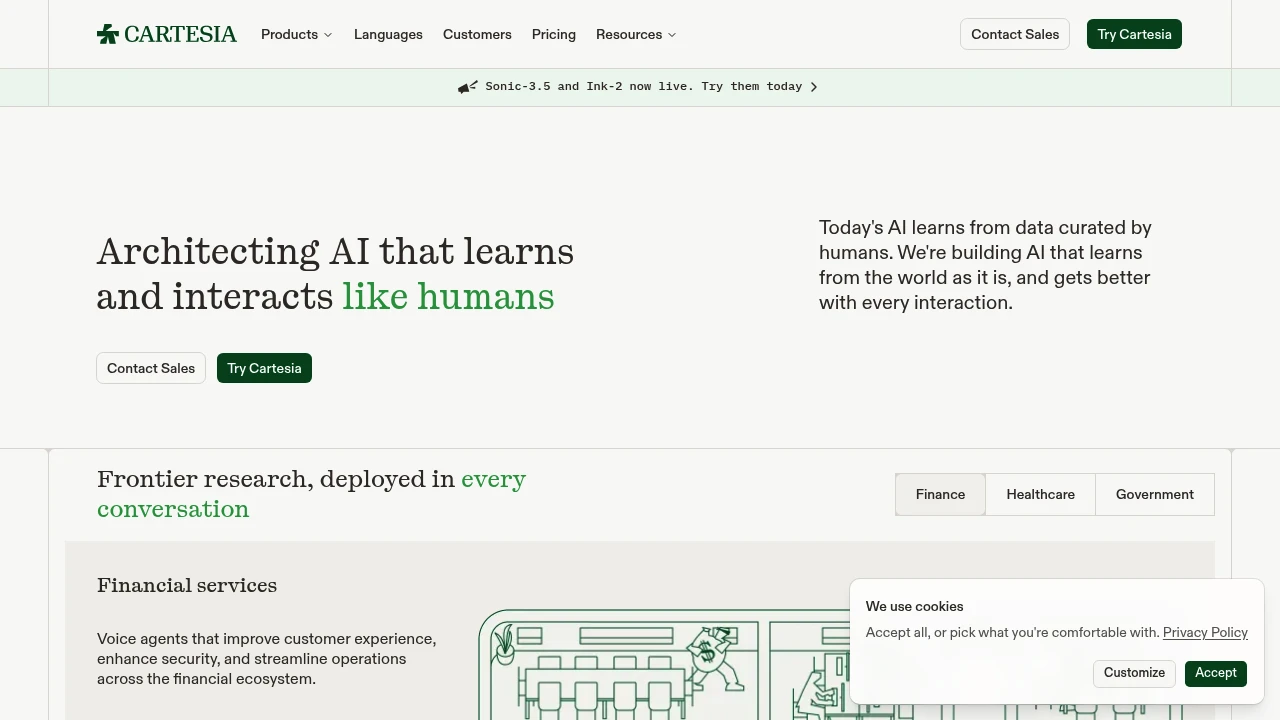
Cartesia is a real-time voice AI platform built around Sonic, its streaming text-to-speech model. It is made for developers and teams building voice agents, live assistants, and interactive apps that need natural speech with very low latency. You reach the models through an API and SDKs, and can run them in the cloud, on-premise, or on-device.
Key Highlights
- Sonic-3.5 streaming text-to-speech with expressive voices in 40+ languages
- Ink-2 speech-to-text for transcription in voice pipelines
- Line voice agents that handle live phone and in-app conversations
- Instant voice cloning from a short audio sample
- Deploy in the cloud, in your own VPC or hardware, or on-device
- SDKs and developer tools for production integration
What Makes It Different
Cartesia's models are built on State Space Models (SSMs), an architecture its founding team helped pioneer at Stanford (including Mamba and H-Nets). SSMs are designed for live, synchronous interactions, so Sonic targets ultra-low time-to-first-audio rather than batch generation. Sonic-3.5 streams its first audio in roughly 90 milliseconds, fast enough for back-and-forth conversation where any delay is noticeable.
The other differentiator is deployment flexibility. The same models and agents run across cloud, on-premise, and on-device, with inference kept in-region for teams with data residency, compliance, or latency needs a single cloud endpoint cannot meet.
Features & Capabilities
The core workflow is API-first: send text to Sonic and stream audio back, send audio to Ink-2 for a transcript, or combine both with the Line agent layer for full voice conversations. Agents can take phone calls on a Cartesia-provided number and connect to your own systems and logic at scale.
Beyond synthesis, it offers instant voice cloning from a short sample, professional voice cloning on higher tiers, a voice changer, and voice localization across languages. Every plan includes unlimited seats and voice slots, with concurrency and agent limits that scale by tier.
User Ratings and Testimonials
Cartesia is best known for speed. Reviewers consistently rank Sonic among the lowest-latency text-to-speech options for real-time agents, and its instant voice cloning from a few seconds of audio draws frequent praise. The common criticism is that for long-form, expressive narration, rivals such as ElevenLabs often rate higher on voice realism, so Cartesia suits live, conversational use more than polished voiceover.
Pricing & Value
- Free: $0/month, 20K credits and $1 of prepaid agents, with text-to-speech and speech-to-text
- Pro: $4/month, 100K credits and $5 prepaid agents, adds a commercial-use license and instant voice cloning
- Startup: $39/month, 1.25M credits and $49 prepaid agents, adds professional voice cloning and organizations
- Scale: $239/month, 8M credits and $299 prepaid agents, adds priority support and high concurrency
- Enterprise: custom pricing with volume rates, custom concurrency, SSO, and compliance agreements
Voice agent calls are billed at $0.06 per minute, plus $0.014 per minute for telephony on a Cartesia number. Yearly billing saves 20%, and the free tier is enough to prototype before you commit.

Developer platform for text-to-speech, voice cloning, and realtime voice agents.
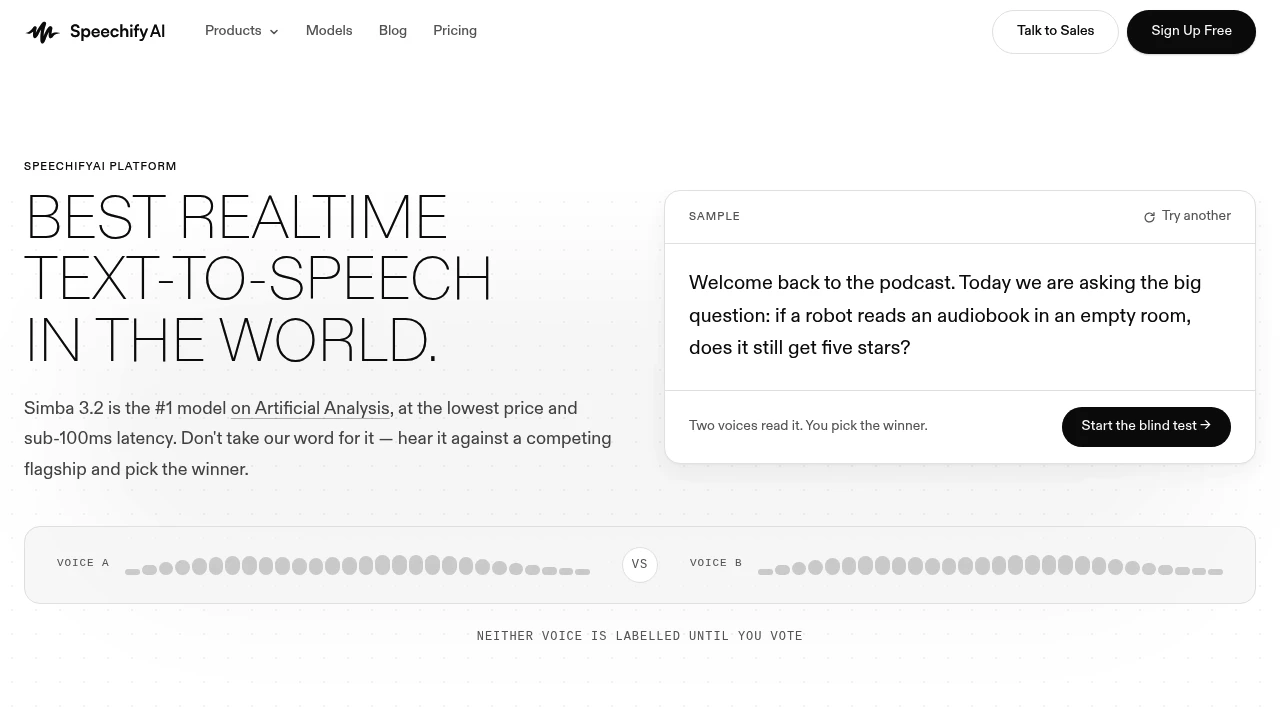
SpeechifyAI is Speechify's developer platform for adding generated speech and conversational voice experiences to applications. Its Build API covers text-to-speech, streaming, SSML, emotion control, speech marks, and voice cloning, while SpeechifyAI Agents provides a managed runtime for realtime voice agents.
Key Highlights
- One API key works across speech generation, voices, and agent endpoints.
- The free plan includes 50,000 text-to-speech characters and 60 voice-agent minutes each month.
- Official Python and TypeScript SDKs are available alongside REST endpoints.
- Developers can start with built-in voices or create a cloned voice from a short audio sample.
What Makes It Different
SpeechifyAI is separate from the consumer Speechify reader. It exposes the voice technology as developer building blocks instead of focusing on reading documents aloud. The same platform combines streaming speech, voice cloning, and full voice agents, so teams can use one account and billing model instead of assembling separate text-to-speech, agent, and orchestration services.
Features & Capabilities
The Build API generates audio from text and supports streaming playback, SSML controls, emotional delivery, multilingual synthesis, and word-level speech marks. Voice cloning creates a reusable voice ID from a 10 to 30 second reference recording. SpeechifyAI Agents adds function calling, knowledge bases, conversation memory, inbound and outbound telephony, webhooks, testing, and an embeddable web component. These capabilities suit product narration, accessibility features, support lines, appointment booking, and other interactive voice workflows.
User Ratings and Testimonials
SpeechifyAI is primarily a developer service, so technical fit is better evaluated with a prototype than with consumer reader reviews. Teams can test latency, pronunciation, emotional range, streaming behavior, and agent tool calls against their own scripts and call flows before choosing a paid plan.
Pricing & Value
- Free: $0 per month with 50,000 text-to-speech characters, 60 voice-agent minutes, and three concurrent calls.
- Starter: $10 per month with 1 million characters, 120 agent minutes, voice cloning, streaming, and SSML.
- Pro: $99 per month with 3 million characters, 1,200 agent minutes, knowledge bases, tool calling, and priority support.
- Scale: $499 per month with 10 million characters, 6,000 agent minutes, higher concurrency, and dedicated support.
Paid usage beyond the included allowances is metered by characters for text-to-speech and by conversation minutes for voice agents. Enterprise pricing is available for custom volume, compliance, and support requirements.

Similar proprietary alternatives:

 bisibility — Free beta: Track your website’s keywords, Google rankings, Search Console insights, and share of voice.


