Webflow Alternatives
A curated collection of the 5 best alternatives to Webflow.
The best alternative to Webflow is Wegic. If that doesn't suit you, we've compiled a ranked list of other Webflow alternatives to help you find a suitable replacement. Other interesting alternatives to Webflow are: Bubble, Framer, Duda and Glide.
Webflow alternatives are mainly AI App Builders tools but may also be AI Design tools. Browse these if you want a narrower list of alternatives or looking for a specific functionality of Webflow.


Wegic is a chat-based AI website builder that designs, edits, and publishes a custom site for you, with no coding required.
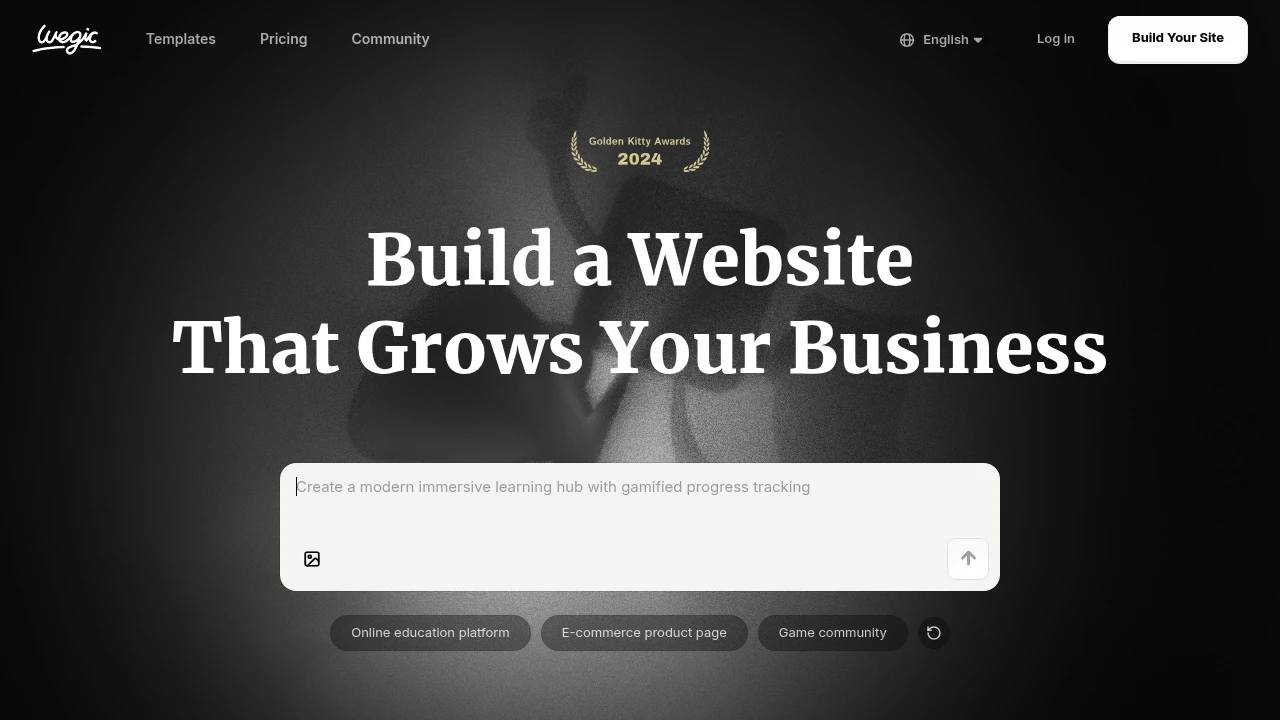
Wegic is a chat-based AI website builder that acts like an on-demand website team: an AI designer, developer, and manager in one chat box. It is built for small business owners, freelancers, and first-timers who want a custom site without an agency or code. You describe the site, pick a style and language, and Wegic generates it, then you keep editing by chat and publish in one click.
Key Highlights
- Generate a full custom website from a plain-language chat description
- Edit any element by talking to the AI, no template wrangling
- One-click publishing with automatic hosting
- Built-in SEO suite plus Google search indexing
- AI generation of logos, images, and video
- Hundreds of multilingual templates across retail, travel, health, and more
What Makes It Different
Most AI website builders hand you a draft, then drop you into a traditional drag-and-drop editor. Wegic keeps the whole workflow conversational: the same AI that builds the first version also handles edits, so changing a section, swapping copy, or restyling a page is a chat message rather than a manual task. Wegic frames this as an "AI website team" so beginners are never stuck on a blank canvas.
Features & Capabilities
The core loop is chat to build, edit, and go live in one click. You provide a name, requirements, style, and language, and Wegic produces a mobile-responsive site you refine through conversation. Paid plans add a custom domain, watermark removal, code download, auto-backup version history, and AI media generation.
Wegic also bundles conversion tools: a booking and form system, basic e-commerce, global payments, social integration, and a built-in SEO and local SEO toolkit. The company says more than 500,000 sites have been built across 230+ countries, around 80% by first-time builders.
User Ratings and Testimonials
Wegic holds about 4.2 out of 5 from 25+ reviews on Product Hunt, where users praise how fast it generates a usable site and how approachable the chat editing is. Trustpilot is more critical (around 2.9/5 from a handful of ratings), citing slow performance or crashes, credits consumed when an edit fails, and refund terms some find restrictive.
Pricing & Value
- Trial pack: $2.99 one-time (once per account), 1 website generation, free .wegic.net domain for 7 days, credited toward a future plan
- Starter: $39.90/month (about $23.94/month annually at 40% off), 600 credits/month, permanent .wegic.net publishing, watermark removed, SEO suite, code download
- Premium: $69.90/month (about $41.94/month annually), 2,000 credits/month, a permanent custom domain, and discounted extra credits
Free sign-up credits let you chat with the AI, but generating a site needs a paid plan. The $2.99 trial pack is the cheapest way to test a real generation; yearly plans carry a 14-day money-back guarantee.
Looking for alternatives to other popular tools? Check out other posts in the alternatives series and flowtools.co, a directory of best AI tools with filters for tags and categories for easy browsing and discovery.

A no-code platform that builds full-stack web and mobile apps from AI prompts, for founders and teams without developers.
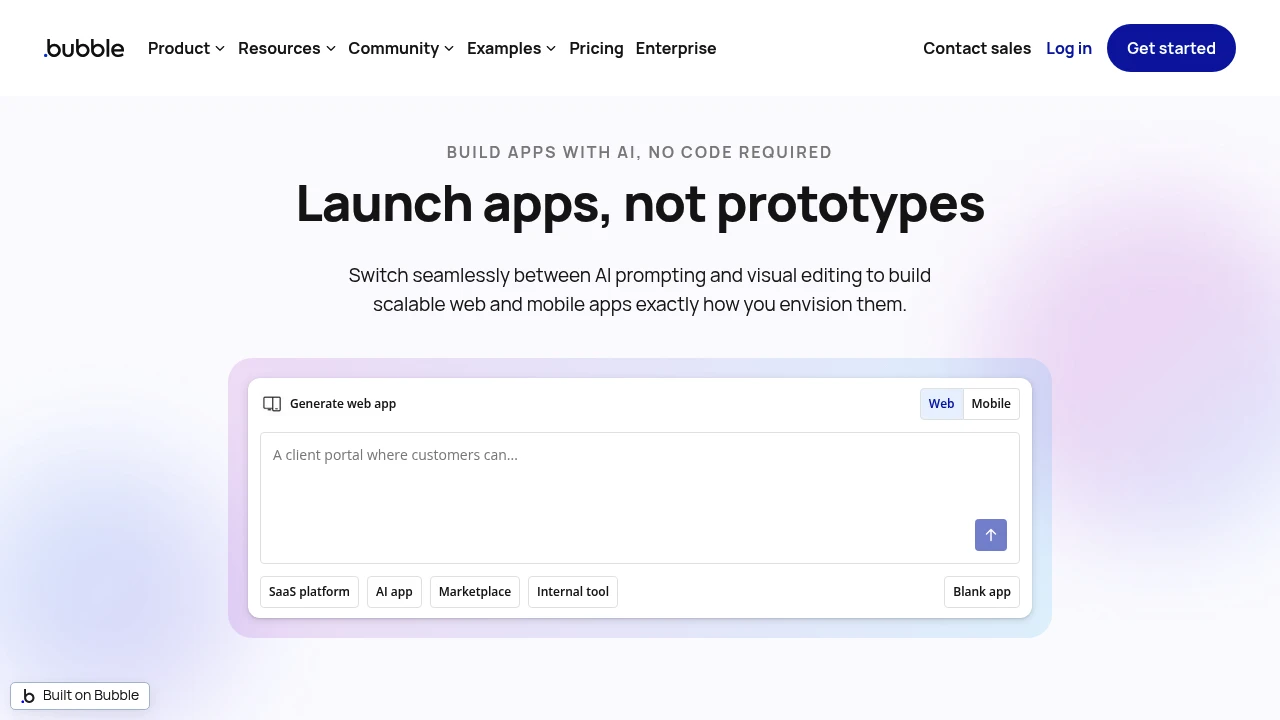
Bubble is a no-code platform for building full-stack web and mobile apps using AI prompts and a visual editor. It is built for founders, agencies, and teams who want to ship real software without hiring developers. You start with the AI agent to generate an app, then fine-tune the design, database, and logic by hand for precision.
Key Highlights
- Generate a working app from a text prompt, then edit it visually
- Build for web, iOS, and Android from one project with a shared backend
- Built-in database, hosting, and security, with no separate stack to manage
- Connect services like Stripe and Google Maps through an API connector
- Thousands of templates and plugins to extend an app
- Used by over 5 million builders, with more than 6 million apps created
What Makes It Different
Bubble combines AI generation with full visual control rather than locking you into prompt-only editing. After the AI agent scaffolds an app, you open the visual editor to set exact design, workflows, and privacy rules, so you are not stuck regenerating the whole app to change one detail. It also covers web and native mobile (mobile runs on React Native) from one project, which most AI builders cannot.
Features & Capabilities
The workflow has three parts: design, data, and logic. You generate or import a design, build a database to organize your information, and automate actions through a point-and-click logic editor, all without code. Bubble handles hosting and the secure backend.
External services connect through plugins or the API connector, including Stripe and Google Maps, and native mobile apps publish to the Apple App Store and Google Play.
User Ratings and Testimonials
Bubble holds a 4.4 out of 5 rating on G2 across about 166 reviews. Users praise how much development time it saves, the all-in-one stack (database, APIs, front end, hosting), and the large plugin and agency marketplace. Common criticisms are a real learning curve and the usage-based "workload unit" pricing, which can grow unpredictable and costlier as an app scales.
Pricing & Value
- Free: $0, a development version with 1 app editor, 50K workload units per month, the API connector, and the native mobile editor for building (not launching)
- Starter: $59/month billed annually, adds a live website, custom domain, 175K workload units, and mobile build submissions
- Growth: $209/month billed annually, adds premium version control, two-factor authentication, 2 app editors, and 250K workload units
- Team: $549/month billed annually, adds sub apps, 5 app editors, and 500K workload units
- Enterprise: custom pricing with custom workload, choice of hosting location, and a dedicated support team
The Free plan is enough to build and test an app end to end, so you only pay once you launch. Students, nonprofits, and schools get discounts.

Framer is a no-code website builder that turns AI prompts and visual design into fast, live sites, built for designers and teams.
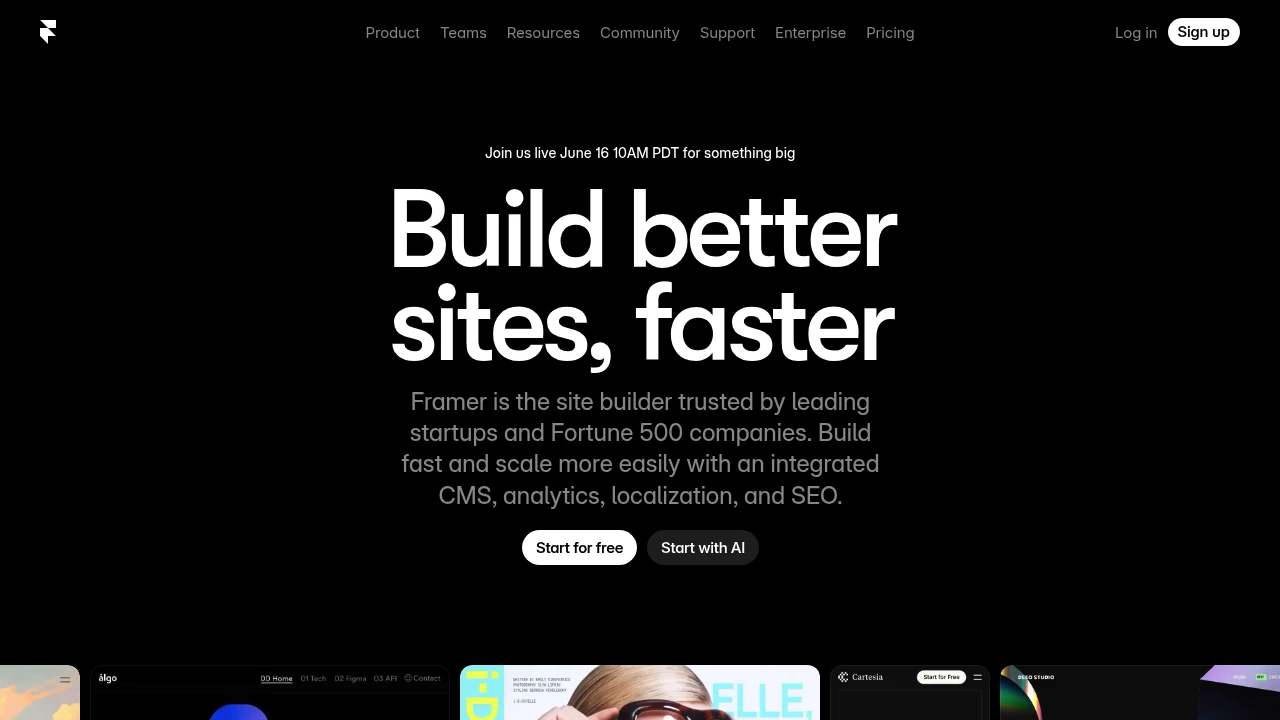
Framer is a no-code website builder that lets you design and publish professional sites from a visual canvas instead of writing code. It is built for designers, freelancers, and marketing teams who want control over layout and animation without a developer in the loop. Generate a starting layout with AI, refine it visually, and push it live on fast global hosting.
Key Highlights
- Visual, no-code canvas for responsive layouts, effects, and animations
- AI generation of page layouts and components to skip the blank canvas
- Built-in CMS for managing content without touching code
- Built-in SEO settings, metadata, and fast global hosting
- Analytics, A/B testing, and funnels to track and improve conversions
- Real-time collaboration with on-page editing and auto-save
What Makes It Different
Framer combines a design tool and a publishing platform, so the canvas you design on is the site you ship. The workflow feels close to Figma, which makes it fast for designers who already think in frames and components. Instead of handing a static mockup to a developer, you publish the real, responsive site directly, with CMS, SEO, and hosting already wired in.
Features & Capabilities
You start from an AI-generated layout or a blank canvas, then craft responsive pages with smooth interactions and animations. A built-in CMS handles structured content like blog posts and collections, AI localization translates pages into more languages, and analytics tracks pageviews, visitors, and traffic sources.
Collaboration is built in: the workspace owner and viewers are free, while editors design, edit content, and publish together with live, auto-saved changes. Add-ons extend the platform with A/B testing and funnels (Convert), extra translation locales, and advanced hosting.
User Ratings and Testimonials
Framer holds a rating of about 4.5 out of 5 on G2. Users praise how quickly they can ship polished, responsive marketing sites, the strong animation controls, and the familiar Figma-like workflow. Common criticisms are a steeper learning curve than expected, editor lag on larger projects, and limited CMS depth for complex, content-heavy sites.
Pricing & Value
- Free: $0, design and explore with 10 CMS collections and up to three editors, but no custom domain
- Basic: $10/month, a free custom domain on yearly billing, AI design tools, hosting, and built-in SEO
- Pro: $30/month, adds staging and instant rollback, roles and permissions, a relational CMS, and redirects
- Scale: $100/month plus usage, adds custom locale regions, events and funnels, priority support, and a premium CDN
- Enterprise: Custom pricing for custom limits, enterprise security, and dedicated support
Additional editors are $20/month each and viewers are always free, so the Free plan is a genuine way to test the builder before paying.


Similar proprietary alternatives:

 bisibility — Free beta: Track your website’s keywords, Google rankings, Search Console insights, and share of voice.


